October 26, 2026
An AI Tool Isn't a Pentest. It's a Faster Scanner.
An AI Tool Isn't a Pentest. It's a Faster Scanner.

Omair Manzoor


Omair Manzoor is the Founder, CEO, and Chief Hacker of ioSENTRIX, a CREST-accredited cybersecurity firm. With 20+ years in offensive security, he has led penetration tests for Fortune 500 companies including engagements for Amazon, Bank of America, VISA, and the London Underground. His exploits are part of the Metasploit Framework and Immunity Canvas. Omair is a published researcher, conference keynote speaker (DOD, CISA, BSides), and technical reviewer for academic security textbooks.
The AI posture dashboard is green. Every model discovered and inventoried, shadow deployments flagged and resolved, every endpoint behind the gateway, guardrails enabled on all production assistants, no misconfigurations outstanding.
Then the question from the audit committee: has anyone established that the guardrail on the customer-facing assistant stops what it is supposed to stop?
The posture view cannot answer that. Not because it is a poor product — the better AI-SPM tools are genuinely good at what they do — but because of where that particular function stands. Reading configuration and telemetry from inside the system under assessment answers "is this set up correctly" and does not answer "did this hold under attack."
That is a limit of position, not of quality. It is worth understanding precisely, because the two questions get conflated in procurement and the conflation is expensive.
AI security posture management (AI-SPM) is a class of tooling that discovers an organization's AI assets — models, endpoints, agents, datasets and the services around them — and continuously evaluates their configuration, exposure and policy alignment against a desired state. It is the AI-specific descendant of cloud security posture management, and it inherits both the strengths and the structural limits of that lineage.
One clarification before anything else, because it decides what this post is actually claiming. Products sold under the AI-SPM label increasingly bundle other things beside the posture function — runtime detection, and in several cases genuine adversarial testing and red-teaming modules that send attack payloads at a system. This post is about the posture function specifically: what configuration reading can and cannot establish. It is not a claim about what any product can do, and where a platform ships a testing module alongside its posture module, that module is answering a different question and may well answer it well.
The category is real and the demand is real. If you cannot name every model and endpoint in your estate, posture management is the right first purchase and nothing in this post argues otherwise.
Four things, and they are not small: discovery, drift detection, exposure mapping, and policy conformance at scale. Give the category its due before taking anything away from it.
Discovery. AI footprints are routinely larger than the owning organization expects, because models arrive through SaaS features and individual team initiative rather than through procurement. A tool that enumerates what exists solves a problem that cannot be solved by reasoning. We have written about why the inventory is the prerequisite for everything else in AI inventory discovery and about the SaaS-shaped version of it in shadow AI discovery.
Drift detection. A guardrail gets disabled to debug something at 11pm and stays disabled; a tool's scope is widened for a sprint. Continuous configuration reading catches that class of change reliably, and humans do not.
Exposure mapping and policy conformance at scale. Which endpoints are reachable from where, which have authentication, which datasets feed which model — tedious, mechanical, high-value work that automation does better than people. And if you have a hundred deployments and a policy that each must have an output filter, something has to check all hundred continuously.

None of that is in dispute. The dispute is about what a green result licenses you to say.
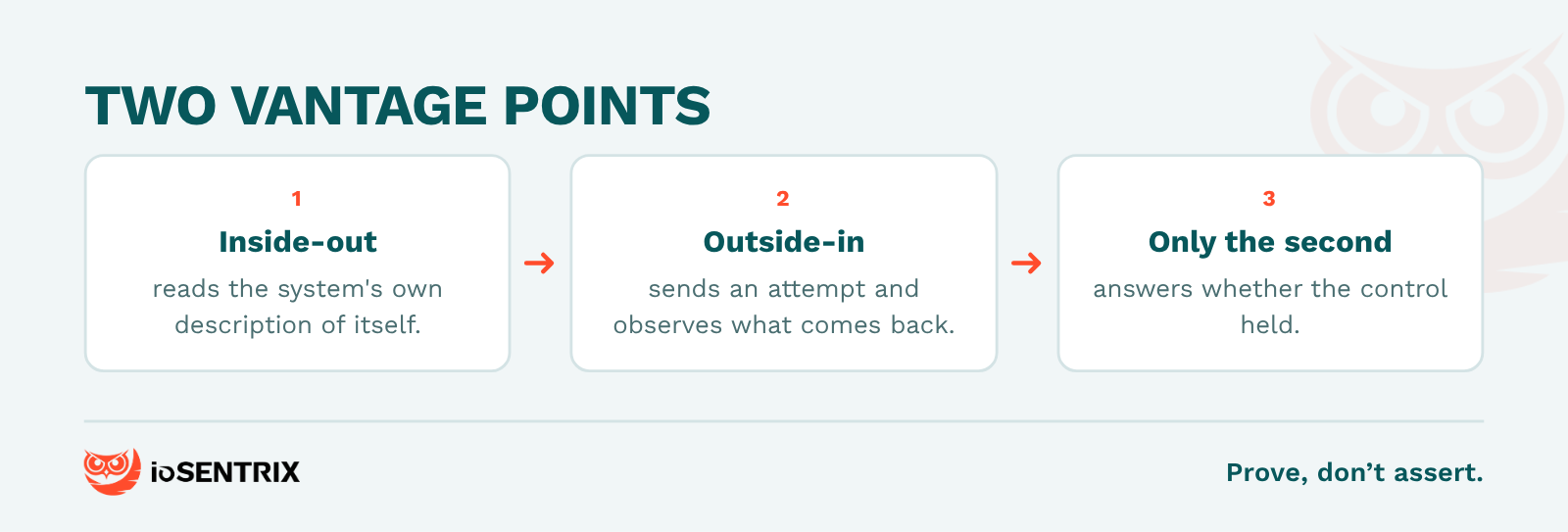
Because the posture function observes the system from inside it, and an attack is defined by whether an outside party can make the system do something it should not — a question that cannot be answered by reading the system's own description of itself. Three specific consequences follow.
It reads settings, not behavior. "Guardrail: enabled" is a fact about a configuration value. Whether that guardrail declines a hostile instruction arriving inside a retrieved document is a fact about behavior, and the two are only loosely coupled. A guardrail can be enabled, healthy, and positioned on a path the attack does not use.
It evaluates against a desired state that someone wrote. Conformance means "matches the policy." If the policy is incomplete — and policies about probabilistic systems usually are — full conformance is compatible with a wide-open failure mode. The posture function cannot flag the absence of a rule nobody thought to write.
The posture module's evidence is produced by the environment under assessment. Configuration and telemetry readings are statements the system makes about itself, and that is the same structural problem we set out at length in signal-layer assurance: a record generated by the system being investigated is not independent evidence about that system. That post is about the integrity of the record of what happened. This one is about the integrity of the claim that a control is adequate. Related problem, different half. Testing modules that send payloads at a system are a different case entirely — they generate their own evidence from outside, which is exactly why they can answer questions a configuration read cannot.
There is a fourth consequence worth naming because it is counter-intuitive. A posture coverage metric can be perfect and its usefulness still low, because coverage counts assets inspected rather than attacks attempted. One hundred percent of assets inspected for a property that does not predict compromise is a precise measurement of the wrong thing.
A control is configured when its settings match the intended design. A control is effective when a party outside the system has attempted to defeat it from a realistic position and failed, against a pass condition written down beforehand. Those are different claims, requiring different evidence, and no amount of the first produces the second.
NIST's AI Risk Management Framework words this more carefully than most vendor material. MEASURE 2.7 asks that "AI system security and resilience – as identified in the MAP function – are evaluated and documented." The verb is evaluated. A configuration reading is not an evaluation of resilience; it is an inventory of settings. MEASURE 1.1 then asks that approaches and metrics be selected for implementation starting with the most significant risks, and that "the risks or trustworthiness characteristics that will not – or cannot – be measured are properly documented" — which is precisely the entry a posture dashboard has no field for, and precisely the entry an honest AI program needs.
We have mapped what those subcategories actually demand as evidence in NIST AI RMF evidence, and the broader argument that framework alignment is not correctness in compliant is not correct. Framework alignment is not compliance and not certification, and a posture tool reporting alignment is reporting on itself.
Here the content genuinely is a list, so here is the list.
The posture-reading function can establish, on its own evidence:
The posture-reading function cannot establish, and a configuration finding should not be read as establishing:
Every item in the second list resolves to an attempt rather than a reading. That is the dividing line, and it is a cleaner test than any feature comparison: if the claim could be settled by reading a setting, the posture function can make it. If it could only be settled by trying something, it cannot. Several vendors now ship adversarial testing modules beside the posture module in one platform — indirect prompt injection, tool misuse and privilege escalation all appear as named scan categories in shipping products. If yours does, these questions are answerable by that module. The distinction this post is drawing is between functions, not between vendors.

Note what this is not. It is not an argument that posture management is a weak purchase, and it is certainly not an argument that any particular product oversells itself. Our position is that these are complementary layers: the posture function answers the continuous, broad, configuration-shaped question across the whole estate, and adversarial testing answers the deep, narrow, behavior-shaped question on the deployments that matter. We sell no competing platform, so we have no interest in displacing one — we assure the stack you have chosen.
This is a synthetic composite assembled to illustrate the pattern. It is not a client, a real incident, or a real company.
A financial services company runs the posture module of an AI-SPM platform across a mature AI estate, and has not licensed its testing module. The quarterly report is strong: full asset coverage, two shadow deployments found and retired, guardrails enabled on every production assistant, no outstanding misconfigurations, policy conformance at 98 percent.
An independent test is commissioned on one deployment: the customer-service assistant, which answers account questions over an indexed knowledge base and can raise service tickets.
Three findings in a week. The guardrail is enabled and inspects the customer's message only, so an instruction planted in a knowledge-base article steers the assistant's behavior — the posture module correctly reported "guardrail: enabled," which was true. The ticket-raising tool accepts out-of-policy arguments when called directly with the assistant's credential, because the constraint lives in the prompt; the tool's configuration is exactly as approved, so there was nothing to flag. And the assistant's service account can read a second document store connected eighteen months earlier for a migration — within policy, because the policy never enumerated stores.
Policy conformance was 98 percent before the test and 98 percent after. Not one finding corresponded to a misconfiguration. The posture module was not wrong about anything it reported; it was answering the question it is built to answer.
Buy it for breadth and continuity, and do not let the posture reading stand in for evidence on the deployments where being wrong is expensive. In practice, three things.
Read the posture dashboard as a map rather than a verdict: it tells you what you have and whether it is set up as intended, which is genuinely most of the work and none of the proof.
Pick the deployments that matter — customer-facing, agentic, or touching regulated data — and have the controls on those tested adversarially, against pass conditions written before the test. AI penetration testing scope is the practical starting point for deciding how much.
And treat each posture finding as a hypothesis to confirm rather than a resolved item. "Guardrail enabled" is the beginning of a test, not the end of one. Because AI deployments change underneath you, a single point-in-time result decays — the same reason continuous penetration testing exists outside AI.
None of this eliminates risk and we would not claim it does. It replaces a green dashboard you hope is meaningful with a smaller set of claims you have reasons to believe, plus an explicit list of what remains unmeasured. That is a less comfortable report and a more honest one.
What does AI-SPM stand for? AI security posture management: tooling that discovers AI assets and continuously evaluates their configuration, exposure and policy conformance against a desired state. It is the AI-specific counterpart to cloud security posture management.
Does AI-SPM replace AI penetration testing? No, and the reverse is also true. The posture function reads configuration continuously across the whole estate. Penetration testing attempts to defeat specific controls from an attacker's position on specific deployments. Neither produces the other's evidence, and most mature programs need both — which is also why several vendors now sell both, as separate modules, in one platform.
Can AI-SPM detect prompt injection? A posture reading can detect whether a control intended to mitigate prompt injection is present and enabled. Whether that control actually refuses an injected instruction — particularly one arriving in retrieved content rather than a user prompt — is a behavioral question answered by testing, whether that testing comes from a platform's own red-teaming module or from an independent party. See prompt injection testing.
Is a 100 percent posture score good, and where should we start if we have neither? A full score means every asset inspected matched the policy as written. It says nothing about whether the policy covers the failure modes that matter, or whether the matching controls would hold — a precise measurement of conformance, not of security. On where to start: the posture function first if you cannot currently enumerate your AI assets, because you cannot test what you cannot list. If you already have a reliable inventory, start with adversarial testing of the one deployment you would least like to be wrong about.
ioSENTRIX is ISO/IEC 27001 certified, SOC 2 Type 2 attested, and a CREST-accredited penetration testing firm. Our AI and ML penetration testing work sits deliberately alongside whatever posture tooling you run: we take the claims your dashboard makes and establish, adversarially and from outside, which of them hold. Because we sell no competing AI platform, the finding is not a sales path to a product of ours.
A good first conversation is short: name the deployment whose green status you would least like to be mistaken, and we will tell you what testing it properly would involve.