October 26, 2026
An AI Tool Isn't a Pentest. It's a Faster Scanner.
An AI Tool Isn't a Pentest. It's a Faster Scanner.

Omair Manzoor

Omair Manzoor is the Founder, CEO, and Chief Hacker of ioSENTRIX, a CREST-accredited cybersecurity firm. With 20+ years in offensive security, he has led penetration tests for Fortune 500 companies including engagements for Amazon, Bank of America, VISA, and the London Underground. His exploits are part of the Metasploit Framework and Immunity Canvas. Omair is a published researcher, conference keynote speaker (DOD, CISA, BSides), and technical reviewer for academic security textbooks.
Pull up your AI control inventory and read down the list. Guardrail: yes. Output filtering: yes. Tool authorization: yes. Audit logging: yes. Access scoped to least privilege: yes.
Now change one word in the question. Not "do we have these controls" but "which of these has someone outside the team tried to break, and what happened?"
That question usually produces a pause. It is the same pause we hear when a client has an excellent control matrix and no test results, and it is not a sign of a badly run program. It is a sign that the industry built its AI control language around inventory, and inventory is a cheaper thing to produce than evidence.
An AI security control is a measure placed around an AI system to constrain what it can be made to do, what it can reach, or what it can disclose — for example an input guardrail, an output filter, a tool-call authorization check, a scoped machine identity, or a retrieval permission boundary. The definition is uncontroversial. What varies enormously is whether any given control has been demonstrated to work in the deployment it is protecting.
Good control catalogs exist and are worth using. The Cloud Security Alliance's AI Controls Matrix (AICM) v1.1 sets out 247 control objectives across 18 domains, with mappings to BSI AIC4, ISO/IEC 42001:2023, ISO/IEC 27001, AIUC-1, the EU AI Act, and NIST's AI RMF and AI 600-1. That is a serious piece of work and a legitimate answer to "which controls should we have." It is not, and does not claim to be, an answer to "did ours hold."
The distinction matters more for AI than for most technology, because the behavior under test is probabilistic. A firewall rule either permits a packet or does not. A guardrail declines a phrasing and accepts a paraphrase of it, and the only way to learn which is to try.
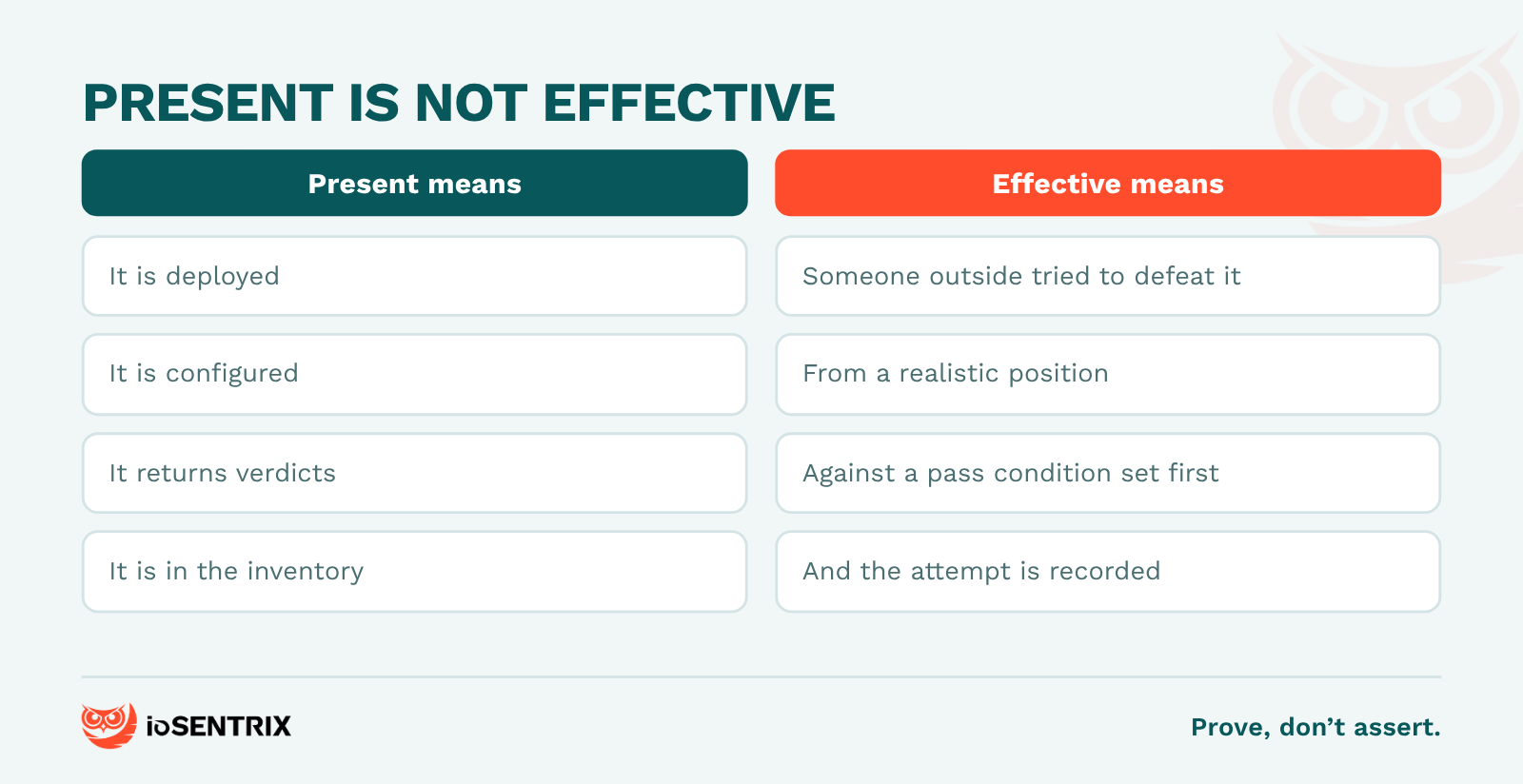
Because an inventory records a control's existence, and existence and effectiveness are independent properties. A control can be present, correctly configured, monitored, documented in your policy, and still fail to stop the thing it was bought to stop — because it is positioned on the wrong path, inspects the wrong input, or can be bypassed by an actor who is inside the boundary it assumes.
NIST's AI Risk Management Framework is unusually precise about this, and the precision is easy to skim past. MEASURE 2.7 asks that "AI system security and resilience – as identified in the MAP function – are evaluated and documented." Evaluated. Not listed. And MEASURE 1.1 asks that approaches and metrics for measuring the AI risks enumerated during MAP be selected for implementation, starting with the most significant risks, and that the risks or trustworthiness characteristics which will not — or cannot — be measured be properly documented.
That last clause is the most useful sentence in the framework for our purposes. It gives you permission to write down "we cannot currently measure this" — which is a true and actionable statement — instead of a green cell that is neither. We have worked through what the MEASURE subcategories ask for as evidence in NIST AI RMF evidence.
A note on what the standards landscape does not yet give you: there is no published NIST control overlay for securing AI systems. The Control Overlays for Securing AI Systems effort has produced a concept paper, released 14 August 2025, and an annotated outline on using and fine-tuning predictive AI — a discussion draft, released 8 January 2026 and dated January 2026. No initial public draft of an SP 800-53 overlay has been released. If a vendor or an advisor has told you that NIST AI control overlays are available to map against, that is not correct as of this writing, and it is worth checking what else in the same deck was asserted rather than verified. This is the pattern we described in compliant is not correct.
The rest of this post takes the five controls that nearly every AI deployment relies on and, for each, names the test that separates present from effective.
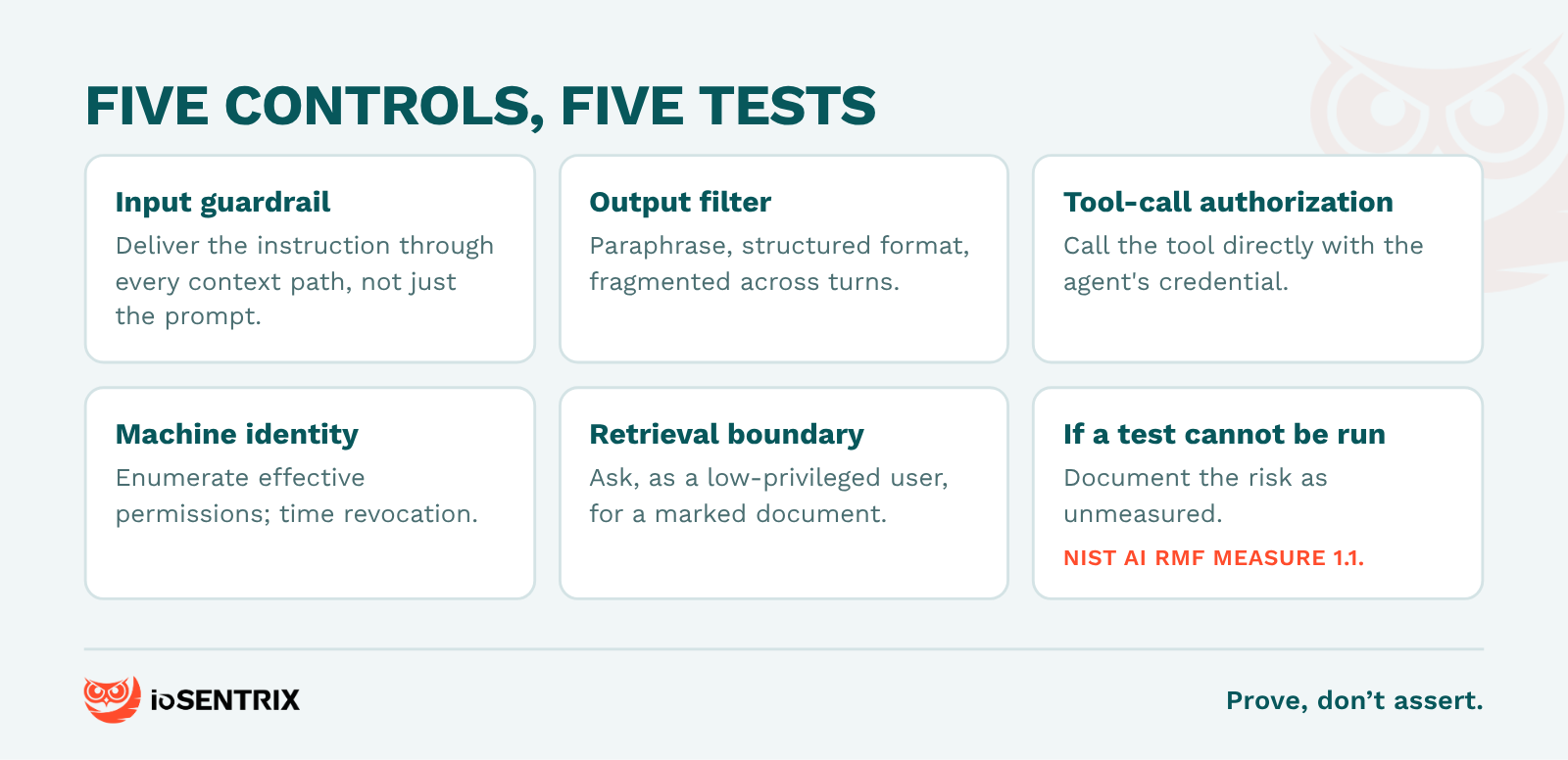
Test an input guardrail by delivering the hostile instruction through every path that reaches the model, not just the one the user types into. The failure mode is rarely that the guardrail misjudges text it was shown. It is that the guardrail was never shown the text.
In a retrieval-augmented or agentic system, the model's context is assembled from several sources: the user's message, retrieved documents, tool output, system instructions, prior turns. In the deployments we assess, guardrail inspection is commonly wired to the user's message alone. An instruction arriving in a retrieved document frequently bypasses inspection entirely while remaining fully effective on the model.
What distinguishes present from effective: present means a guardrail is deployed and returns verdicts. Effective means you have delivered the same hostile instruction through each context source in turn and recorded which paths were inspected and which were not. Our write-ups on prompt injection testing and LLM guardrail testing both start here because everything downstream depends on it.
Test an output filter by asking for the prohibited thing in forms the filter was not written against: a paraphrase, a different language, a different encoding, a structured format, a fragment across several turns. A filter tuned on examples will usually block the examples.
The two recurring findings here are format and fragmentation. A filter that catches a credit card number in prose often misses the same number inside a JSON field or a base64 blob. And a filter evaluating one response at a time cannot see that six consecutive responses, each individually harmless, have reconstructed a record. Data-leakage paths are their own discipline — see AI data leakage testing and data leakage in AI fine-tuning.
What distinguishes present from effective: present means the filter blocks the canonical case. Effective means you have a documented bypass rate across paraphrase, format and multi-turn fragmentation, and someone has decided whether that rate is acceptable.
Test tool-call authorization by issuing the call directly against the tool with the agent's credential, bypassing the model entirely. If the call succeeds, your authorization control was the model's judgment, and model judgment is not an authorization control.
This is the single most consequential test in the set, and it is also the quickest. Take the agent's runtime credential, call the tool with out-of-policy arguments from a shell, and see what happens. We regularly find agentic deployments that enforce policy in the prompt — "only use this tool for X" — and leave the tool itself open to anything the credential can reach. For systems using the Model Context Protocol, each remote server is an API in its own right: the specification has an HTTP-based server act as an OAuth 2.1 resource server that must validate tokens issued specifically for it, so each has its own authorization model to test. Locally launched stdio servers are the inverse case — authorization is optional in MCP and stdio servers take credentials from the environment, so the question becomes what that environment hands them. Both are the argument of MCP server security testing.
What distinguishes present from effective: present means the agent behaves correctly in testing. Effective means the tool rejects out-of-policy arguments when the model is removed from the loop, and the rejection is recorded where the agent cannot alter it.
Test the agent's identity by enumerating the full effective permission set of its credential and comparing that set against the actions the agent is designed to perform. Do not read the policy document. Exercise the credential.
Two things turn up repeatedly in our testing. The effective scope is wider than the documented scope, usually because a permission was widened to unblock something and never narrowed. And revocation is slower than anyone expects: a credential is revoked centrally while cached copies keep working for minutes. Both are measurable, and the measurement is the control. We have set out the broader case in non-human identity security, and the inventory problem that precedes it in AI inventory discovery.
What distinguishes present from effective: present means least privilege is a stated principle. Effective means the credential's enumerated permissions equal its documented scope, with the surplus listed, and time-to-revocation measured and stated as a number.
Test the retrieval boundary by asking the agent, as a low-privileged user, for something only a high-privileged user should be able to see. A common RAG pattern is an index built once with broad permissions and queried with none.
This control fails quietly, because the agent is being helpful and the user cannot tell that the answer came from a document they had no right to. There is rarely an alert. The test is trivial and the finding is often serious: seed a uniquely marked document in a restricted location, then ask the agent about it from an account with no access to that location. The canary pattern applies to entitlements as well as data — the logic is in synthetic canary testing.
What distinguishes present from effective: present means the source systems have permissions. Effective means the retrieval layer evaluates the requesting user's entitlements at query time, and you have a marked document proving it.
This is a synthetic composite assembled to illustrate the pattern. It is not a client, a real incident, or a real company.
An internal assistant at a mid-market company answers HR and policy questions over an indexed document store. The control inventory shows five of five: guardrail deployed, output filter deployed, tool access read-only, identity scoped to a service account, audit logging on.
A test takes an afternoon. The guardrail inspects the user's question and not the retrieved documents, so an instruction planted in a policy PDF changes the assistant's behavior. The output filter catches salary figures in prose and not in the JSON the assistant emits when asked for a table. Tool access is indeed read-only — and the read scope covers the entire document store, including the folder holding the compensation review. The service account's effective permissions turn out to include a second store nobody remembered connecting. Audit logging is on, and records that a document was retrieved, not which one.
Five controls, all present, all correctly configured, none effective against the thing a reasonable attacker would do first. Nothing in the inventory was false. The inventory was answering a different question.
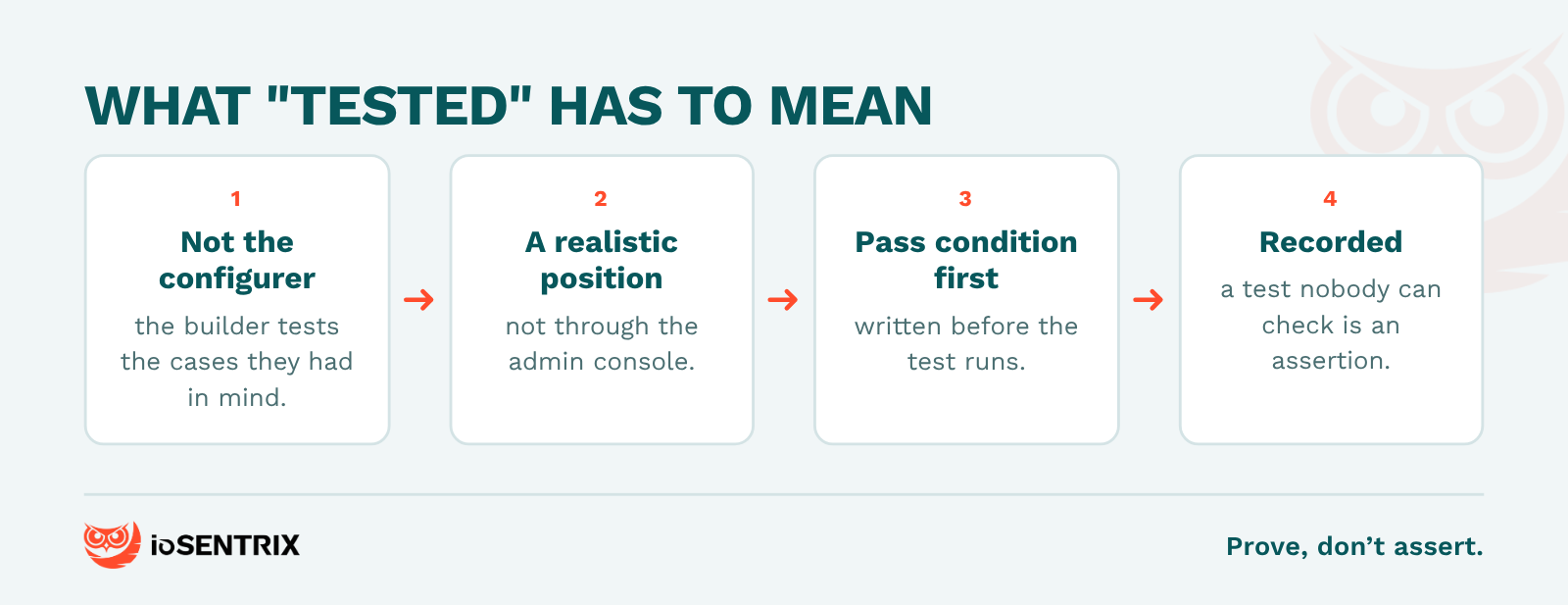
A control is tested when someone who did not configure it has attempted to defeat it from a realistic position, against a pass condition written down beforehand, and the attempt and its outcome are both recorded. Each clause is load-bearing: the person who built a control tests the cases they had in mind; testing a guardrail through an admin console tells you nothing about the path an attacker uses; a threshold chosen after seeing the result describes the result instead of judging it; and a test nobody can check is an assertion with extra steps.
One push-back on a common plan. Teams often intend to test controls once, at go-live, and then rely on the inventory. AI deployments change underneath you — a model version, a new tool, a widened index, a prompt edit — and each of those can invalidate a prior result without touching the control itself. Continuous penetration testing exists for the same reason here as elsewhere.
None of this reduces risk to zero, and we would not claim it does. It replaces a list of controls you believe in with a smaller list you have reasons to believe in, plus an honest record of what remains unmeasured. On a prove-don't-assert view, that trade is the whole job.
How many AI security controls should we have? The number is the wrong target. The CSA AI Controls Matrix v1.1 lists 247 control objectives across 18 domains, and almost no organization needs all of them. A short list of controls with test evidence behind them is worth more than a long list without.
Is there a NIST control overlay for AI systems we can map to? Not yet. NIST's Control Overlays for Securing AI Systems effort has published a concept paper (released 14 August 2025) and an annotated outline on predictive AI (released 8 January 2026). No initial public draft of an SP 800-53 overlay has been released, so any claim that NIST AI control overlays are available to map against should be checked.
Does ISO/IEC 42001 certification mean our AI controls have been tested? No, and it does not claim to. ISO/IEC 42001 is certifiable by accredited independent certification bodies, and what they certify is an AI management system — that you have the processes, roles and documentation in place. It is a genuine and useful certification. It is silent on whether any individual control withstood an attack, which is a separate question needing separate evidence. See ISO/IEC 42001 and what it covers.
Which control should we test first, and can we do it ourselves? Tool-call authorization, if your system has tools: it takes the least time, and a failure there usually makes every other control moot because the model's judgment turns out to be the only thing between a credential and an action. The retrieval-boundary and credential-enumeration tests are well within a competent internal team and worth running yourselves. The limit is structural rather than technical — the team that configured a control is the least likely to find the case it does not handle, which is why the final evidence usually has to come from outside.
ioSENTRIX is ISO/IEC 27001 certified, SOC 2 Type 2 attested, and a CREST-accredited penetration testing firm. Our AI and ML penetration testing work is built on a single premise: a control that has not been attacked is a claim, and turning claims into evidence requires an adversarial party that did not build the system. We sell no competing AI platform, so we assess the stack you have chosen rather than steering you toward ours.
If you want to start small, pick the one control you would least like to be wrong about and have it tested properly. That is usually a more informative week than a full inventory review.