


AI security services for LLMs, RAG, agents and MCP
Find out what an attacker could make your AI do before a customer, an auditor or an attacker finds out first. Penetration testing, red teaming, agentic and MCP testing, assessments and ISO 42001 readiness from a CREST-accredited firm.
- Tested RAG systems, custom LLM pipelines, chatbots, AI in SaaS products and MCP servers
- Mapped to the OWASP LLM and Agentic Top 10, MITRE ATLAS and NIST AI RMF
- Trusted by Fortune 100, financial services, insurance and SaaS teams
- Engagements from 2 weeks to 4 months, on PTaaS credits or a subscription






Six ways to test the AI you build and buy
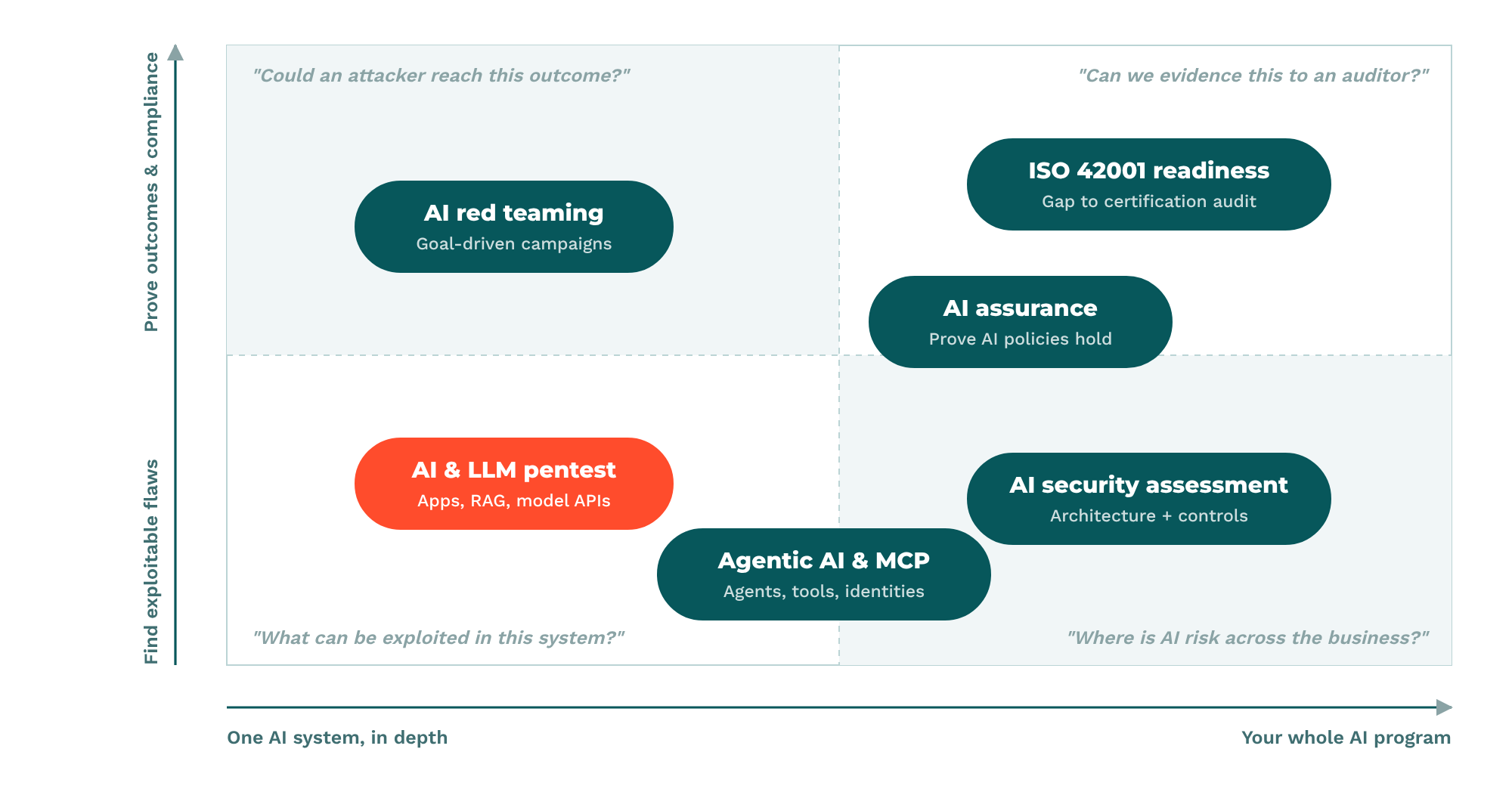
Each engagement has its own scope, method and deliverable. Not sure which fits? Tell us what you are building and we will scope it with you.
AI & LLM Penetration Testing
Hands-on testing of chatbots, RAG pipelines, model APIs and AI features in your product.
AI Red Teaming
Goal-driven adversarial campaigns that test whether your AI can be pushed into harmful or unauthorized outcomes.
Agentic AI & MCP Security
Testing for agents that plan, call tools and act on your systems, including MCP servers and clients.
AI Security Assessment
Architecture review, threat modeling and control validation mapped to NIST AI RMF and OWASP.
ISO 42001 Readiness
Gap assessment against ISO/IEC 42001, then compliance as a service through the certification audit.
AI Assurance & Control Validation
Prove your AI usage policies hold: shadow AI discovery and data-leakage testing.
What are AI security services?
AI security services test and assess AI systems for the ways they can be manipulated, leak data or act outside their intended limits. They cover large language model (LLM) applications, retrieval-augmented generation (RAG), model APIs, AI agents and the tools agents call, such as MCP servers, plus the governance around them.
AI security testing differs from a standard application pentest because the model itself becomes an input processor: anything it reads can carry instructions, and anything it outputs can reach a browser, a database or a tool. Generative AI security work therefore covers the prompts, the data, the model and the actions, not just the web layer.
You need AI security testing if
- You are shipping an LLM chatbot, copilot or RAG search feature
- Your AI agents can call tools, APIs or MCP servers with real credentials
- An enterprise customer, auditor or board has asked for AI security evidence
- You need to show how you govern AI, for example for ISO/IEC 42001
Most AI tests cover one layer. Attackers use all of them.
AI risk spans prompts, data, agents and the governance around them. This is how each of our engagements maps to the layers of your AI attack surface.
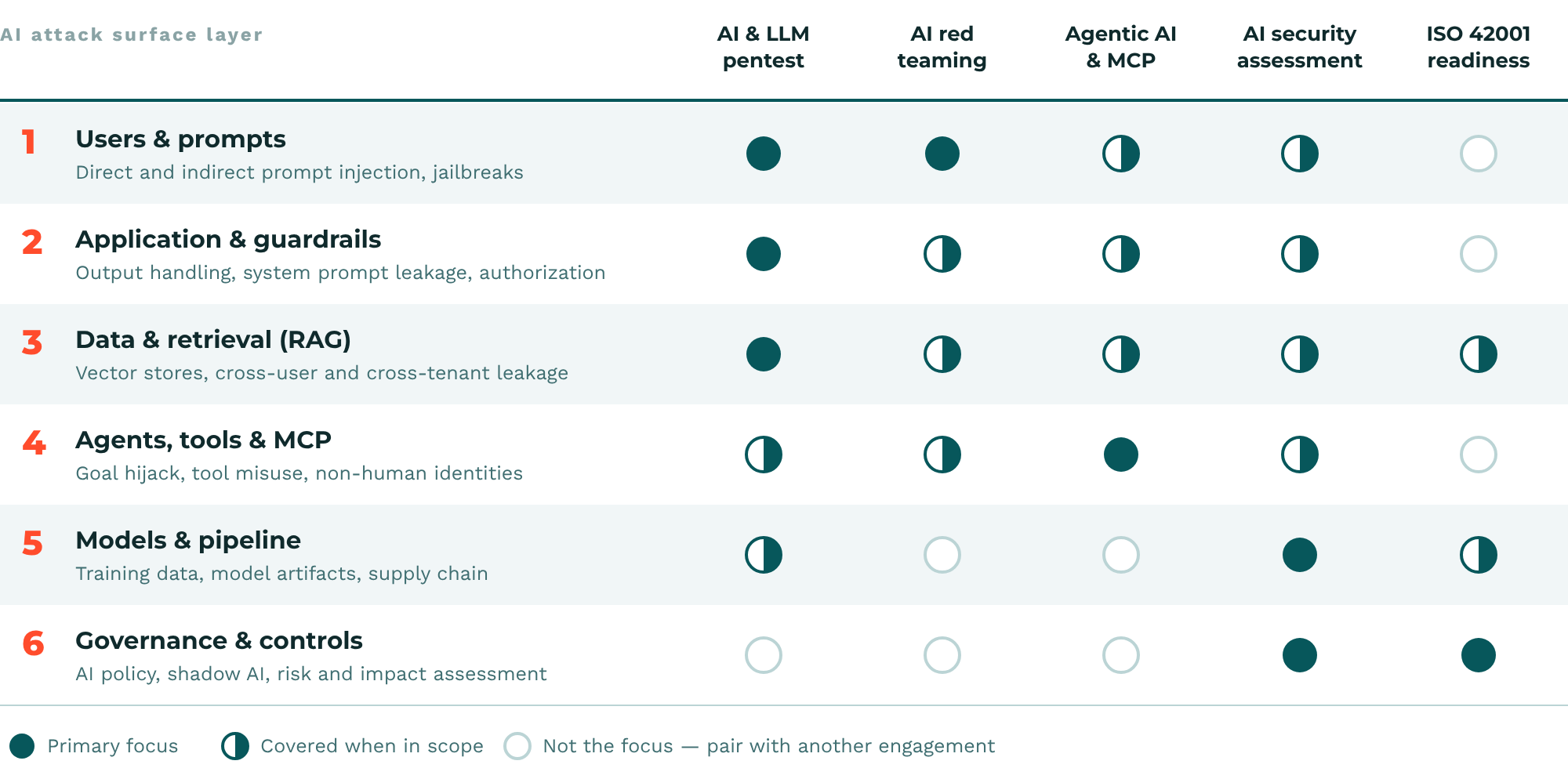
Shipping an AI feature? An AI & LLM pentest covers the first three layers in one engagement.
If your AI can act — call tools, hit APIs, use credentials — agentic & MCP testing is where the real impact sits.
For governance and audits, an assessment or ISO 42001 readiness turns policy into tested evidence.
What every AI engagement delivers
Not a scan export. Evidence your engineers can act on and your auditors can read.
Findings with proof
Each finding has a severity, a reproducible proof of concept and remediation guidance your engineers can act on.
Mapped to AI standards
Results mapped to the OWASP LLM and Agentic Top 10, MITRE ATLAS and NIST AI RMF, ready for enterprise security reviews.
A walkthrough, then retesting
We walk your team through every finding, and retesting is available once fixes land.
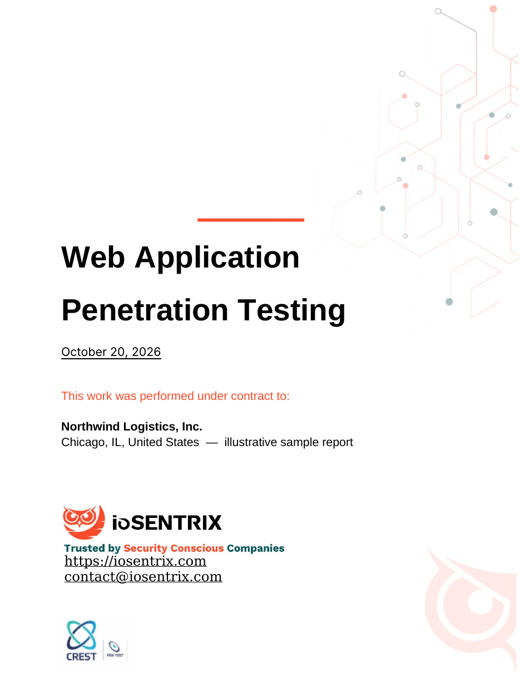
See how we write findings before you talk to us
A redacted sample penetration test report (web application) — finding write-ups, proof-of-concept evidence and remediation. No form required.
Download the sample report (PDF) →AI systems we have already tested
A real engagement, described without the client’s name.
Fortune 500 financial services: AI/ML threat model across AWS and Azure
We threat-modeled the client’s AI estate — RAG pipelines, LLM orchestration layers and ML inference workflows — using STRIDE, NIST SP 800-30 and the NVIDIA AI Red Team framework.
Read the case study →Numbers you can check
Ratings you can verify on G2 and Clutch.


Who does the testing
Offensive security engineers do the hands-on testing and write up the findings, so the person who found an issue explains it to your team.
Certified testers
Each tester holds one or more of OSCP, OSWE, OSCE, CISSP, CISA or AWS security certifications.
Accredited firm
ioSENTRIX is CREST-accredited for penetration testing, ISO/IEC 27001 certified and SOC 2 Type 2 attested.
Since 2017
Founded in 2017, with offensive security work for Fortune 100, financial services, insurance and SaaS companies.
Frequently asked questions
What is the difference between AI penetration testing and AI red teaming?
AI penetration testing looks for as many exploitable weaknesses as possible within a defined scope, such as prompt injection, data leakage and broken authorization. AI red teaming is a goal-driven campaign that tries to reach a specific harmful outcome, the way a real adversary would. Read our full comparison of AI red teaming vs AI penetration testing.
Which frameworks do you test against?
We map testing and findings to the OWASP Top 10 for LLM Applications, the OWASP Top 10 for Agentic Applications, MITRE ATLAS and the NIST AI Risk Management Framework.
What kinds of AI systems have you tested?
RAG systems, custom LLM pipelines and model training, chatbots, organization-wide AI rollouts, AI features inside SaaS products, and MCP servers, for Fortune 100, financial services, insurance and SaaS companies.
How long does an engagement take, and how is it priced?
Engagements run from 2 weeks to 4 months depending on scope. Each one is a fixed quote based on effort, and can be bought with PTaaS credits or a subscription.
Can you help us get ISO 42001 certified?
Yes. We run an ISO/IEC 42001 readiness and gap assessment, then support you through compliance as a service, including bringing in the auditor for the certification audit. The certification decision itself is made by an independent certification body. See ISO 42001 readiness.
What is AI security?
AI security is the practice of protecting AI systems, and the data and actions they control, from misuse and attack. It covers threats such as prompt injection, sensitive data disclosure, data and model poisoning and excessive agency, and the controls that prevent them.
What is LLM security?
LLM security is the part of AI security that deals with applications built on large language models. The OWASP Top 10 for LLM Applications 2025 is a widely used list of LLM security risks, starting with prompt injection and sensitive information disclosure.
Go deeper before you scope a test
Practical guides from our testers on the questions buyers ask most.

AI Red Teaming vs AI Penetration Testing: What’s the Difference?
Learn how AI red teaming differs from AI penetration testing, what each approach tests, and when your organization should use one or both.
Read the guide →
What Security Questions Should You Ask an AI Vendor?
There is no shortage of AI vendor question lists. What is scarce is a view of which answers break when somebody tests them. Six claims that survive a…
Read the guide →
How Much Does an AI Penetration Test Cost?
Two firms quote the same AI system and the numbers differ fourfold. Both are honest. The seven scope decisions that set the price of an AI…
Read the guide →Related AI security services
Find out what your AI can be made to do
Tell us what you are building or buying. We will scope the right engagement and send a fixed quote based on effort.


