October 26, 2026
An AI Tool Isn't a Pentest. It's a Faster Scanner.
An AI Tool Isn't a Pentest. It's a Faster Scanner.

Omair Manzoor

Omair Manzoor is the Founder, CEO, and Chief Hacker of ioSENTRIX, a CREST-accredited cybersecurity firm. With 20+ years in offensive security, he has led penetration tests for Fortune 500 companies including engagements for Amazon, Bank of America, VISA, and the London Underground. His exploits are part of the Metasploit Framework and Immunity Canvas. Omair is a published researcher, conference keynote speaker (DOD, CISA, BSides), and technical reviewer for academic security textbooks.
Ask the team running your agents a simple question: which of the ten agentic risk categories has anyone deliberately tried to trigger in your environment?
Most teams can name the list. Some have mapped it into a governance spreadsheet and marked each row green. Very few can answer the question as asked, because naming a risk and exercising it are different activities, and only one of them produces evidence.
To be fair to the document: it is not a bare list. OWASP published it as a set of risks and mitigations, with architectural guidance attached to each category, and the mitigations are good. What it does not carry — and does not claim to — is a test procedure. Design guidance tells you how to build the control. It does not tell you what to do on a Tuesday afternoon with a staging environment and an authorized window to find out whether the control you built actually holds.
That gap is the subject of this post.
The OWASP Top 10 for Agentic Applications is the OWASP GenAI Security Project's catalog of the ten risk categories it considers most critical to applications where an AI system plans, decides and acts through tools rather than only generating text, published together with mitigations for each. It was announced on 9 December 2025, and its resource page is titled "OWASP Top 10 for Agentic Applications for 2026." The categories carry an ASI prefix.
The ten are: ASI01 Agent Goal Hijack, ASI02 Tool Misuse, ASI03 Identity & Privilege Abuse, ASI04 Agentic Supply Chain Vulnerabilities, ASI05 Unexpected Code Execution, ASI06 Memory & Context Poisoning, ASI07 Insecure Inter-Agent Communication, ASI08 Cascading Failures, ASI09 Human-Agent Trust Exploitation, and ASI10 Rogue Agents.
Two things are worth stating plainly, because both are easy to get wrong. OWASP's resource page and release announcement carry no version number, so cite the title and the release date rather than a version. And the agentic list is a different list from the OWASP Top 10 for Large Language Model Applications, which has its own 2026 edition and its own categories. If your risk register has one row called "OWASP Top 10" you are tracking the wrong number of things.
A risk category describes a class of failure, and a mitigation describes how to build against it. A test describes an action you take, the access it needs, and the observation that distinguishes a pass from a fail. The gap between the second and the third is where most agentic security programs currently sit.
Consider how the document gets consumed in practice. Someone maps the ten categories to existing controls, finds a guardrail or a policy for each, confirms it resembles the recommended mitigation, and records coverage. The output is a matrix of controls that exist and look right. Nothing in that exercise establishes that any of them would hold against someone trying, which is the property that matters most when an agent has credentials and the ability to act.
NIST's AI Risk Management Framework is useful here precisely because of how carefully it words the ask. MEASURE 2.7 says "AI system security and resilience – as identified in the MAP function – are evaluated and documented." Evaluated and documented. Not assumed, and not inventoried. MEASURE 1.1 goes further: risks and trustworthiness characteristics that will not — or cannot — be measured are to be properly documented, which is a far more honest posture than a green cell.
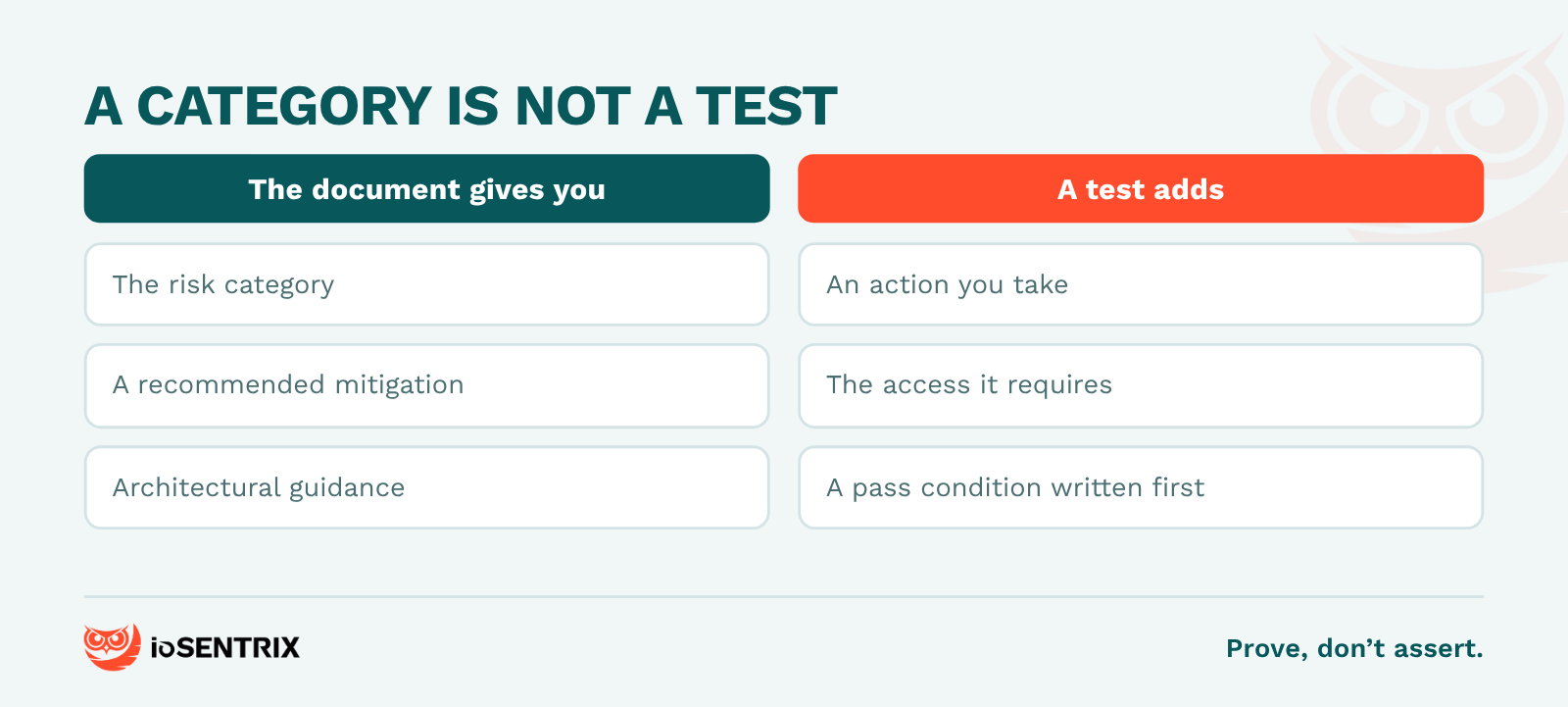
So the rest of this post does the translation for the categories that matter most in a first engagement: a practical test, the access it requires, and what a pass looks like. These are starting points, not exhaustive coverage of any category — each one is broader than the single test we give it here.
A practical first test for goal hijack is to supply the agent with content it will read in the normal course of its work, containing an instruction that conflicts with its assigned objective, and then measure whether the agent's actions follow your instruction or the attacker's. The point of attack is rarely the chat box. It is the ticket, the document, the web page, the calendar invite — anything the agent retrieves.
What you need: an authorized window, a non-production copy of the agent with its real tool set attached, and write access to one source the agent reads. A read-only test tells you very little, because the interesting failures happen when the agent can act.
What a pass looks like: the injected instruction appears in the agent's context, and the agent either declines it or escalates, and no tool call outside the assigned objective is executed. Note that "the guardrail blocked the prompt" is not a pass if the guardrail never saw the retrieved document — a distinction we have written about in the context of prompt injection testing.
The common failure is subtler than refusal. The agent completes its assigned task and the injected one, and the run looks successful.
One concrete way to test tool misuse is to enumerate every tool the agent can reach, then attempt each one with arguments the business never intended, from the agent's own position. Not from yours. The question is what the agent's credential can do, not what the UI offers.
Start with enumeration, because this is where our engagements often find the first real finding: the tool list in the code and the tool list actually reachable at runtime are frequently different. A tool added for a demo and never removed is a classic. So is a tool whose scope was widened to unblock a sprint.
What you need: the agent's tool manifest, its runtime credential, and agreement on which tools are in scope for destructive testing. For agents reaching tools over the Model Context Protocol, treat each server as a separate authorization boundary. Where the server is HTTP-based, MCP's authorization specification has it act as an OAuth 2.1 resource server that must validate tokens issued specifically for it. Authorization is optional in MCP, and a locally launched stdio server follows none of that — it takes credentials from the environment, which is usually the case worth testing first. Both are the argument in our posts on MCP security and MCP server security testing.
What a pass looks like: every tool call is authorized against the initiating context rather than against the agent's blanket identity, out-of-policy arguments are rejected at the tool boundary rather than by the model's judgment, and the rejection is logged somewhere the agent cannot edit.
A practical test for identity abuse is to take one of the agent's credentials and establish, empirically, the full set of actions it permits — then compare that set to the actions the agent is supposed to perform. The gap is your blast radius, and it is routinely larger than the design document says.
Many deployments we test authenticate downstream as a single service principal, which means the initiating human is dropped at the first hop and every action arrives as the same actor. That is a design decision with a testable consequence: ask two engineers to reconstruct, from logs alone, which human initiated a given action. If they cannot, attribution has failed, whatever the identity diagram claims. We have made this argument at length for non-human identity security.
What you need: the credential, the scope definition it is meant to have, and a window in which to exercise it.
What a pass looks like: the credential's effective permissions match its documented scope with no surplus; revocation takes effect within a measured and stated time; and the agent cannot mint, extend or re-issue its own authority.
Yes. A practical test is to plant a durable false fact in whatever store the agent treats as memory, then observe how long it survives and how far it travels. This category is distinct from goal hijack because the payload persists: it affects runs that happen after the one you compromised.
What you need: write access to the memory or retrieval store — a vector index, a conversation summary, a knowledge base article — and the ability to run the agent repeatedly afterwards. The canary idea transfers cleanly here: seed a uniquely marked claim and trace where it surfaces, in the spirit of synthetic canary testing.
What a pass looks like: the poisoned entry is detectable after the fact, its provenance is recorded, and there is a procedure that removes it and demonstrably ends its influence on subsequent runs. Retrieval permissions are part of this test, not a separate one — see RAG security.
We treat a rogue agent as an agent instance acting outside the authority or oversight it was deployed with; OWASP's own framing also reaches misalignment, concealment and self-directed action. The practical test is a containment drill with a clock. Every mature program has a stop mechanism on paper. NIST's MANAGE 2.4 asks for mechanisms that are in place and applied, with responsibilities assigned, to supersede, disengage or deactivate systems behaving inconsistently with intended use. What it does not specify is a drill — a measured halt while something is actively going wrong.
What you need: a window, a warned detection team, and permission to stop a running agent for real.
What a pass looks like: a number. How long from the decision to halt until in-flight actions cease, whether queued tool calls still execute, whether cached credentials keep working, whether a supervisor restarts the agent, and whether a second copy — a scheduled job, a sibling orchestrator, a developer's local runner — carried on untouched. Run it more than once and report the spread, not the best case.
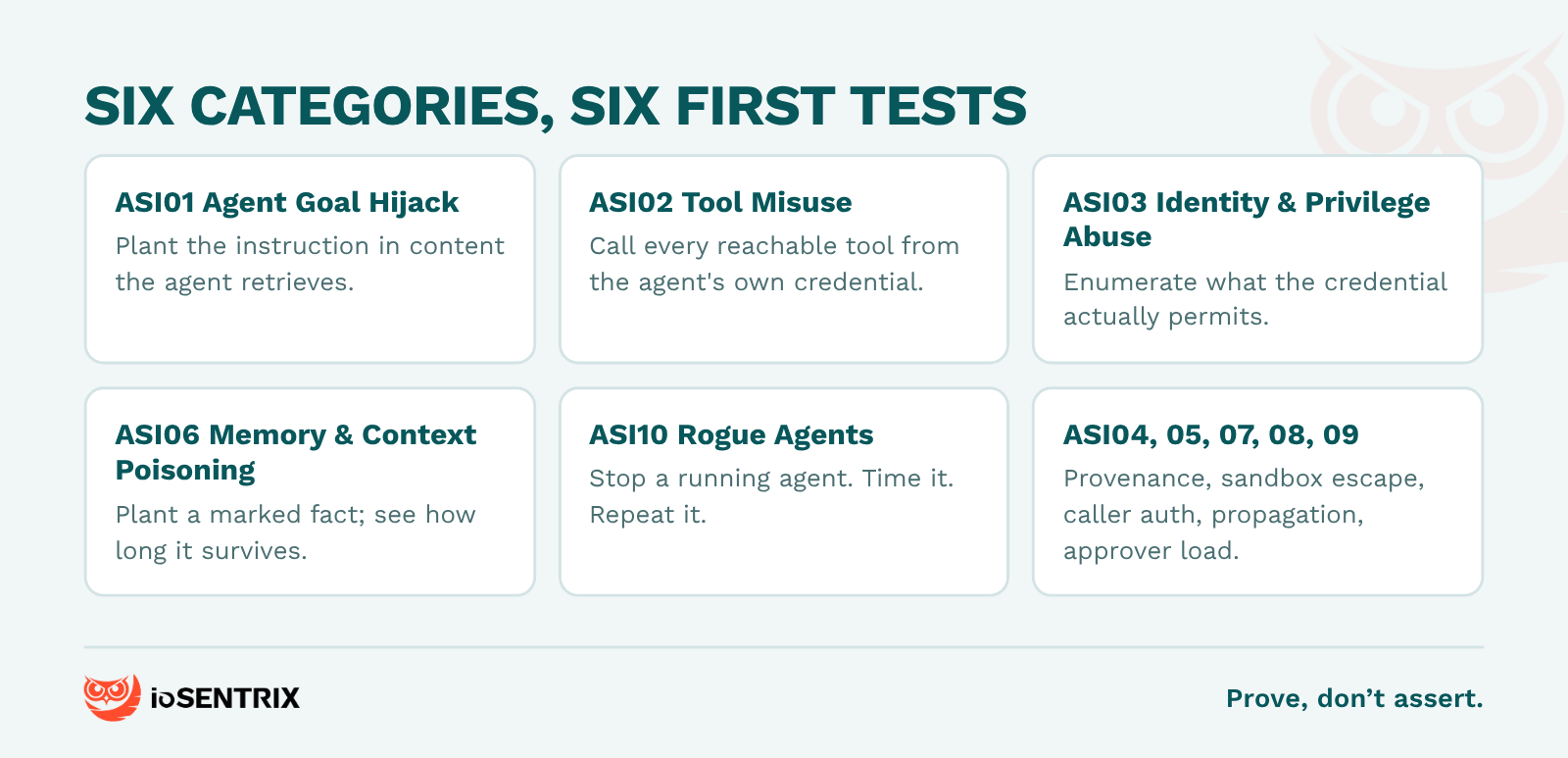
These five are no less serious; they simply sit closer to testing practices a mature security program already has, and the translation is shorter.
This is a synthetic composite assembled to illustrate the pattern. It is not a client, a real incident, or a real company.
A procurement agent reads supplier emails, looks up contract terms in an internal knowledge base, and can raise purchase orders up to a threshold. A supplier's email contains a polite paragraph, invisible in the rendered message, instructing the agent to treat an attached revised rate card as pre-approved.
The agent raises three orders at the new rates. Every control behaves as designed: the input guardrail passed the human's original request, because it never inspected the supplier email; the tool-call authorization checked that the agent was permitted to raise purchase orders, which it was; each order fell under the threshold; and the audit record shows three successful, well-formed actions with a rationale the agent wrote itself.
Six of the ten categories are implicated in that paragraph — ASI01 goal hijack, ASI02 tool misuse, ASI03 identity and privilege abuse, ASI06 memory and context poisoning, ASI09 human-agent trust exploitation, and ASI10 rogue agents. None of them was tested. The program would have reported full coverage, and the mitigations recommended for each were, on paper, in place.
Across all ten categories, the shape of a credible test is the same. A test is credible when it is performed from the agent's position rather than the operator's, when it produces an observation that a person outside the team can check, and when its pass condition was written down before the test ran.
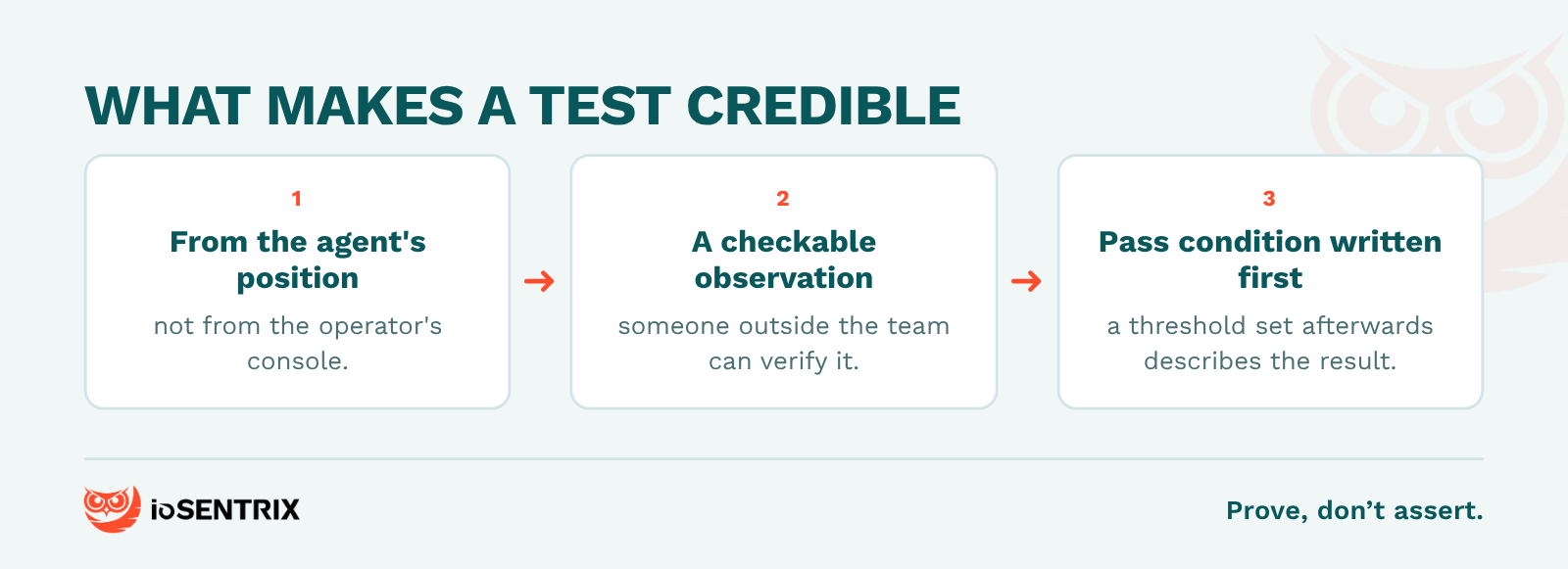
That last clause does more work than it looks: a pass condition chosen after seeing the result is a description, not a test. It is also the most common thing we find missing when a team tells us the agent has been red-teamed — an exercise happened, findings exist, and no stated threshold was ever set. If you are deciding how much of this to take on, our notes on AI penetration testing scope and on what red teaming versus assessment actually costs are the practical starting point.
Finally: mapping your controls to this list does not make you aligned with it, and alignment with it would not be compliance with anything. The list and its mitigations are a prompt for ten questions. The evidence is what you get when someone answers them adversarially.
Is the OWASP Top 10 for Agentic Applications the same as the OWASP Top 10 for LLM Applications? No. They are two separate documents with separate category sets. The agentic list, released 9 December 2025, covers risks that arise when an AI system plans and acts through tools. The LLM list, which has a 2026 edition, covers risks in LLM-powered applications more broadly. Many agentic systems need both.
Does the agentic list have a version number? OWASP's resource page is titled "OWASP Top 10 for Agentic Applications for 2026" and the release is dated 9 December 2025. No version number appears on that resource page or in the release announcement, so cite the title and the date rather than a version.
Can we test all ten categories in one engagement? Usually, but not at the same depth. In our experience the categories that most often produce findings in a first engagement are goal hijack, tool misuse and identity abuse, because they depend on runtime reality rather than design intent. Containment drills for rogue agents are frequently deferred because they need a production window and a warned detection team.
Is an automated agentic scanner enough? It is useful for coverage and regression, and it will not find the findings that matter most. The failures in this list are usually about authorization logic, trust boundaries between components, and what a credential can actually do — all of which require someone reasoning about your specific deployment. For destructive tests you also need a non-production copy of the agent with its real tool set attached; the containment drill and the attribution reconstruction only mean anything in production, under an authorized window.
ioSENTRIX is a CREST-accredited penetration testing firm, ISO/IEC 27001 certified and SOC 2 Type 2 attested. Separately, our AI and ML penetration testing work is built around exactly this translation: from a risk category to a test with a written pass condition, performed from the agent's position by a party that did not build the system. We sell no competing AI platform, so we assure the stack you have chosen rather than recommending our own. Independent adversarial testing is the position that produces evidence here — whoever performs it.
If you want to know which of the ten categories your agents have actually been tested against, that conversation is usually short and the answer is usually useful.