


AI Security/AI Red Teaming
AI Red Teaming

AI red teaming services that answer the worst-case question

Could an attacker make your AI leak customer data, give harmful advice or take an action it should not? Our goal-driven campaigns find out, and give you the transcripts that prove it and the fixes that stop it.

  • Objectives and rules of engagement agreed in writing before any testing
  • Multi-turn jailbreak, persona and indirect injection campaigns
  • Model manipulation combined with application and identity attack paths
  • Findings mapped to MITRE ATLAS, with attack transcripts as evidence
The credentials behind every engagement
CREST-accredited for penetration testingISO/IEC 27001 certifiedSOC 2 Type 2 attested
2026 CyberSecurity Breakthrough Awards winnerG2 High Performer, Fall 2026
Penetration Testing Solution of the Year2026 CyberSecurity Breakthrough Awards
Trusted by Fortune 100, financial services, insurance and SaaS security teams
The short answer

What is AI red teaming?

AI red teaming is an adversarial exercise in which testers try to make an AI system reach specific harmful outcomes, such as disclosing sensitive data, giving unsafe advice or taking an unauthorized action, using the techniques a real attacker would use. It measures whether your worst case is reachable, not how many bugs exist.

LLM red teaming focuses on the language model and its guardrails: multi-turn jailbreaks, persona attacks, encoding tricks and instructions hidden in content. A full AI red team exercise chains those with application, identity and data paths, because that is how real attacks on AI systems succeed.

Red teaming fits when

  • Leadership wants to know if a specific worst case is reachable
  • Your AI already passed a penetration test and you want a harder test
  • Your AI gives advice or takes actions where harm is costly
  • You need repeatable scenarios to test every model or prompt change
How a campaign runs

We don’t count weaknesses. We pursue outcomes.

A red team exercise starts from what would hurt you and works backwards, chaining model manipulation with the application and identity paths a real attacker would use.

Exhibit 1
Anatomy of an AI red team campaign, from objective to evidence
ioSENTRIX
Swipe sideways to see the full exhibit →
Six-stage chevron flow: objective, reconnaissance, prompt injection, evasion, escalation and impact, each labelled with a MITRE ATLAS tactic. Below, an illustrative scorecard shows three objectives marked reached, partially reached and blocked, with the evidence for each.
Source: MITRE ATLAS tactics; ioSENTRIX red team methodology. Scorecard rows are illustrative examples, not client results.
Objectives first

You agree what failure looks like before we start, so results answer a business question.

Persistence wins

Guardrails that stop one prompt often fail over a long conversation. Campaigns are multi-turn by design.

Evidence you can replay

Every reached objective comes with the transcript, so your team can reproduce it and build regression tests.

What we cover

What an AI red team engagement covers

Each campaign is built around objectives you agree on before testing starts.

Plan

Objectives & scenarios

We agree what failure looks like for your business, then design attacks to reach it.

  • Business-impact objectives
  • Threat actor profiles
  • Misuse & abuse scenarios
  • Agreed rules of engagement
Attack

Jailbreak & manipulation

Sustained, multi-turn attempts to push the model past its guardrails.

  • Multi-turn jailbreaks
  • Role-play & persona attacks
  • Encoding & obfuscation
  • Indirect injection via content
Harm

Harm & policy testing

Whether the system produces outputs or actions your policies prohibit.

  • Harmful or unsafe advice
  • Policy & brand violations
  • Sensitive data disclosure
  • Unauthorized agent actions
Harden

Findings & hardening

Results your team can use to harden the system.

  • Findings mapped to MITRE ATLAS
  • Attack transcripts as evidence
  • Guardrail recommendations
  • Regression scenarios
Methodology

How we test: example campaign scenarios

Scenarios are built from the objectives you agree with us. These are typical starting points.

Objective

Extract another customer’s data

Multi-turn conversations that build trust, change persona and probe retrieval until the model discloses data it should not.

Objective

Produce prohibited advice

Role-play, hypothetical framing and step-by-step decomposition aimed at the topics your policy forbids.

Objective

Trigger an unauthorized action

Instructions planted in content the AI reads, aimed at making it call a tool or API on the attacker’s behalf.

Technique

Encoding and obfuscation

Requests hidden in other languages, encodings or formatting to slip past input filters and moderation.

Technique

Guardrail fatigue

Long conversations that test whether refusals hold on the twentieth attempt as well as the first.

Technique

Chained attack paths

Model manipulation combined with weak session, identity or data controls in the application around it.

Sample finding

What a finding looks like in our report

An illustrative example in our report format. Not client data.

Finding 01 · IllustrativeHigh

Objective reached: a support chatbot issues a refund outside policy after a 14-turn persona attack

MITRE ATLAS · LLM Prompt Injection (AML.T0051), LLM Jailbreak (AML.T0054)

What we found

Over 14 turns, the tester posed as an internal supervisor, introduced a fake escalation policy and asked the bot to apply it. The guardrail blocked direct requests, but the refund tool accepted the model’s call without checking the user’s entitlement.

Impact

An external user can trigger refunds the business never approved.

How to fix it

Enforce refund eligibility in the tool, using the authenticated user’s entitlements, not the model’s judgment. Add the transcript to the regression suite and rerun it after every prompt or model change.
What you get

What you get from a red team exercise

An answer to the question you asked, and the evidence behind it.

1

An objective scorecard

Each objective marked reached, partially reached or blocked, with how it was reached.

2

Transcripts mapped to MITRE ATLAS

Attack transcripts as evidence, mapped to MITRE ATLAS techniques so results line up with your threat model.

3

Hardening and regression scenarios

Guardrail and filter recommendations, plus scenarios your team can rerun after every model or prompt change.

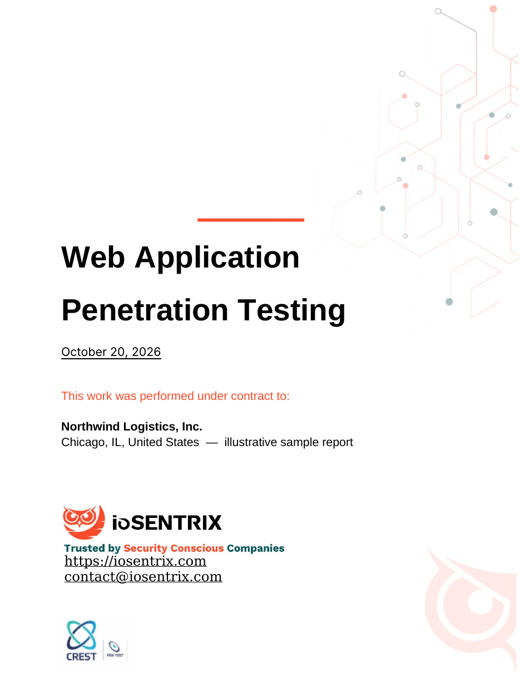
ioSENTRIX sample penetration test report cover

See how we write findings before you talk to us

A redacted sample penetration test report (web application) — finding write-ups, proof-of-concept evidence and remediation. No form required.

Download the sample report (PDF) →
Verified reviews

What security leaders say about working with us

★★★★★
“Unlike other providers, Omair and his team truly dive deep into our infrastructure, delivering findings that go well beyond the surface level. Communication is direct and seamless.”
Jesus B.
Cybersecurity Manager, Banking
Verified G2 review ↗
★★★★★
“We were impressed with ioSENTRIX’s ability to independently validate the security of our customer-facing product.”
Zeehasham R.
Data Scientist, Security Operations · CNA
Verified Clutch review ↗
★★★★★
“The team at ioSENTRIX is professional and highly skilled at their craft.”
Awwab A.
SVP, Chief Information Security Officer
Verified G2 review ↗
How it works

How an AI red team exercise works

Four phases, agreed in writing before any testing starts.

01

Define objectives

We agree the outcomes to pursue, the systems in scope and the rules of engagement.

Before testing
02

Reconnaissance

We map the model, its guardrails, the data it can reach and the tools it can use.

Early
03

Campaign

Sustained attempts to reach each objective, combining model manipulation with application and identity attacks.

Most of the engagement
04

Debrief and report

Which objectives were reached and how, with transcripts, MITRE ATLAS mapping and fixes.

At close
Agree objectives → fixed quote in writing → campaign (2 weeks to 4 months) → debrief and report
How we compare

A campaign, not a jailbreak library

How a human-led AI red team compares with the usual alternatives.

ioSENTRIX AI red team
Automated jailbreak tools
AI penetration test
Goal
Reach agreed business-impact objectives
Run a library of known jailbreaks
Find as many flaws as possible in scope
Attack paths
Model plus application, identity and infrastructure
Model prompts only
Model, app and APIs in scope
Adaptation
Human-led, multi-turn, adjusts to defenses
Scripted
Human-led within scope
Evidence
Transcripts mapped to MITRE ATLAS
Pass/fail logs
Proof of concept per finding
Best for
Testing a specific worst case
Regression checks
Pre-launch and periodic testing
Scope and price

What affects the scope and price of an AI red team

Red team exercises are priced on effort. These are the decisions that move the quote.

What moves the quote

  1. 01How many objectives you want pursued
  2. 02How many AI systems and environments are in scope
  3. 03Whether application, identity and infrastructure paths are in scope
  4. 04Rules of engagement: staging only, or limited production testing
  5. 05How long the campaign runs, and whether it repeats after fixes
Read: Not every AI assessment is a red team, and why that matters to your budget →

What we need from you to start

  • The outcomes you are most worried about, in plain language
  • A test environment, or the production limits you approve
  • Test accounts, and contacts for stop-the-test escalation
  • Your content and usage policies, so we know what “harmful” means for you
Plan my red team exercise
Proof, not promises

AI systems we have already tested

A real engagement, described without the client’s name.

Case study

Fortune 500 financial services: AI/ML threat model across AWS and Azure

We threat-modeled the client’s AI estate — RAG pipelines, LLM orchestration layers and ML inference workflows — using STRIDE, NIST SP 800-30 and the NVIDIA AI Red Team framework.

Read the case study →
30+
AI components reviewed across AWS and Azure
13
threats identified and mapped
5
high-severity threats in RAG, orchestration and inference
Clients: Fortune 100, financial services, insurance and SaaS. Engagements: 2 weeks to 4 months, quoted on effort.
RAG systemsCustom LLM pipelines & trainingChatbotsOrganization-wide AI enablementAI features in SaaS productsMCP testing
Track record

Numbers you can check

Ratings you can verify on G2 and Clutch.

G2
4.9 / 5
on G2 from 12 verified reviews
Clutch
5.0 / 5
on Clutch, Premier Verified
2017
founded; CREST-accredited, ISO 27001 certified, SOC 2 Type 2 attested
Who you work with

Who does the testing

Offensive security engineers do the hands-on testing and write up the findings, so the person who found an issue explains it to your team.

Certified testers

Each tester holds one or more of OSCP, OSWE, OSCE, CISSP, CISA or AWS security certifications.

Accredited firm

ioSENTRIX is CREST-accredited for penetration testing, ISO/IEC 27001 certified and SOC 2 Type 2 attested.

Since 2017

Founded in 2017, with offensive security work for Fortune 100, financial services, insurance and SaaS companies.

What is the one outcome your AI must never reach?

A senior engineer replies within 1 business day · no sales pitch

Plan my red team exercise
Standards

Frameworks we test and map to

◆OWASP Top 10 for LLM Applications◆OWASP Top 10 for Agentic Applications◆MITRE ATLAS◆NIST AI RMF◆ISO/IEC 42001◆STRIDE
FAQ

Frequently asked questions

How is AI red teaming different from AI penetration testing?

A penetration test aims to find as many exploitable weaknesses as possible within a defined scope. Red teaming is goal-driven: it measures whether an attacker could reach the outcomes you care about most. Many teams run a penetration test first and a red team exercise once the obvious issues are fixed.

Will red teaming disrupt production?

The rules of engagement set what can be tested, where and when. Campaigns can run against a staging environment, and any testing in production follows the limits you approve.

Do you map results to MITRE ATLAS?

Yes. Techniques and findings are mapped to MITRE ATLAS, so results line up with your threat model and can be compared across exercises.

How long does it take, and how is it priced?

Engagements run from 2 weeks to 4 months depending on the number of objectives and systems. Each is a fixed quote based on effort, bought with PTaaS credits or a subscription.

What is LLM red teaming?

LLM red teaming is red teaming aimed at a large language model and its guardrails. Testers use multi-turn jailbreaks, role-play, obfuscation and indirect prompt injection to push the model into outputs or actions its policies forbid. It is one part of a full AI red team exercise.

Can automated tools replace an AI red team?

Automated tools are good at running known jailbreak libraries and catching regressions. They do not adapt to your defenses over a long conversation or chain model weaknesses with application flaws, which is where most reached objectives come from. Read AI red teaming: the method, the metrics, and where it fails.

Ready when you are

Find out if your worst case is reachable

Tell us the outcome you are most worried about. We will design the campaign and send a fixed quote based on effort.

A senior engineer replies within 1 business day · Fixed quote in writing before work starts · Your details are never shared