


AI Security/AI & LLM Penetration Testing
AI & LLM Penetration Testing

AI & LLM penetration testing that proves what is exploitable

Hands-on testing of your chatbots, RAG pipelines, model APIs and AI features for prompt injection, data leakage, broken authorization and unsafe output. Every finding comes with a reproducible proof of concept and a fix your engineers can ship.

  • Direct and indirect prompt injection, jailbreaks and system prompt extraction
  • RAG, vector store and cross-tenant data leakage
  • Every OWASP Top 10 for LLM Applications (2025) risk that applies to your architecture
  • Model layer and the web app and APIs around it, in one engagement
The credentials behind every engagement
CREST-accredited for penetration testingISO/IEC 27001 certifiedSOC 2 Type 2 attested
2026 CyberSecurity Breakthrough Awards winnerG2 High Performer, Fall 2026
Penetration Testing Solution of the Year2026 CyberSecurity Breakthrough Awards
Trusted by Fortune 100, financial services, insurance and SaaS security teams
The short answer

What is AI penetration testing?

AI penetration testing (AI pentesting) is a hands-on security test of an application that uses a large language model or other AI component. Testers attack the prompts, the data the model can reach, its APIs and the tools it can call, and prove each exploitable weakness with a reproducible proof of concept.

An LLM penetration test covers the model layer that a standard web pentest leaves out, together with the web app and APIs around it. Findings are mapped to the OWASP Top 10 for LLM Applications 2025 and MITRE ATLAS, so your engineers, auditors and enterprise customers read the same evidence.

You need an AI pentest if

  • You are launching a chatbot, copilot or RAG search feature
  • An enterprise customer or auditor asked for an AI pentest report
  • Your AI can read internal documents or customer data
  • You changed models, prompts or retrieval sources since the last test
Where we attack

Ten OWASP LLM risks. We test every one that applies to you.

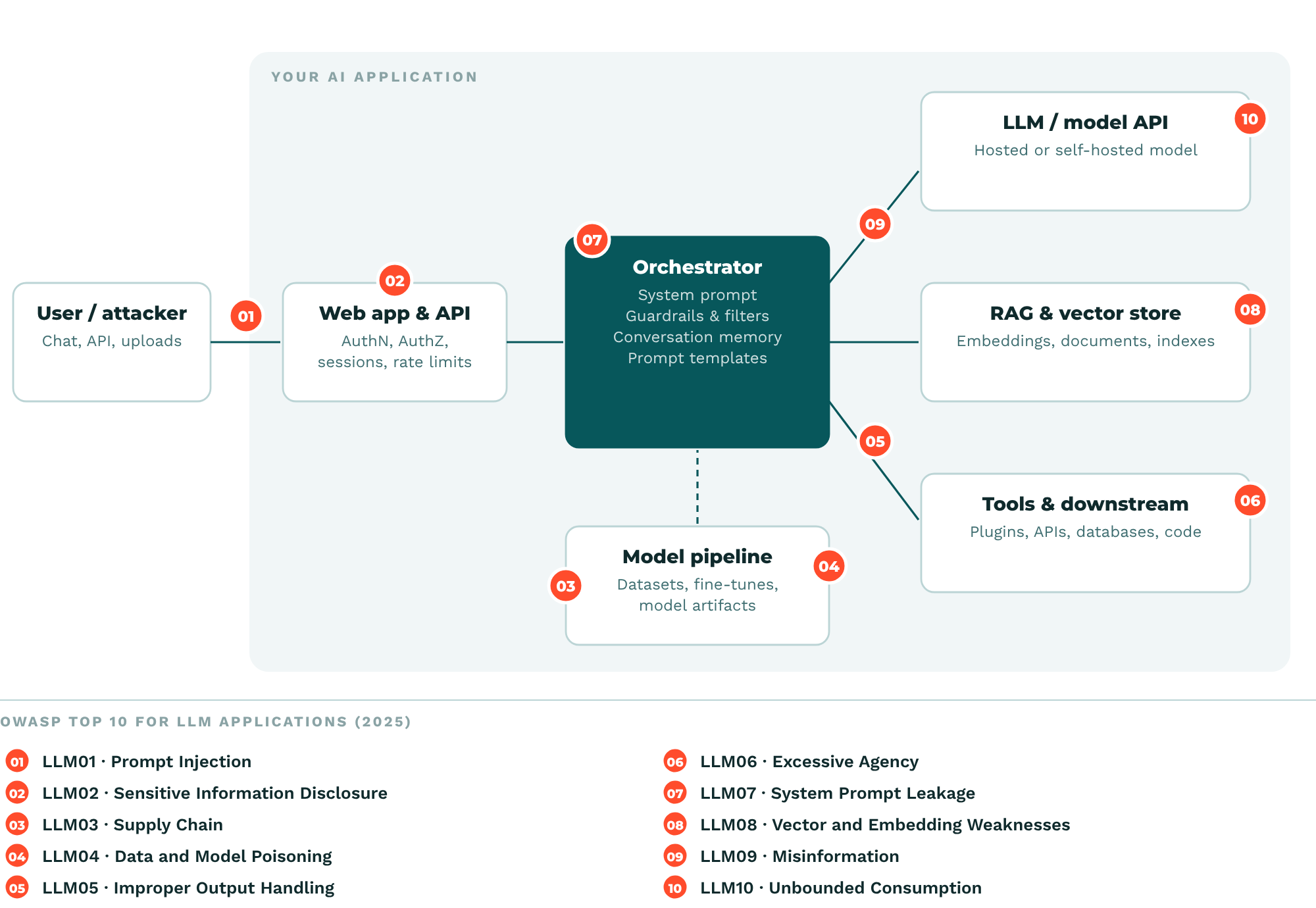
Prompt injection gets the headlines, but most damage happens where the model meets your data, tools and users. This is where each OWASP LLM risk shows up in a typical architecture.

Exhibit 1
Where an AI penetration test attacks a typical LLM application
ioSENTRIX
Swipe sideways to see the full exhibit →
Architecture diagram of an LLM application: user, web app and API, orchestrator with system prompt and guardrails, model API, RAG vector store, tools and downstream systems, and the training pipeline. Ten numbered markers place each OWASP Top 10 for LLM Applications 2025 risk where it is tested.
Source: OWASP Top 10 for LLM Applications 2025 (OWASP GenAI Security Project); ioSENTRIX test methodology. Your architecture and scope will differ.
The model is not the perimeter

Most of the ten risks involve the app, data and tools around the model, not just the model itself.

Indirect beats direct

Documents, web pages and tool output can carry instructions. We test what your model reads, not only what users type.

Output is an input

Model output that reaches a browser, database or tool is tested like any untrusted input.

What we test

Four layers, tested by hand

Scope follows your architecture. Most AI penetration tests cover these four areas.

Layer 1

Prompt & model

Attacks on how the model interprets instructions and untrusted input.

  • Direct & indirect prompt injection
  • Jailbreaks & guardrail bypass
  • System prompt extraction
  • Insecure output handling
Layer 2

RAG & data

What the model can retrieve, and who it will show it to.

  • Cross-user & cross-tenant leakage
  • Vector store access controls
  • Document poisoning paths
  • Sensitive data in responses
Layer 3

APIs, plugins & integrations

The application around the model, tested like any other attack surface.

  • Model API authN & authZ
  • Rate limits & cost abuse
  • Plugin & tool abuse
  • Excessive agency
Layer 4

Training & model pipeline

For teams that build or fine-tune models.

  • Training data poisoning paths
  • Model & artifact access
  • Pipeline secrets
  • Model & library supply chain
Methodology

How we test: example test cases

A sample of the manual test cases in a typical AI penetration test. Your scope decides the full list.

LLM01

Indirect prompt injection through retrieved content

We plant instructions in a document, page or ticket the system ingests, then check whether the model follows them when a different user asks a question.

LLM02 · LLM08

Cross-tenant retrieval

Signed in as one customer, we try to make the model retrieve and quote another customer’s documents from the vector store.

LLM07

System prompt extraction

We try to recover hidden instructions, business rules or credentials embedded in the system prompt.

LLM05

Model output reaching a sink

We craft input that makes the model emit markup, code or queries, and test whether the browser, database or downstream tool runs them.

LLM06

Tool and function abuse

We test whether the model can be talked into calling functions or APIs beyond what the signed-in user is allowed to do.

LLM10

Cost and resource abuse

We test rate limits and input sizes for requests that run up token spend or degrade the service.

Sample finding

What a finding looks like in our report

An illustrative example in our report format. Not client data.

Finding 01 · IllustrativeHigh

Instructions hidden in an uploaded PDF make the assistant reveal other users’ support tickets

OWASP LLM01 Prompt Injection · LLM02 Sensitive Information Disclosure

What we found

A user uploads a PDF containing hidden instructions. When another user later asks the support assistant a question, the retrieved PDF tells the model to search all tickets and include them in its answer. The assistant’s retrieval tool ran with service-level access, so it returned tickets the second user was never allowed to see.

Impact

Any user able to upload a document can read other customers’ support history.

How to fix it

Enforce document-level access control at retrieval time using the end user’s identity, not in the prompt. Treat retrieved text as untrusted data, and limit the tools the assistant can call while answering from retrieved content.
What you get

What you get from every AI pentest

Not a model scan. Proven AI attacks and fixes your engineers can act on.

1

Findings with proof, ranked by exploitability

Each finding — prompt injection, data leakage, broken authorization — has a severity, a reproducible proof of concept and remediation guidance.

2

Mapped to OWASP LLM Top 10 and MITRE ATLAS

A report your auditors and enterprise customers can read, with every finding mapped to the standards they ask about.

3

Walkthrough, then retesting

We walk your engineers through the findings, and retesting is available once fixes land.

ioSENTRIX sample penetration test report cover

See how we write findings before you talk to us

A redacted sample penetration test report (web application) — finding write-ups, proof-of-concept evidence and remediation. No form required.

Download the sample report (PDF) →
Verified reviews

What security leaders say about working with us

★★★★★
“Unlike other providers, Omair and his team truly dive deep into our infrastructure, delivering findings that go well beyond the surface level. Communication is direct and seamless.”
Jesus B.
Cybersecurity Manager, Banking
Verified G2 review ↗
★★★★★
“We were impressed with ioSENTRIX’s ability to independently validate the security of our customer-facing product.”
Zeehasham R.
Data Scientist, Security Operations · CNA
Verified Clutch review ↗
★★★★★
“The team at ioSENTRIX is professional and highly skilled at their craft.”
Awwab A.
SVP, Chief Information Security Officer
Verified G2 review ↗
How it works

How an AI penetration test works

Four steps, so you know what happens and what you get.

01

Scope and threat model

We walk through your architecture, data flows and trust boundaries, and agree what is in scope.

Week 1
02

Manual testing

Testers attack the model, its data and its integrations, mapped to the OWASP LLM Top 10 and MITRE ATLAS.

Most of the engagement
03

Report

Each finding has a severity, a reproducible proof of concept and remediation guidance.

At close
04

Remediation support

We walk your engineers through the findings, and retesting is available once fixes land.

After fixes
Reply within 1 business day → fixed quote in writing → engagements from 2 weeks → report, walkthrough and retest
How we compare

Not a prompt scanner. Not a web pentest with AI bolted on.

What an AI penetration test covers compared with the usual alternatives.

ioSENTRIX AI pentest
Automated LLM scanner
Standard web pentest
What is tested
Model, RAG, APIs, tools and the app around them
Known prompt patterns against the model endpoint
Web app and API; model layer out of scope
Indirect prompt injection
Tested through documents, pages and tool output
Rarely
Not tested
Authorization & data leakage
Tested by hand across users and tenants
Not tested
Web layer only
Evidence
Reproducible proof of concept and a fix
Pass/fail results to triage
Finding list
Standards
OWASP LLM Top 10 (2025), MITRE ATLAS
Varies by tool
OWASP Top 10 (web)
Scope and price

What affects the scope and price of an AI pentest

AI penetration tests are priced on effort, not on the size of the model. These are the decisions that move the quote.

What moves the quote

  1. 01How many AI features, models and user roles are in scope
  2. 02Whether the AI can call tools, functions or agents
  3. 03The RAG data sources and how tenants are separated
  4. 04Whether the surrounding web app and APIs are tested in the same engagement
  5. 05Black-box testing, or access to prompts, architecture and code
  6. 06Retesting windows and the report format your customers expect
Read: How much does an AI penetration test cost? →

What we need from you to start

  • A test environment or staging tenant that mirrors production
  • Test accounts for each user role, across at least two tenants
  • Architecture notes: model provider, prompts, retrieval sources and tools
  • Rate-limit and spend guardrails we should respect
  • A technical contact for questions during testing
Get my AI pentest quote
Proof, not promises

AI systems we have already tested

A real engagement, described without the client’s name.

Case study

Fortune 500 financial services: AI/ML threat model across AWS and Azure

We threat-modeled the client’s AI estate — RAG pipelines, LLM orchestration layers and ML inference workflows — using STRIDE, NIST SP 800-30 and the NVIDIA AI Red Team framework.

Read the case study →
30+
AI components reviewed across AWS and Azure
13
threats identified and mapped
5
high-severity threats in RAG, orchestration and inference
Clients: Fortune 100, financial services, insurance and SaaS. Engagements: 2 weeks to 4 months, quoted on effort.
RAG systemsCustom LLM pipelines & trainingChatbotsOrganization-wide AI enablementAI features in SaaS productsMCP testing
Track record

Numbers you can check

Ratings you can verify on G2 and Clutch.

G2
4.9 / 5
on G2 from 12 verified reviews
Clutch
5.0 / 5
on Clutch, Premier Verified
2017
founded; CREST-accredited, ISO 27001 certified, SOC 2 Type 2 attested
Who you work with

Who does the testing

Offensive security engineers do the hands-on testing and write up the findings, so the person who found an issue explains it to your team.

Certified testers

Each tester holds one or more of OSCP, OSWE, OSCE, CISSP, CISA or AWS security certifications.

Accredited firm

ioSENTRIX is CREST-accredited for penetration testing, ISO/IEC 27001 certified and SOC 2 Type 2 attested.

Since 2017

Founded in 2017, with offensive security work for Fortune 100, financial services, insurance and SaaS companies.

Ready to see what your AI can be made to do?

A senior engineer replies within 1 business day · no sales pitch

Get my AI pentest quote
Standards

Frameworks we test and map to

◆OWASP Top 10 for LLM Applications◆OWASP Top 10 for Agentic Applications◆MITRE ATLAS◆NIST AI RMF◆ISO/IEC 42001◆STRIDE
FAQ

Frequently asked questions

How is it different from a regular web application pentest?

A web pentest covers the application and its APIs. An AI pentest adds the model layer: prompt injection, jailbreaks, retrieval of data the user should not see, and unsafe use of model output by the rest of the system. We test both layers in the same engagement.

Which OWASP LLM risks do you test?

All ten categories in the OWASP Top 10 for LLM Applications 2025: prompt injection, sensitive information disclosure, supply chain, data and model poisoning, improper output handling, excessive agency, system prompt leakage, vector and embedding weaknesses, misinformation and unbounded consumption, as they apply to your scope.

Is AI penetration testing the same as AI red teaming?

No. A penetration test aims to find as many exploitable weaknesses as possible within a scope. Red teaming pursues specific harmful outcomes the way an adversary would. See our AI red teaming services and our comparison of the two.

Do you test AI features inside our SaaS product?

Yes. Adding AI to SaaS products is one of the AI engagement types we run.

How long does it take, and how is it priced?

Engagements run from 2 weeks to 4 months depending on scope. Each is a fixed quote based on effort, bought with PTaaS credits or a subscription.

What should be in scope for an AI penetration test?

Scope should follow what the AI can reach and do: the model and its prompts, every data source it retrieves from, the tools and APIs it can call, and the web app and APIs around it. Read our guide to AI penetration test scope.

What are the best AI penetration testing tools?

Open-source tools such as NVIDIA garak, Microsoft PyRIT and promptfoo run large libraries of known attacks against a model, which is useful for coverage and regression testing. They do not understand your authorization model or business rules, so they miss the data-access and tool-abuse findings that matter most. A good AI penetration test uses tools for breadth and people for depth. See why an AI tool isn’t a pentest.

Ready when you are

Test your AI before an attacker does

Tell us what AI you have shipped — chatbots, RAG, model APIs or AI features — and we will scope a test and send a fixed quote based on effort.

A senior engineer replies within 1 business day · Fixed quote in writing before work starts · Your details are never shared