

AI Security/AI Security Assessment
AI Security Assessment

AI security assessment services with evidence, not questionnaires

A structured review of the AI you build and buy — architecture, threat model and the controls around it — run by offensive testers who attempt the controls that matter. Your board and auditors get evidence of what holds, not a checklist.

  • An inventory of the AI you build and buy, including shadow AI
  • STRIDE and MITRE ATLAS threat models for each in-scope system
  • Controls tested to see if they hold, not just documented
  • Findings mapped to NIST AI RMF and OWASP, with a prioritized roadmap
The credentials behind every engagement
CREST-accredited for penetration testingISO/IEC 27001 certifiedSOC 2 Type 2 attested
2026 CyberSecurity Breakthrough Awards winnerG2 High Performer, Fall 2026
Penetration Testing Solution of the Year2026 CyberSecurity Breakthrough Awards
Trusted by Fortune 100, financial services, insurance and SaaS security teams
The short answer

What is an AI security assessment?

An AI security assessment reviews how an organization builds, deploys and uses AI, identifies where the risk sits, and checks whether the controls around those systems work. It usually combines an AI inventory, architecture review, AI threat modeling and control validation, and ends with a prioritized roadmap.

An AI risk assessment often stops at likelihood and impact ratings based on interviews and questionnaires. Our assessments are run by offensive testers, so the controls that matter most are attempted, and each rating is backed by evidence of whether the control held.

An assessment fits when

  • You have many AI systems and need to know where to test first
  • Your board or auditors want an AI risk view backed by evidence
  • You are designing a new AI system and want a threat model before launch
  • You need a baseline before ISO/IEC 42001 or a customer security review
Evidence over assertion

A control that exists is not a control that works.

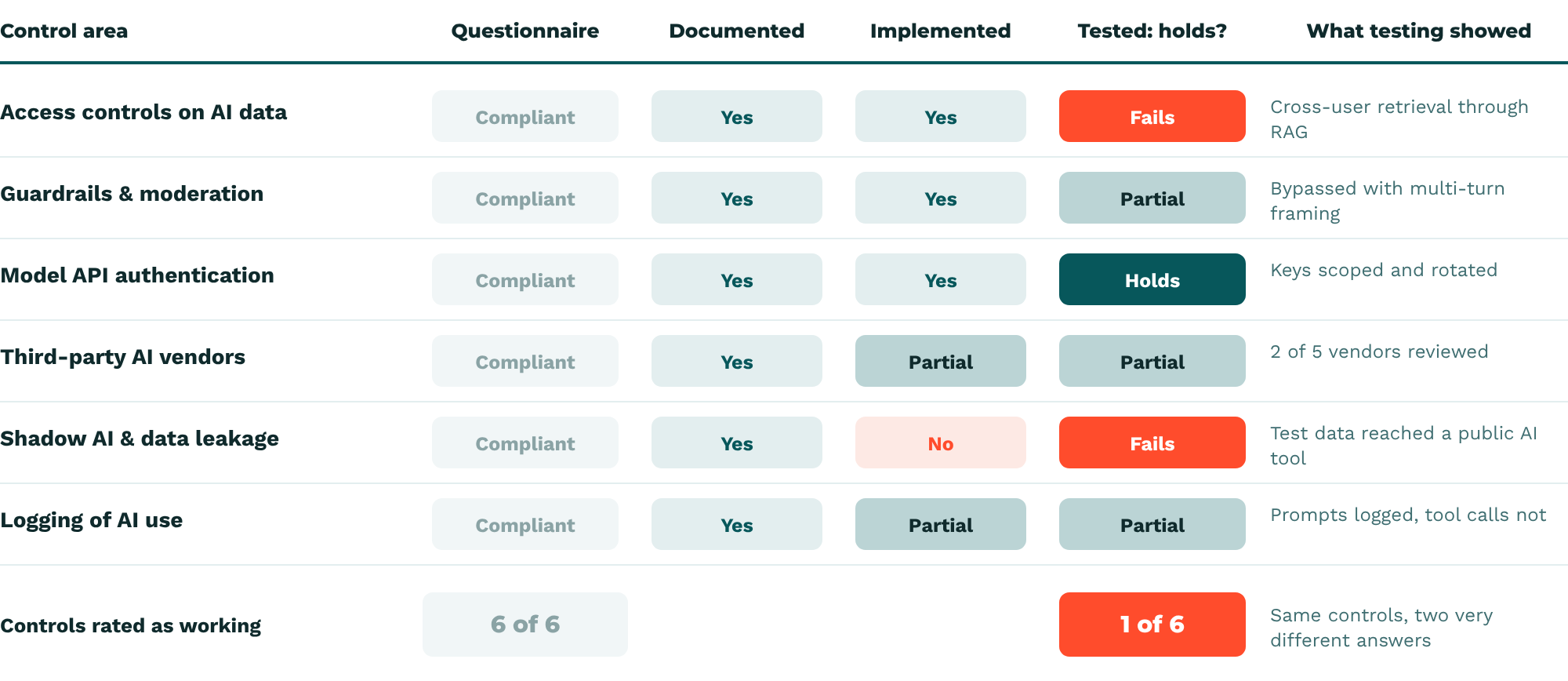
Questionnaires record that a control is in place. Testing shows whether it holds when someone tries to get around it. The gap between the two is where AI incidents come from.

Exhibit 1
Illustrative AI control assessment: the questionnaire view versus the tested view
ioSENTRIX
Swipe sideways to see the full exhibit →
Heatmap of six AI control areas. A questionnaire rates all six compliant; documentation and implementation checks are mixed; adversarial testing shows one holds, three are partial and two fail. Illustrative output, not client data.
Source: Illustrative output based on the ioSENTRIX assessment format. Not client data.
Same controls, different answer

Six controls rated compliant on paper; only one held up under testing in this example.

Shadow AI is a control gap

Policies that ban public AI tools are only as good as the paths that enforce them.

Fix the right thing first

Tested ratings drive a roadmap ordered by real exposure, not by questionnaire score.

What we cover

What an AI security assessment covers

Scoped to your AI footprint, from one application to an organization-wide rollout.

Design

Architecture review

Secure design validation across AI pipelines, APIs, models and infrastructure.

  • Trust boundary mapping
  • Data flow & retention review
  • API & token exposure
  • Secure deployment validation
Threats

AI threat modeling

AI-specific attack paths, identified before they are built or exploited.

  • STRIDE-based threat models
  • MITRE ATLAS mapping
  • Misuse & abuse cases
  • Prioritized remediation roadmap
Controls

Control validation

Testing that the controls you rely on hold in practice.

  • Guardrail & moderation testing
  • Access controls on AI data
  • Shadow AI discovery
  • Data leakage to AI tools
Program

Governance & third parties

The program around your AI systems.

  • NIST AI RMF alignment
  • OWASP LLM Top 10 mapping
  • Third-party AI vendor reviews
  • AI policy review
Methodology

How we assess: example checks

A sample of the checks in a typical AI security assessment. Your AI footprint decides the full list.

Inventory

Shadow AI discovery

We find AI tools and AI features in use that nobody approved, including AI built into SaaS you already pay for.

Architecture

Trust boundary review

We trace where untrusted input enters each AI system and where model output is allowed to act.

Threat model

STRIDE and MITRE ATLAS per system

We map AI-specific attack paths for each in-scope system and rank them by exposure.

Control

Data leakage to public AI tools

We test whether the data-loss and access controls your policy relies on stop sensitive data reaching public AI tools.

Control

Guardrail and moderation testing

We attempt the guardrails on your highest-risk system to see whether they hold under realistic attacks.

Program

Third-party AI vendor review

We review how AI vendors handle your data, using the questions an enterprise security team would ask.

Sample finding

What a finding looks like in our report

An illustrative example in our report format. Not client data.

Finding 01 · IllustrativeHigh

Control rated “in place” failed: sensitive files reached a public AI tool through a browser extension

NIST AI RMF MANAGE · OWASP LLM02 Sensitive Information Disclosure

What we found

The questionnaire showed a policy blocking public AI tools and a web filter enforcing it. Testing found an approved browser extension with a built-in AI assistant that sent page and document content to its vendor, outside the filter.

Impact

Confidential documents can leave the organization through an approved tool the policy never considered.

How to fix it

Add AI features in approved software to the AI inventory, restrict the extension’s AI features through browser policy, and retest the control.


What you get

What you get from an AI security assessment

A view of AI risk your board can read and your engineers can act on.

1

AI inventory and threat models

The AI you build and buy, with a threat model for each in-scope system.

2

Tested control ratings

Each control rated on whether it held when we attempted it, with the evidence behind every rating.

3

A prioritized roadmap

Findings mapped to NIST AI RMF and OWASP, ordered by real exposure, with owners and next steps.

Verified reviews

What security leaders say about working with us

★★★★★
“Unlike other providers, Omair and his team truly dive deep into our infrastructure, delivering findings that go well beyond the surface level. Communication is direct and seamless.”
Jesus B.
Cybersecurity Manager, Banking
Verified G2 review ↗
★★★★★
“We were impressed with ioSENTRIX’s ability to independently validate the security of our customer-facing product.”
Zeehasham R.
Data Scientist, Security Operations · CNA
Verified Clutch review ↗
★★★★★
“The team at ioSENTRIX is professional and highly skilled at their craft.”
Awwab A.
SVP, Chief Information Security Officer
Verified G2 review ↗
How it works

How an AI security assessment works

From inventory to a prioritized roadmap, with test evidence behind every rating.

01

Discover

Inventory the AI you build and buy, including tools in use that nobody approved.

Week 1
02

Review and model

Architecture review and threat modeling for each in-scope system.

Early
03

Validate controls

Attempt the controls that matter most and record what holds and what does not.

Most of the engagement
04

Roadmap

Findings mapped to NIST AI RMF and OWASP, with a prioritized remediation plan.

At close
Reply within 1 business day → fixed quote in writing → assessments from 2 weeks → roadmap and readout
How we compare

An assessment run by attackers, not auditors

How an ioSENTRIX AI security assessment compares with the usual alternatives.

ioSENTRIX assessment
Questionnaire / GRC review
Single-app pentest
Scope
Your AI program and its highest-risk systems
Your AI program
One application
How controls are rated
Attempted by offensive testers
Self-reported
Only those in the app
Threat modeling
STRIDE and MITRE ATLAS per system
Rarely
Sometimes
Output
Tested ratings and a prioritized roadmap
A compliance score
Finding list
Scope and price

What affects the scope and price of an AI security assessment

Assessments are priced on effort. These are the decisions that move the quote.

What moves the quote

  1. 01How many AI systems and vendors are in scope
  2. 02How many systems get a full threat model
  3. 03Which controls are tested, rather than reviewed
  4. 04Whether interviews span several business units
  5. 05The frameworks you need findings mapped to
Read: Prove, don’t assert: why “do you have a policy?” is the wrong AI security question →

What we need from you to start

  • A list of known AI systems and vendors, even if incomplete
  • Architecture diagrams for the highest-risk systems
  • Your AI and acceptable-use policies
  • Contacts in security, engineering and the business units using AI
Request my AI assessment
Proof, not promises

AI systems we have already tested

A real engagement, described without the client’s name.

Case study

Fortune 500 financial services: AI/ML threat model across AWS and Azure

We threat-modeled the client’s AI estate — RAG pipelines, LLM orchestration layers and ML inference workflows — using STRIDE, NIST SP 800-30 and the NVIDIA AI Red Team framework.

Read the case study →
30+
AI components reviewed across AWS and Azure
13
threats identified and mapped
5
high-severity threats in RAG, orchestration and inference
Clients: Fortune 100, financial services, insurance and SaaS. Engagements: 2 weeks to 4 months, quoted on effort.
RAG systemsCustom LLM pipelines & trainingChatbotsOrganization-wide AI enablementAI features in SaaS productsMCP testing
Track record

Numbers you can check

Ratings you can verify on G2 and Clutch.

G2
4.9 / 5
on G2 from 12 verified reviews
Clutch
5.0 / 5
on Clutch, Premier Verified
2017
founded; CREST-accredited, ISO 27001 certified, SOC 2 Type 2 attested
Who you work with

Who does the testing

Offensive security engineers do the hands-on testing and write up the findings, so the person who found an issue explains it to your team.

Certified testers

Each tester holds one or more of OSCP, OSWE, OSCE, CISSP, CISA or AWS security certifications.

Accredited firm

ioSENTRIX is CREST-accredited for penetration testing, ISO/IEC 27001 certified and SOC 2 Type 2 attested.

Since 2017

Founded in 2017, with offensive security work for Fortune 100, financial services, insurance and SaaS companies.

Want evidence of which AI controls actually hold?

A senior engineer replies within 1 business day · no sales pitch

Request my AI assessment
Standards

Frameworks we test and map to

◆OWASP Top 10 for LLM Applications◆OWASP Top 10 for Agentic Applications◆MITRE ATLAS◆NIST AI RMF◆ISO/IEC 42001◆STRIDE
FAQ

Frequently asked questions

How is an assessment different from an AI penetration test?

An assessment looks across your AI program and architecture to find where risk sits and which controls are missing. A penetration test goes deep on one application to find exploitable flaws. Many clients start with an assessment and then pentest the highest-risk systems.

Which frameworks do you use?

We map findings to the NIST AI Risk Management Framework and the OWASP Top 10 for LLM Applications, and use STRIDE and MITRE ATLAS for threat modeling. If you are preparing for ISO/IEC 42001, see our ISO 42001 readiness service.

Do you cover shadow AI?

Yes. Discovery covers AI tools in use that nobody approved, and control validation tests whether sensitive data can reach them. See AI assurance and control validation.

How long does it take, and how is it priced?

Assessments run from 2 weeks to 4 months depending on how many AI systems are in scope. Each is a fixed quote based on effort, bought with PTaaS credits or a subscription.

What is AI threat modeling?

AI threat modeling identifies how an AI system could be attacked before it is built or exploited. It maps trust boundaries, data flows and the tools the AI can use, then lists the AI-specific attack paths, often using STRIDE and MITRE ATLAS. Read our guide to AI system threat modeling.

What is the difference between an AI risk assessment and an AI security assessment?

An AI risk assessment rates the likelihood and impact of AI risks across the business, often for governance frameworks such as the NIST AI RMF. An AI security assessment focuses on the security of the systems themselves and tests whether the controls hold. Ours combines both, with test evidence behind the ratings.

Ready when you are

Get evidence of where your AI risk really sits

Tell us how your organization builds and uses AI. We will scope the assessment and send a fixed quote based on effort.

A senior engineer replies within 1 business day · Fixed quote in writing before work starts · Your details are never shared