June 28, 2026
AI Penetration Testing Services: How to Choose an AI and LLM Pentest Vendor in 2026
AI Penetration Testing Services: How to Choose an AI and LLM Pentest Vendor in 2026

Omair


Fiza Nadeem is an SEO content writer at ioSENTRIX with 2.5+ years of experience in content writing, copywriting, and SEO.
Security belongs at the start of the development process, not at the end. DevSecOps solutions put it there. They combine tooling, pipeline automation and team practices so that every commit, build and deploy is checked for security problems while a fix is still cheap. This guide covers what DevSecOps solutions are, how they differ from DevSecOps services, which tools fit each CI/CD stage, how to build a DevSecOps strategy, and how pipeline evidence supports SOC 2, PCI DSS and NIST SSDF compliance.
DevSecOps solutions are the combination of tools, automated pipeline controls and team practices that integrate security into every phase of software development and operations, from the first commit to production monitoring. Instead of treating security as a separate final step, a DevSecOps solution "shifts left": security checks run early and continuously through development, testing, deployment and production.
In practice, a DevSecOps solution has three layers. The tool layer covers code and application security testing, infrastructure and cloud configuration scanning, secrets management and monitoring. The process layer covers secure SDLC integration, threat modeling, continuous vulnerability management and automated compliance evidence. The culture layer is the part most vendors skip: security is everyone's responsibility, findings are visible to the whole team, and priorities follow business risk rather than scanner severity alone. See our glossary entry on what DevSecOps is and AppSec vs DevSecOps for how it fits a broader program.
DevSecOps solutions are the tools and pipeline controls you run. DevSecOps services are the people and expertise that design, integrate, tune and operate those controls for you. Most organizations need both: a scanner nobody tunes produces noise, and a consultant with no automation produces slides.
DevSecOps services typically include a pipeline and tooling assessment, secure SDLC design, tool selection and integration, policy-as-code authoring, developer training and ongoing triage of findings. Some providers also run the testing automation cannot do, such as manual penetration testing and business logic review, and feed results back into the pipeline. That is the model behind integrating PTaaS into a DevSecOps workflow.
When you evaluate DevSecOps services and solutions together, ask one question of each control: does it prove the security property holds, or does it only assert that a tool ran? A green pipeline badge is an assertion. A remediated finding with a retest record is proof.
DevSecOps tooling falls into seven categories, and a mature pipeline uses at least one tool from each: static application security testing (SAST), software composition analysis (SCA), secrets detection, infrastructure as code (IaC) scanning, container and artifact scanning, dynamic application security testing (DAST), and runtime monitoring with incident response. The OWASP DevSecOps Guideline lists a similar set of checks, with the stated objective of detecting security issues as fast as possible.
SAST reads source code before it runs; DAST probes the running application without source code, which is why it finds issues SAST cannot (see SAST vs DAST). SCA and secrets detection guard what goes into the repository, IaC and container scanning guard what gets provisioned, and runtime monitoring watches what is already in production.
The best automation tools for DevSecOps are the ones that run at the right stage, produce output your pipeline can act on, and do not block developers for low-risk findings. The map below is organized by stage, and each description reflects what the project or vendor says about its own tool. It is a coverage map, not an endorsement, and it is not exhaustive.
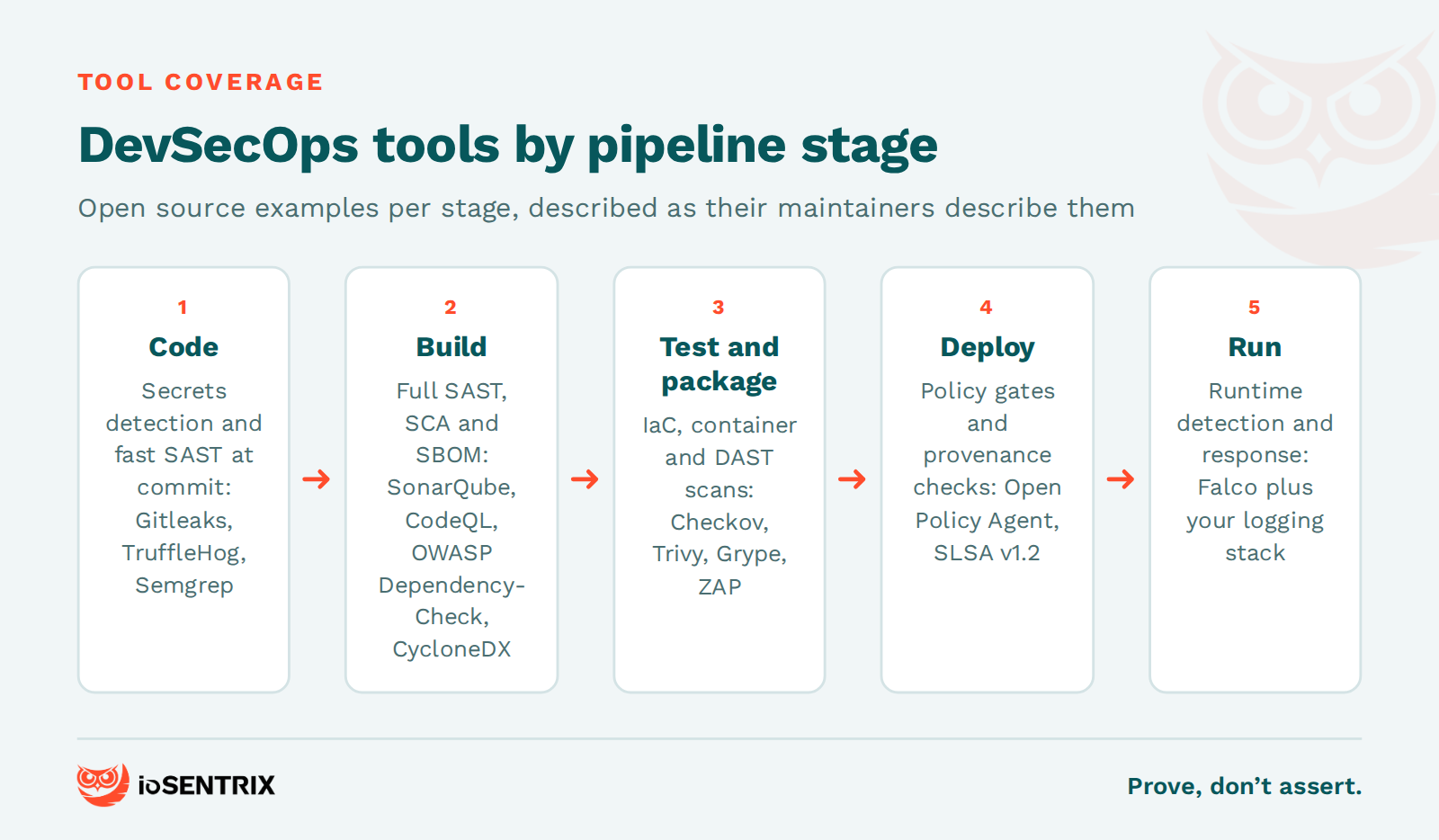
At the code stage, before or at commit, secrets detection and lightweight static analysis run fastest. Gitleaks describes itself as a tool for detecting secrets like passwords, API keys and tokens in git repos; TruffleHog is described by its vendor as a secrets scanning tool for code repositories. Semgrep describes itself as an application security platform that scans source code with SAST, SCA and secrets detection.
At the build stage, deeper SAST and SCA run against the full codebase. SonarQube is described by SonarSource as a platform for automated code quality and security analysis. CodeQL, from GitHub, is described as a programming language and tools that treat code like data, and it powers GitHub code scanning. OWASP Dependency-Check is described by OWASP as a software composition analysis tool suite that checks project dependencies for known, publicly disclosed vulnerabilities; Snyk Open Source is described by Snyk as an SCA solution for open source dependencies. This is also where a software bill of materials is generated, in CycloneDX (an OWASP project, standardized as ECMA-424) or SPDX (ISO/IEC 5962:2021). See software supply chain security for why that matters.
At the test and package stage, infrastructure and artifact scanning run. Checkov describes itself as a policy-as-code tool that scans cloud infrastructure configurations (Terraform, CloudFormation, Kubernetes, Helm, ARM templates) for misconfigurations before deployment. Trivy, maintained by Aqua Security, is described as a scanner for vulnerabilities and IaC misconfigurations across code repositories, binary artifacts, container images and Kubernetes clusters. Grype, from Anchore, is described as a vulnerability scanner for container images and filesystems. DAST runs here against a staging build; ZAP describes itself as a free and open source web app scanner.
At the deploy stage, policy engines decide whether an artifact may ship. Open Policy Agent is described as a policy engine for managing policy across a stack, and it is a CNCF graduated project. The SLSA framework, at specification v1.2, is a checklist of standards and controls to prevent tampering and improve the integrity of packages and build infrastructure.
At the run stage, Falco is described as a cloud native runtime security tool for hosts, containers, Kubernetes and cloud environments, also a CNCF graduated project. For the CI/CD platforms themselves, GitHub Actions is described by GitHub as a CI/CD platform that automates build, test and deployment pipelines, and Jenkins describes itself as an open source automation server; GitLab CI/CD and Azure Pipelines fill the same role. The top CI/CD solutions in the DevSecOps field are the ones your team already runs; the security value comes from what you wire into them. Prefer tools that emit SARIF, the OASIS standard for static analysis results (version 2.1.0), because most CI platforms can annotate pull requests from it with little glue code.
A DevSecOps strategy is a written plan that says which security controls run at which pipeline stage, what blocks a release, who owns the findings, and how you will measure whether the controls work. Tools follow the strategy, not the other way around. Buying seven scanners before deciding what a failing check means is how most DevSecOps programs stall.
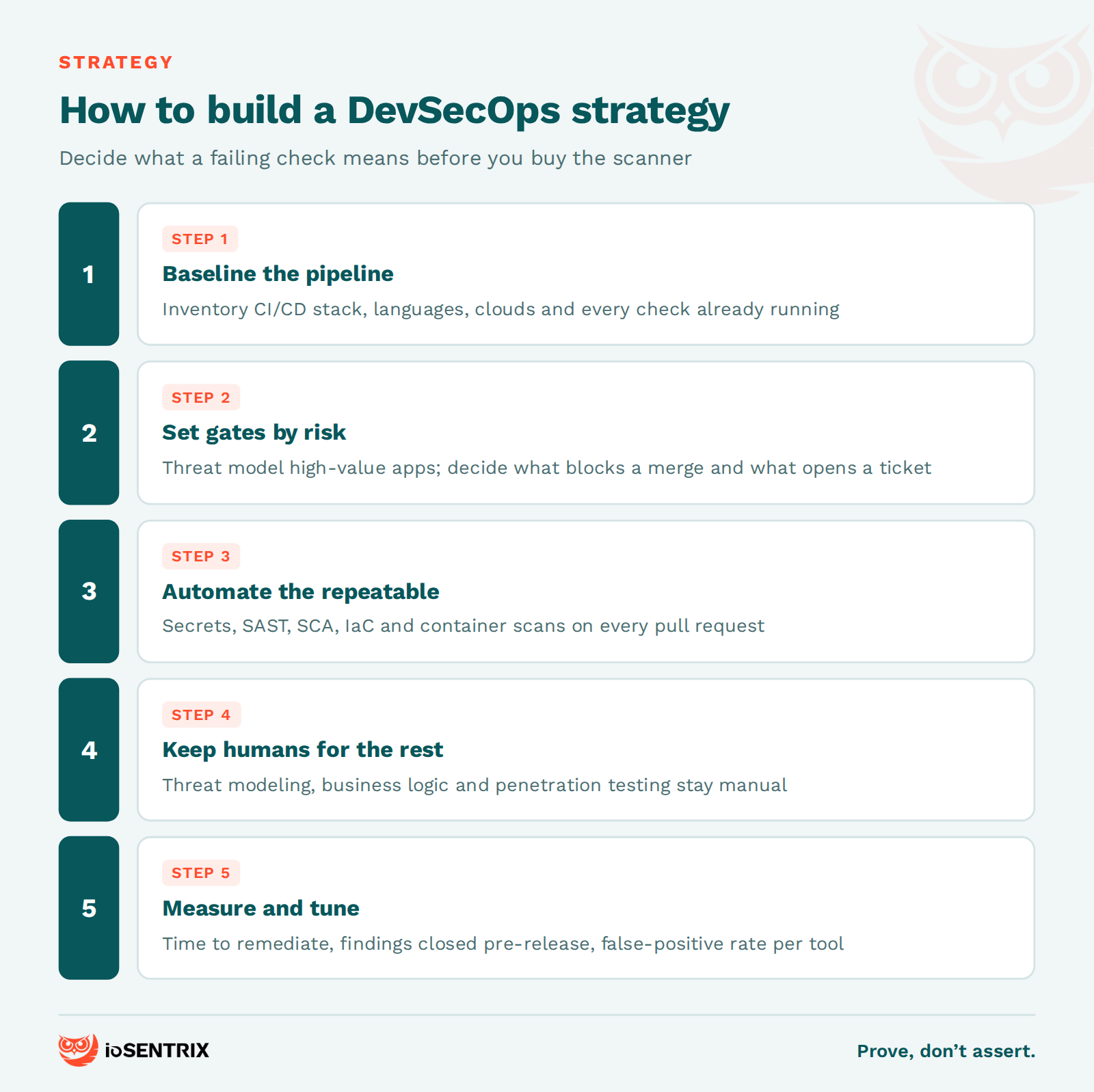
Start by baselining the pipeline you have: the CI/CD stack, languages and frameworks, cloud providers, and every security check already running, including the ones nobody reads. Then set gates by risk. A threat model of your highest-value applications tells you which findings block a merge and which open a ticket. A critical SQL injection in a payment path blocks; a low-severity linting finding does not.
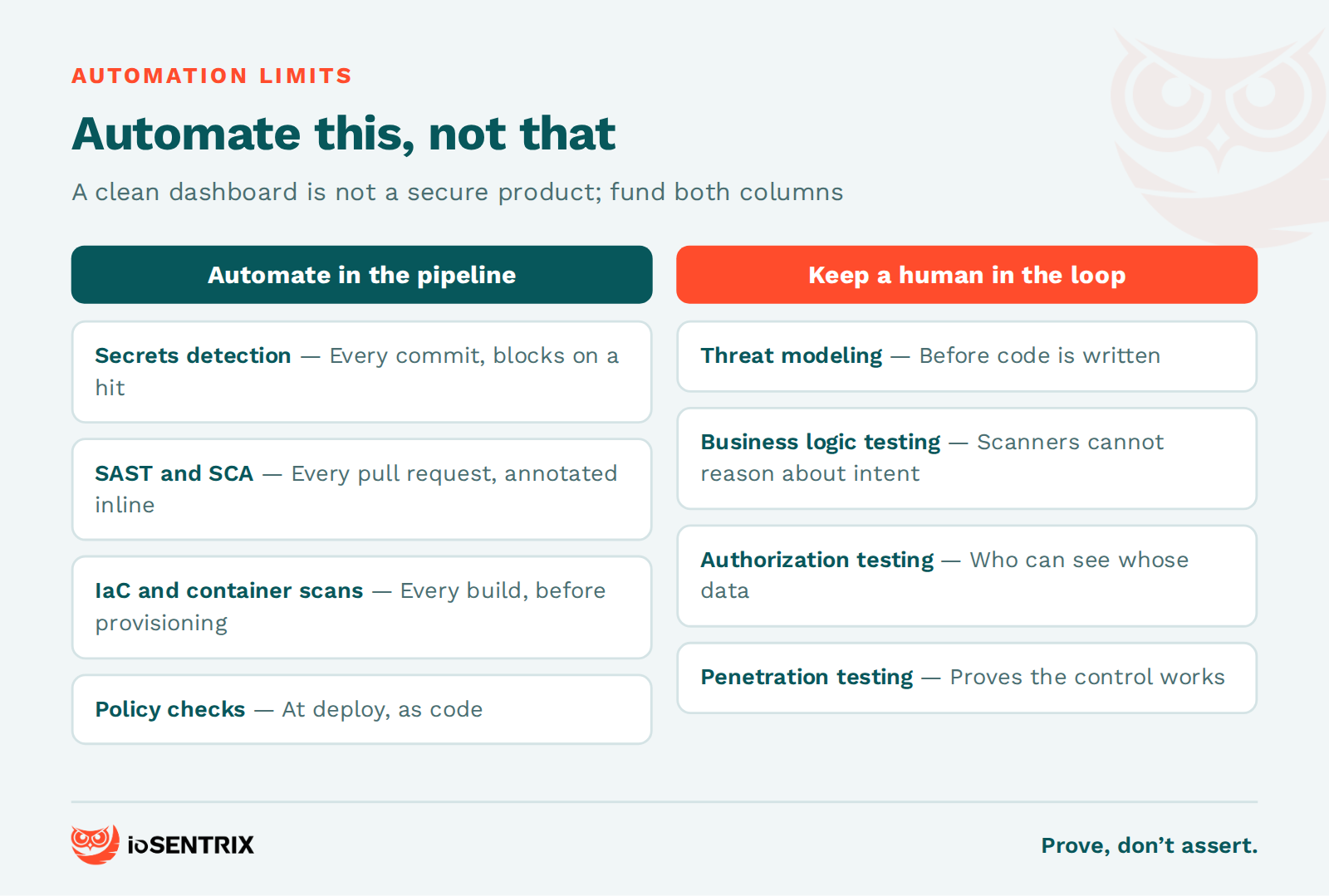
Next, automate what is repeatable and leave humans for what is not. Secrets detection, SAST, SCA, IaC and container scanning can run on every pull request unattended. Threat modeling, business logic testing, authorization testing and penetration testing cannot be fully automated, and a strategy that pretends otherwise produces a clean dashboard and an insecure product. Finally, measure: mean time to remediate by severity, the share of findings closed before release, and the false-positive rate per tool. A gate that developers routinely bypass is not a control.
Align the strategy to a published framework so the results are defensible. The NIST Secure Software Development Framework (SSDF), SP 800-218, Version 1.1, is the reference most auditors recognize; a draft Version 1.2 (SP 800-218 Rev. 1) was released for public comment in December 2025. The OWASP DevSecOps Maturity Model is useful for scoring where you are and picking the next step. For the SDLC practices underneath, see top 10 best practices for secure SDLC.
The five challenges that derail most DevSecOps programs are resistance to change, speed versus security friction, tool integration, multi-cloud sprawl and the limits of automation. None of them is solved by buying another tool.
Resistance to change is a people problem. Teams used to an end-of-cycle review see pipeline gates as an obstacle, so bring product owners, engineers, operations and leadership into the program's design and make the case in terms of risk reduction and release speed. Speed versus security is a design problem. Heavy manual checks in a fast pipeline get routed around; low-friction gates that block only on critical findings, with everything else ticketed, keep velocity and still catch what matters.
Tool integration is a plumbing problem: tools without native CI/CD integrations or standard output formats create glue code nobody maintains. Multi-cloud is a consistency problem: provider-neutral IaC scanning and policy-as-code, with least-privilege IAM and federated identity, keep one rule set across AWS, Azure and GCP (see our cloud security services). The limits of automation are a scoping problem: decide which checks are automated and which are human, then fund both.
DevSecOps compliance solutions are the same pipeline controls, configured to produce evidence an auditor can use. The pipeline already records who changed what, which tests ran, what they found and who approved the release. Capturing that history is most of the work.
For SOC 2, the relevant criteria are in the AICPA Trust Services Criteria. CC8.1 covers change management: the entity authorizes, designs, develops, configures, documents, tests, approves and implements changes to infrastructure, data, software and procedures. A pipeline with enforced code review, automated testing and approval records maps directly to it. CC7.1 covers detection and monitoring procedures for new vulnerabilities, and its points of focus include vulnerability scans run periodically and after significant changes; automated SCA and container scanning on every build is strong evidence for that. Penetration testing itself is covered in Is penetration testing required for SOC 2 compliance?.
For PCI DSS v4.0.1, Requirement 6, Develop and Maintain Secure Systems and Software, expects secure development practices and an inventory of bespoke and custom software to support vulnerability and patch management. SCA output and an SBOM per release address the inventory; SAST and code review records support secure development. See secure SDLC practices to meet PCI DSS standards.
For organizations that sell to the US federal government, NIST SSDF practices are the reference point, and the pipeline evidence above is how you attest to them. Regulated industries add their own expectations; see DevSecOps in the banking sector. In every case, alignment with a framework is not certification, and a pipeline that runs a scanner is not a pipeline whose findings get fixed.
DevSecOps is a way of building and running software in which development, security and operations share responsibility for security, and security checks are automated into the delivery pipeline. It extends DevOps by treating security tests, policy checks and monitoring as pipeline steps rather than a separate review at the end, so vulnerabilities are found while they are cheap to fix.
The best DevSecOps automation tools cover each pipeline stage and integrate with the CI/CD platform you already run. A typical open source set is Gitleaks or TruffleHog for secrets, Semgrep or CodeQL for SAST, OWASP Dependency-Check for SCA, Checkov for IaC, Trivy or Grype for containers, ZAP for DAST, Open Policy Agent for deploy-time policy and Falco for runtime. Commercial platforms bundle several categories; verify coverage against the stage map above before you buy.
The leading DevSecOps practices are threat modeling before code is written, automated security testing on every pull request, dependency and SBOM management, infrastructure as code with policy checks, secrets kept out of repositories, least-privilege pipeline access, and continuous monitoring in production. NIST SP 800-218 (SSDF) and the OWASP DevSecOps Guideline describe these practices in framework form.
A secure SDLC defines security activities for each phase of building software, from requirements through release. DevSecOps is how those activities are automated and run continuously inside a delivery pipeline, extending past release into production monitoring. Most organizations need a secure SDLC as the policy and DevSecOps as the implementation.
The most common CI/CD platforms used for DevSecOps are GitHub Actions, GitLab CI/CD, Jenkins and Azure Pipelines, and any of them can run the security tools in this guide. The differentiator is how easily each ingests scanner output, which is why SARIF support and native pull request annotation matter more than the brand.
ioSENTRIX is a CREST-accredited penetration testing firm, ISO/IEC 27001 certified and SOC 2 Type 2 attested. Our application security services include DevSecOps pipeline assessment, secure SDLC design, tool selection and integration, and the manual testing automation cannot replace, delivered through PTaaS so findings land in your existing workflow. We do not stop at confirming that a scanner runs. We test whether the control works, with evidence.
If you want a second opinion on your pipeline, or you are building a DevSecOps strategy from scratch, talk to our team.