September 24, 2026
The Reflected XSS Methodology: 11 Labs Behind $5,000+ in Bounties and 80+ Pentests
The Reflected XSS Methodology: 11 Labs Behind $5,000+ in Bounties and 80+ Pentests

Salman Khan


Omair Manzoor is the Founder, CEO, and Chief Hacker of ioSENTRIX, a CREST-accredited cybersecurity firm. With 14+ years in offensive security, he has led penetration tests for Fortune 500 companies including engagements for Amazon, Bank of America, VISA, and the London Underground. His exploits are part of the Metasploit Framework and Immunity Canvas. Omair is a published researcher, conference keynote speaker (DOD, CISA, BSides), and technical reviewer for academic security textbooks.
AI penetration testing services are authorized, adversarial security assessments of AI and machine learning systems that find and prove exploitable weaknesses before an attacker does. The scope includes LLM applications, retrieval-augmented generation (RAG) pipelines, AI agents and the tools they call, model APIs, and the infrastructure that hosts and trains the model. A good AI penetration testing service treats the model as one component in a connected system, not as an isolated black box.
The risks are different from the ones a conventional test looks for. An application can have solid authentication and a clean API and still leak customer records through prompt injection. An agent can take an unauthorized action because its tool permissions were never restricted. Jailbreaks, data and model poisoning, model extraction, and unsafe handling of model output round out the list.
So how do you choose an AI penetration testing vendor? This guide covers what these services are, what an LLM penetration test includes, how to evaluate a provider, which frameworks and tools a credible vendor uses, whether AI testing is available as PTaaS, and what drives the cost.
AI penetration testing services are security assessments in which skilled testers attack an AI system the way an adversary would, to identify, exploit, and document vulnerabilities in the model, the application around it, its data sources, and its integrations. The output is evidence: reproduction steps, proof of impact, and remediation guidance, not a list of what controls exist. That is the difference between checking that a guardrail is configured and proving whether it holds.
Depending on the architecture, an AI penetration test can cover LLM applications, RAG pipelines and vector databases, AI agents and tool-calling workflows, AI APIs and integrations, model hosting and inference infrastructure, training and fine-tuning pipelines, and the authentication and authorization controls around all of it. A RAG chatbot is the common example. Testing only the chat interface tells you little. A complete assessment also checks whether an attacker can poison retrieved content, reach documents they should not see, or plant an instruction that steers the model. Our guide to securing RAG pipelines walks through those paths.
Generative AI penetration testing is the subset of AI penetration testing focused on systems built on generative models: LLM applications, copilots, chatbots, and agents. It concentrates on the behaviors those systems introduce, such as following injected instructions, disclosing context data, producing output that downstream code trusts, and acting through tools. In practice the term overlaps with "LLM penetration testing." Testing a classical ML model, such as a fraud classifier, uses different techniques (adversarial examples, model inversion, membership inference) and is usually scoped as AI and ML penetration testing.
AI penetration testing extends traditional penetration testing; it does not replace it. A conventional web or API test finds flaws in code, configuration, and access control. An AI penetration test asks a further set of questions: can the model be manipulated into calling that API, does the agent hold more privilege than the task needs, and can an attacker turn a model-level weakness into a business impact?
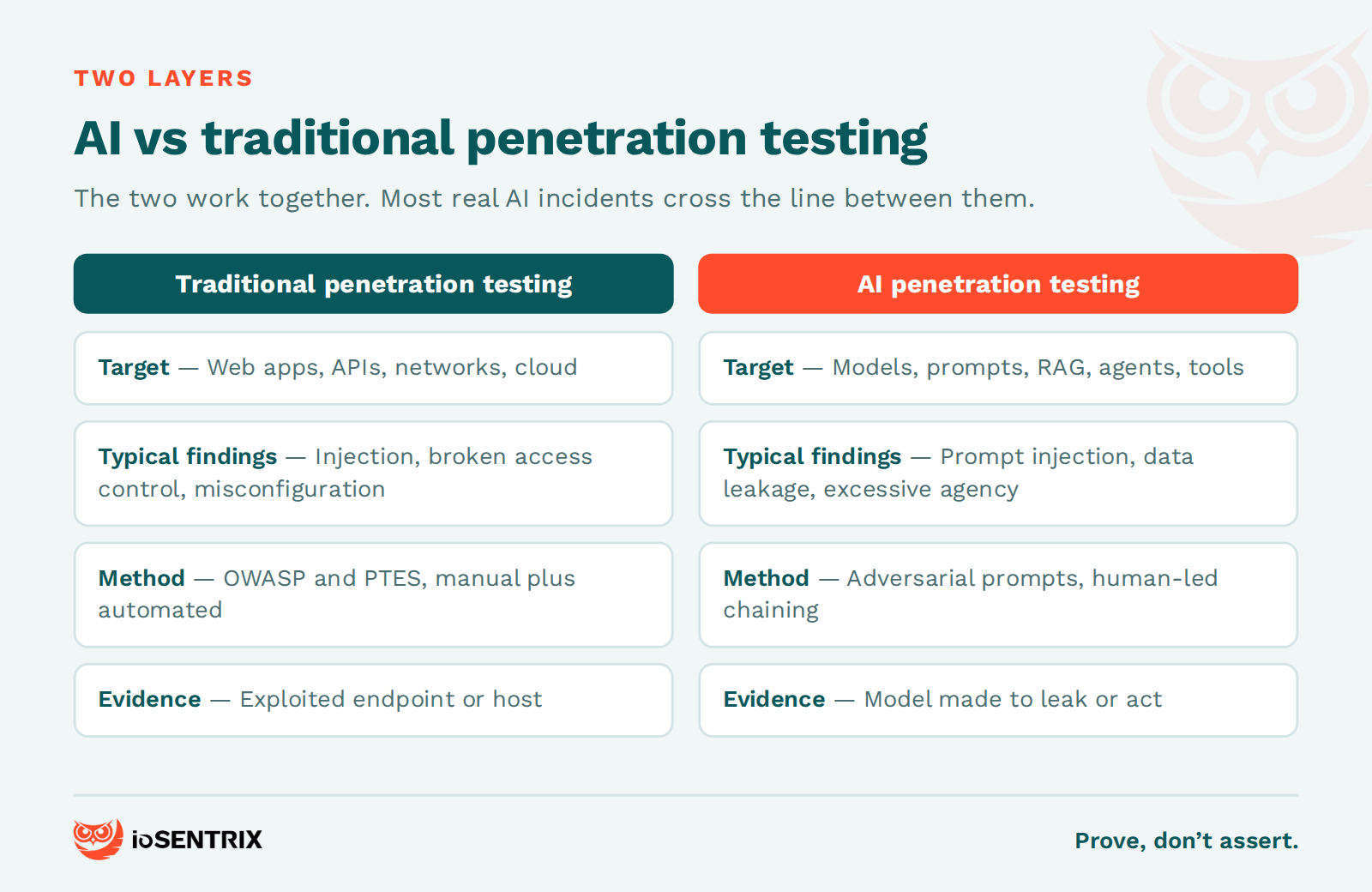
The two work best together. A traditional test might find an access-control flaw in an internal API. An AI assessment then checks whether a customer-facing assistant can be talked into exercising that flaw for the attacker. That chain, from prompt to tool call to data, is invisible to a test that stops at the model or at the API. If you are weighing a scoped assessment against an open-ended adversarial exercise, see AI red teaming vs AI penetration testing.
LLM penetration testing services test an LLM-powered application against the attacks that target language models and the systems wired to them, then prove which ones succeed. A serious engagement covers far more than a handful of malicious prompts sent to a chatbot. The scope follows how your system is built and what it can reach.
The OWASP Top 10 for LLM Applications (2025 edition) is the reference most buyers and vendors share, and it is a useful checklist for what an LLM pentest should cover: prompt injection, sensitive information disclosure, supply chain, data and model poisoning, improper output handling, excessive agency, system prompt leakage, vector and embedding weaknesses, misinformation, and unbounded consumption. We break down each category in our OWASP Top 10 for LLMs explainer.
In practice, that means test cases such as direct and indirect prompt injection through user input, documents, web pages, and tool results; jailbreaks that bypass policy controls; extraction of system prompts, secrets, and context data; AI data leakage across tenants, users, and sessions; output rendered or executed without validation; abuse of tools and function calls; privilege escalation through the agent; and denial of service or wallet through unbounded consumption. Each test should end with a documented result, not a screenshot of an odd response.
A vendor should not simply claim its assessment is "OWASP aligned." Ask how the list changes the testing. If excessive agency is in scope, does the vendor check whether the agent can reach tools it does not need, chain prompt manipulation into an unauthorized tool call, and prove the impact on a real system? Those details separate an LLM security assessment from a checklist.
Agents raise the stakes because the model can act, not just answer. Many agents now reach tools and data through the Model Context Protocol (MCP), an open standard for connecting AI applications to external systems. Every connected server is new attack surface: a poisoned tool description, an over-broad permission, or a tool result carrying injected instructions can turn an assistant into an attacker's proxy. An AI penetration test should inventory the agent's tools and MCP servers, test each permission boundary, and try to chain a prompt injection into a real action. If you cannot say what your agents can do, who they act as, and what they can reach, start with the four questions you can't answer about your AI agents.
Choose an AI penetration testing vendor by evaluating five things: proven AI and LLM security expertise, coverage of the full AI attack surface, a hybrid of automation and human-led testing, methodology mapped to recognized frameworks, and evidence-based reporting with retesting. Treat it as a security decision, not a procurement exercise. A provider can advertise AI security testing without the depth to assess modern LLM, RAG, or agentic systems.
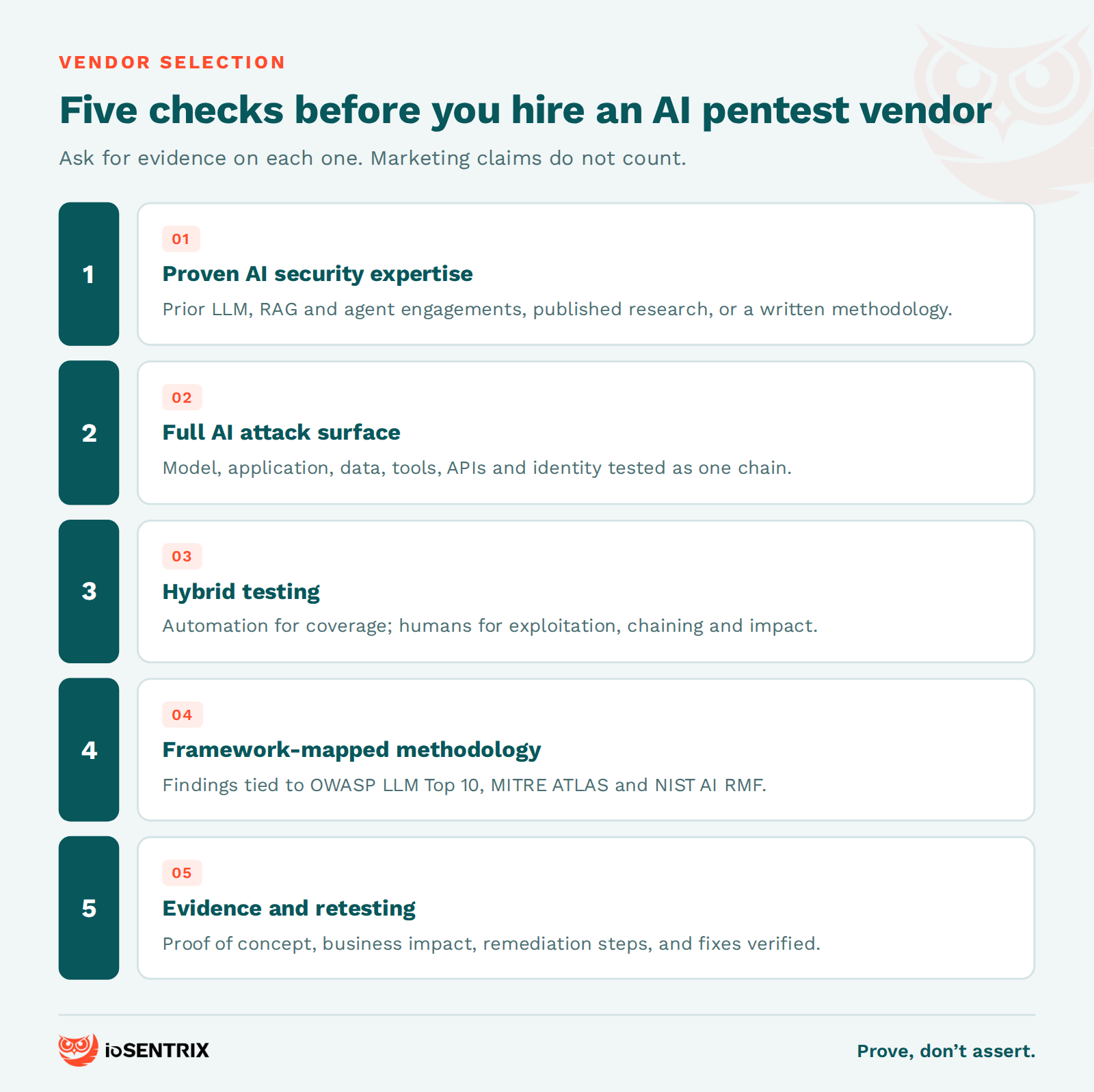
Experience in traditional penetration testing does not transfer automatically. AI attack paths require offensive security skill plus a working understanding of LLM behavior, ML pipelines, RAG, and agents. Ask the vendor how it would approach your environment rather than whether it "offers AI pentesting," and ask for prior AI engagements, published research, or a written methodology for systems like yours. The provider should be able to say what it tests, how it validates a finding, and how it rates business impact.
Testing only the LLM interface leaves most attack paths untouched. A modern AI application is a chain: user, application, model, retrieval and data, tools and APIs, enterprise systems. Each link can fail. Ask whether the vendor assesses the model alone or the complete application and its connections, including model APIs, identity and access, vector stores, plugins, cloud infrastructure, and training and fine-tuning data. The second approach gives a far more realistic picture of risk.
Automated AI vulnerability scanning runs large prompt sets, fuzzes inputs, and finds candidate weaknesses at scale. Human-led testing understands the architecture, builds attack scenarios, validates findings, and assesses impact. For most organizations the hybrid model is right: automation for coverage and rapid retesting, humans for exploitation, attack chaining, business logic, and false-positive reduction. Not every strange model response is a vulnerability. A tester decides whether the behavior can be exploited and what an attacker would gain.
A credible vendor can map its test plan and findings to OWASP, MITRE ATLAS, and the NIST AI RMF, covered in the next section. Framework names alone decide nothing. The question is how the framework shapes the engagement: which risks are tested, how findings are categorized, and whether the report carries the mapping.
A report is useful only if your team can act on it. Every finding should include reproduction steps, proof-of-concept evidence, affected systems and data, business impact, and specific remediation guidance. Retesting should be included so fixes are validated, not assumed. This is the same standard we argue for in Prove, Don't Assert: the question is never whether a policy or control exists, but whether it works under attack.
An AI penetration testing vendor should use recognized frameworks to define scope and classify findings, and open or commercial tools to generate and run attacks at scale, with human testers validating and chaining the results. The frameworks tell you what to test and how to talk about risk. The tools find leads. The tester proves impact.
A note on terms: "AI penetration testing tools" here means tools for testing AI systems. That is different from "AI tools for penetration testing," which use AI to speed up conventional pentesting. We cover the second topic in What Is AI-Driven Penetration Testing?.
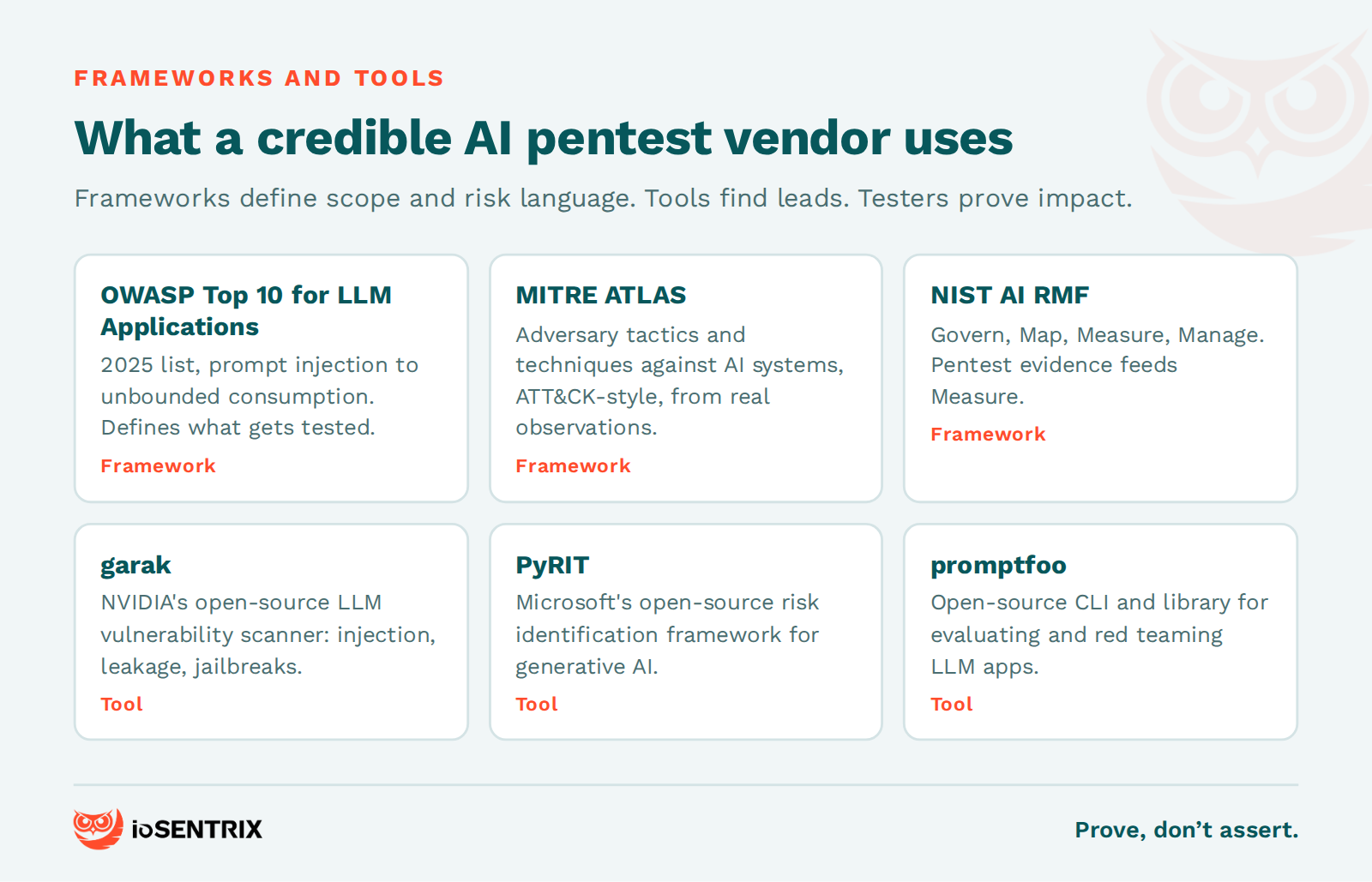
The OWASP Top 10 for LLM Applications (2025) defines the risk categories most LLM pentests are scoped against. MITRE ATLAS (Adversarial Threat Landscape for Artificial-Intelligence Systems) is a knowledge base of adversary tactics and techniques against AI-enabled systems, built in the style of ATT&CK and based on real-world attack observations and demonstrations from AI red teams. It is the reference for judging whether a vendor's attack scenarios reflect how adversaries operate. The NIST AI Risk Management Framework (AI RMF 1.0) organizes AI risk management into four functions, Govern, Map, Measure, and Manage, and NIST's Generative AI Profile (NIST AI 600-1) extends it to generative systems; a penetration test feeds the Measure function with technical evidence. ISO/IEC 42001, the AI management system standard, is a governance standard, not a testing methodology. Framework alignment is not compliance or certification, and a vendor that blurs the two should raise a flag.
Three open-source tools show up in most credible AI testing stacks. garak, maintained by NVIDIA, is an LLM vulnerability scanner that probes models for failures such as prompt injection, data leakage, jailbreaks, and toxic or hallucinated output. PyRIT, the Python Risk Identification Tool for generative AI from Microsoft, is an open-source framework for identifying risks in generative AI systems. promptfoo is a CLI and library for evaluating and red teaming LLM applications, including vulnerability scanning. Vendors also build custom harnesses for agent and tool-use testing and use standard web and API tooling for the conventional layer. Ask which tools the vendor runs, what they cover, and what the human testers do with the output. A vendor that hands you raw scanner results has not done a penetration test.
Yes. AI penetration testing is available through penetration testing as a service (PTaaS), which delivers testing on a subscription or credit basis through a platform with live findings, retesting, and integrations into your ticketing and CI/CD workflow. The fit is good because AI systems change faster than almost anything else in the stack. A new tool on an agent, a new document set in a RAG index, a model version bump, or an edited system prompt can each open a path that last quarter's test never saw. Continuous or recurring testing catches those changes; an annual test does not. When comparing providers, ask whether LLM, RAG, ML model, and API testing are included in the PTaaS plan or sold as a specialist add-on, and whether retests are on demand.
The cost of AI penetration testing services is driven by scope, architecture complexity, access model, testing depth, and cadence, not by a fixed price per model. Scope is the biggest driver: the number of applications, models, and environments in the engagement, and whether the conventional application and infrastructure layers are included. Architecture adds effort in proportion to what the system can reach; a read-only chatbot is a smaller job than an agent with a dozen tools, several MCP servers, and write access to business systems. The access model matters too: gray-box testing with documentation, source access, and test accounts is more efficient and finds more than blind testing. Testing depth ranges from automated scanning through human-led exploitation to open-ended red teaming, and each step up costs more and proves more. Retesting, framework-mapped reporting for auditors, and a continuous cadence all shape the total. A quote far below the others usually means automated scanning presented as a pentest. Our penetration testing cost guide explains how conventional engagements are priced, and the same logic applies here.
Before you sign, ask questions that reveal technical depth, methodology, scope flexibility, and deliverables. The answers should reflect your environment, not a fixed package.
On expertise:
On methodology:
On scope and deliverables:
Consider a composite example, not any one client. A financial-services team shortlists two vendors for an AI assistant that answers account questions and can open support tickets. The first quotes a "GenAI security scan" that runs a prompt library against the chat endpoint. The second scopes the assistant, its RAG index, the ticketing tool, and the identity layer, and plans to chain an indirect injection through a support document into an unauthorized ticket action. Only the second engagement would show that a customer could create tickets on another customer's account. The questions above are how you tell the two apart before the report arrives.
AI penetration testing is an authorized, adversarial assessment of an AI or machine learning system that attempts to exploit weaknesses in the model, the application around it, its data sources, and its integrations, then documents the results with evidence. It covers AI-specific attacks such as prompt injection, jailbreaks, data leakage, poisoning, and excessive agency, alongside conventional application and API flaws.
The top AI penetration testing providers are the ones that can demonstrate hands-on LLM, RAG, and agent testing experience, cover the full AI attack surface rather than the model alone, combine automation with human-led exploitation, map findings to OWASP, MITRE ATLAS, and the NIST AI RMF, and include retesting. Independent accreditation for the underlying penetration testing practice, such as CREST, is a useful filter. Rank vendors against those criteria and your architecture, not against a generic list.
AI-assisted penetration testing uses AI to speed up conventional penetration testing, for example by triaging scanner output, generating test cases, or summarizing findings. It is a delivery method, not a target. AI penetration testing, the subject of this guide, is testing performed against AI systems. Some vendors offer both, and it is worth confirming which one a quote describes.
No. Automated tools such as garak, PyRIT, and promptfoo are valuable for coverage, fuzzing, and rapid retesting, but they do not understand your business logic, your agent's real permissions, or the impact of a given behavior in your environment. They produce candidates. A human tester validates the candidates, chains them into real attack paths, and proves impact. A hybrid approach gives the strongest result.
Choose based on your objective. AI penetration testing is the right choice when you need a structured, scoped assessment that finds and validates exploitable vulnerabilities across a defined AI system. AI red teaming is an open-ended adversarial simulation that tests how the whole system, including people and processes, responds to realistic attack campaigns. Most organizations start with a penetration test and add red teaming once the basics hold.
ioSENTRIX is a CREST-accredited penetration testing firm, ISO/IEC 27001 certified and SOC 2 Type 2 attested. Our AI and ML penetration testing service covers LLM applications, RAG pipelines, AI agents and their tools, model APIs, and the data pipelines, training processes, and deployment environments behind them. Testing combines human-led attack chaining with automation for coverage, every finding ships with proof-of-concept evidence and remediation guidance, and retesting is included. AI testing is also built into our PTaaS plans for teams that need continuous coverage. The goal is not a list of controls that exist; it is proof of which ones hold.
If you want to know what an attacker could make your AI assistant do, talk to us about scoping an AI penetration test.