September 24, 2026
The Reflected XSS Methodology: 11 Labs Behind $5,000+ in Bounties and 80+ Pentests
The Reflected XSS Methodology: 11 Labs Behind $5,000+ in Bounties and 80+ Pentests

Salman Khan


Omair Manzoor is the Founder, CEO, and Chief Hacker of ioSENTRIX, a CREST-accredited cybersecurity firm. With 14+ years in offensive security, he has led penetration tests for Fortune 500 companies including engagements for Amazon, Bank of America, VISA, and the London Underground. His exploits are part of the Metasploit Framework and Immunity Canvas. Omair is a published researcher, conference keynote speaker (DOD, CISA, BSides), and technical reviewer for academic security textbooks.
Cybersecurity teams can spend weeks preparing for an annual penetration test. Scope is defined, systems are reviewed, testers are engaged, and vulnerabilities are documented in a detailed report.
But there is a problem with this model: the environment does not stop changing after the report is delivered.
Applications receive new releases. Cloud resources are deployed. Authentication controls change. Third-party integrations are introduced. Each change can create new paths for attackers.
An annual penetration test still provides valuable security insight. It can uncover exploitable vulnerabilities and provide a deep assessment of a defined environment. The challenge is that it offers a point-in-time view of security. A system tested in January may have a very different attack surface by December.
This is where continuous penetration testing becomes important. Instead of treating penetration testing as a once-a-year event, organizations can make security validation a recurring process that follows changes in their environment.
The question for security leaders is no longer simply whether they perform penetration testing. It is whether testing once a year provides enough visibility into an environment that changes every week or even every day.
Continuous penetration testing is an approach to security testing in which organizations perform recurring penetration tests and security validation throughout the year rather than relying only on a single annual assessment.
It extends traditional penetration testing beyond one scheduled engagement. Testing can be aligned with meaningful changes in the environment, such as:
The objective is not to conduct a full penetration test against every system every day. That would be inefficient and unnecessary for most organizations. Instead, continuous penetration testing creates a repeatable cycle of testing, remediation, validation, and retesting.
For example, an organization may conduct a comprehensive penetration test to establish a baseline. It can then perform targeted testing when major features are released, new APIs are introduced, or critical vulnerabilities are discovered. After remediation, testers can validate that the issue has actually been resolved.
This model is increasingly associated with Penetration Testing as a Service (PTaaS). PTaaS provides a more flexible way to schedule recurring and on-demand testing, track findings, collaborate with testers, and manage retesting.
ioSENTRIX, for example, offers subscription-based PTaaS for recurring testing as well as credit-based testing for organizations that need more flexibility.
The important distinction is that continuous penetration testing is a security testing strategy, not simply a software product. Automation can help with speed and scale, but human testers remain important for identifying business logic flaws, and determining whether weaknesses can lead to meaningful business impact.
Annual penetration testing is not inherently ineffective. The problem is what happens between assessments.
Modern technology environments can change significantly within a few months. If security testing follows a fixed annual schedule while the attack surface changes continuously, gaps can develop between what has been tested and what actually exists.
A modern organization's attack surface can include web applications, APIs, mobile applications, cloud infrastructure, internal networks, external services, SaaS platforms, and third-party integrations.
New assets can appear between two penetration tests. A development team may launch a new API. A cloud team may expose a new service. A business may integrate a third-party platform.
A mobile application may introduce a new authentication flow. Infrastructure teams may change firewall rules or network architecture. These changes can introduce security weaknesses that were not present during the previous test.
This creates a simple timing problem:
The security report may describe the environment that existed months ago, while attackers are targeting the environment that exists today.
Continuous security testing helps reduce this gap by bringing testing closer to the pace of change.
A clean penetration test does not guarantee that an application will remain secure throughout the year. New releases can introduce vulnerabilities. Developers can change authentication or authorization logic.
A new feature can create an unexpected interaction with an existing function. Business logic is particularly difficult to protect through a one-time assessment because vulnerabilities can depend on how multiple functions interact.
For example, an application may have strong authentication and secure individual endpoints. A later feature could introduce a workflow that allows a legitimate user to manipulate an object belonging to another account. The issue may not exist when the original test is performed.
This is why penetration testing should be viewed as a recurring security validation activity rather than a certificate that an application is permanently secure.
Finding a vulnerability is only one part of the process. Organizations also need to confirm that remediation worked as intended. A proper remediation cycle should answer several questions:
Retesting provides this validation.
Without retesting, security teams may close a vulnerability based on a developer's remediation note without confirming that the underlying security risk has actually been removed.
An annual penetration testing report is a useful snapshot. It documents what testers found within a defined scope and timeframe.
But a snapshot has a limitation: it becomes less representative as the environment changes. This does not make the report useless. It simply means that organizations should avoid treating it as a permanent statement of security.
An annual pentest tells you what was exploitable then. Continuous testing asks what remains exploitable as the environment changes. That distinction is at the heart of the move toward continuous penetration testing.
The difference is not that one approach is “secure” and the other is “insecure.” The difference is how frequently security teams validate their environment and how closely testing follows operational change.
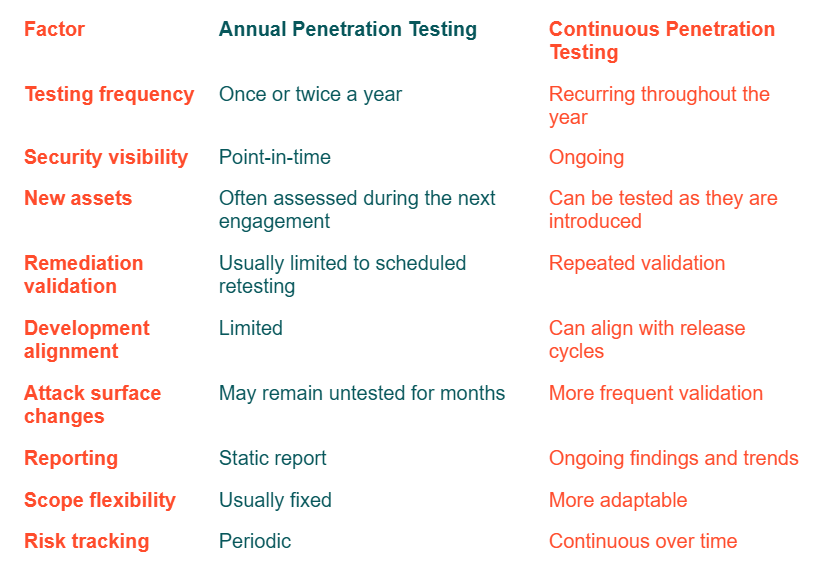
Annual penetration testing still has an important role. Some organizations need a comprehensive periodic assessment for governance, customer assurance, insurance, or compliance purposes.
Certain frameworks and requirements also specify periodic or event-driven testing. For example, PCI DSS includes penetration testing requirements around defined intervals and significant changes to the cardholder data environment.
The weakness appears when an organization treats that annual assessment as its only offensive security validation. Continuous penetration testing fills the gaps between major assessments.
It allows security teams to validate changes, prioritize new risks, and retest fixes without waiting for the next annual engagement.
ioSENTRIX's current PTaaS model reflects this distinction by offering recurring testing, on-demand assessments, retesting, flexible scope, and ongoing risk tracking rather than relying exclusively on an annual or biannual assessment.
A strong continuous penetration testing program is not simply a collection of repeated scans. It is a lifecycle that connects security testing with changes, remediation, and risk management.
The process typically begins with a comprehensive assessment. Security teams define the scope and identify critical applications, APIs, networks, cloud environments, infrastructure, and other assets that need protection.
Testers then assess the environment using appropriate manual and automated techniques. The results establish a baseline of known vulnerabilities, exploitable weaknesses, and potential attack paths.
This baseline gives the organization a starting point for measuring improvement.
The next step is understanding what changes after the initial assessment. Testing priorities may need to change when an organization:
Not every change requires a complete penetration test. The goal is to identify changes that create meaningful security risks and test them accordingly.
Continuous penetration testing can combine several testing methods. These may include automated discovery, manual penetration testing, authenticated testing, API security testing, business logic testing, and targeted assessments based on emerging risks.
Automation is valuable because it can increase testing speed and coverage. But automated tools do not understand every business process or attack path.

Human penetration testers can investigate how multiple weaknesses interact. They can test authorization boundaries, manipulate business workflows, and determine whether apparently separate issues can be combined into a meaningful attack.
ioSENTRIX similarly describes its PTaaS approach as combining manual expertise with automated tools and placing particular emphasis on business logic vulnerabilities that traditional automated approaches can miss.
Not every finding represents the same level of risk. A continuous testing program should prioritize vulnerabilities based on factors such as:
A medium-severity issue on a low-value internal system may deserve less immediate attention than a similar issue affecting an internet-facing application that handles sensitive customer data.
Risk-based prioritization helps security and development teams focus their limited resources where they can reduce the most risk.
Once a vulnerability is remediated, the security team should validate the fix. Retesting can confirm whether:
This closes the loop between finding a vulnerability and reducing actual risk.
The final step is measuring security trends rather than looking at each penetration test as an isolated event. Security leaders can track:
Instead of asking, “How many vulnerabilities did our last pentest find?” leaders can ask, “Is our exploitable risk decreasing over time?”
There is no universal testing frequency that works for every organization. A better approach is to use risk-based testing triggers.
Major application releases can introduce new functionality and new attack paths. Testing before production deployment can help identify security issues before they become part of the live environment.
Cloud migrations, network changes, new services, and major configuration changes can alter the attack surface. These events may justify targeted penetration testing.
Critical vulnerabilities should be retested after remediation. The purpose is to verify that the issue is actually fixed rather than simply marked as resolved.
Security teams should also consider testing when new attack techniques or vulnerabilities affect technologies in their environment.This is particularly important for internet-facing systems and high-value applications.
Organizations that release software frequently may need more frequent testing than organizations with relatively stable environments.
A company deploying multiple application changes every week should not necessarily wait until its annual security assessment to validate those changes.
Continuous penetration testing can supplement compliance-driven assessments, but organizations should not assume that a continuous model automatically replaces every specific regulatory or contractual requirement.
For example, PCI DSS includes defined penetration-testing expectations, including testing after significant changes. Organizations should map their continuous testing program to the exact requirements that apply to their environment.
Not necessarily.
Continuous penetration testing is better viewed as an extension of traditional penetration testing rather than an automatic replacement.
Annual or comprehensive penetration tests can still provide value. They allow organizations to conduct deep assessments across a defined scope and may help satisfy specific compliance, contractual, or governance requirements.
Continuous testing addresses what happens between those assessments. A mature security program may combine:
Each serves a different purpose:
A continuous penetration testing program needs more than frequent scans. It needs skilled testers, flexible testing options, and a process for validating remediation.
ioSENTRIX combines manual penetration testing with automated tools to provide recurring security validation across applications, APIs, networks, mobile environments, and other critical systems.
Its PTaaS offering supports both recurring and on-demand testing models, allowing organizations to adapt testing to their changing security priorities. The approach also places emphasis on business logic vulnerabilities, which can be difficult for automated tools to identify.
For organizations with modern development environments, this model can help connect penetration testing with release cycles and ongoing security operations.
Don't wait for the next annual pentest to discover what has changed. Build a penetration testing program that validates security as your attack surface evolves.
Continuous penetration testing is a recurring approach to penetration testing that validates security throughout the year instead of relying only on a single annual assessment. Testing can be aligned with application releases, infrastructure changes, new APIs, emerging threats, and remediation cycles. It combines recurring security testing with human-led validation, remediation, and retesting.
Annual penetration testing provides a point-in-time assessment of a defined environment. Continuous penetration testing provides recurring security validation as that environment changes. It can help organizations test new assets, validate fixes, and maintain better visibility into security risk between major assessments.
No. Vulnerability scanning primarily uses automated tools to identify potential weaknesses such as known vulnerabilities, missing patches, and configuration issues. Penetration testing attempts to validate whether weaknesses can actually be exploited and may investigate business logic, authorization, authentication, and chained attack paths.
There is no single frequency that fits every organization. Testing should consider the organization's attack surface, release frequency, risk level, compliance requirements, and rate of infrastructure change. High-risk environments or organizations with frequent releases may benefit from more frequent targeted testing.
It can be, particularly when a small business operates internet-facing applications, handles sensitive data, releases software frequently, or has compliance requirements. However, the testing model should be proportionate to the organization's risk and attack surface. A smaller organization may benefit from targeted recurring testing rather than attempting to test every system continuously.