September 24, 2026
The Reflected XSS Methodology: 11 Labs Behind $5,000+ in Bounties and 80+ Pentests
The Reflected XSS Methodology: 11 Labs Behind $5,000+ in Bounties and 80+ Pentests

Salman Khan


Fiza Nadeem is an SEO content writer at ioSENTRIX with 2.5+ years of experience in content writing, copywriting, and SEO.
Cloud penetration testing is a controlled, authorized attack on your AWS, Azure or Google Cloud environment that proves which misconfigurations, identity flaws and exposed services an attacker could use, and how far they could get. It covers the parts of the cloud you are responsible for: identities, network paths, storage, compute, serverless functions and the applications you deploy. Cloud penetration testing services differ from a scan or a posture report because a tester chains findings into a working attack path and shows the impact with evidence.
This guide covers what cloud penetration testing is, how the methodology works, which tools testers use, what AWS, Azure and GCP allow, and what a good cloud penetration testing service should include.
Cloud penetration testing is the authorized simulation of real attacks against the customer-controlled layer of a public cloud environment, including IAM, network configuration, storage, compute, serverless and cloud-hosted applications, to find and exploit weaknesses before an adversary does. The test targets your configuration and your workloads, not the provider's underlying infrastructure, which the provider secures and which you are not permitted to attack.
That boundary comes from the shared responsibility model. AWS describes its part as "security of the cloud" and the customer's part as "security in the cloud," and Azure and Google Cloud draw the same line. Everything on your side of it is fair game: the IAM roles you created, the security groups you opened, the buckets you made public, the function with an over-broad execution role. Our explainer on the shared responsibility model in the cloud covers where the line sits for IaaS, PaaS and SaaS.
Cloud penetration testing is different because identity, not the network, is the perimeter. In a traditional network test, the attacker lands on a subnet and moves laterally between hosts. In the cloud, the attacker steals or abuses a credential and moves between services through the provider's control plane, often without touching a single virtual machine.
That changes what a tester looks for. Privilege escalation through IAM policy combinations, cross-account role trust, exposed instance metadata endpoints, secrets in environment variables and CI pipelines, and over-privileged non-human identities matter more than an unpatched daemon on a server. The MITRE ATT&CK Cloud Matrix maps adversary techniques across IaaS, SaaS, identity providers and office suites, and it reads very differently from the network matrix. We covered why machine identities are the fastest-growing part of this problem in Non-Human Identity Is Eating Your Attack Surface.
A cloud penetration testing methodology follows the same arc as any penetration test, from scoping through reporting, but every phase is adapted to the control plane. The phases below map to the seven sections of the Penetration Testing Execution Standard (PTES): pre-engagement, intelligence gathering, threat modeling, vulnerability analysis, exploitation, post-exploitation and reporting. If you want the generic version first, see our guide to the stages of penetration testing.
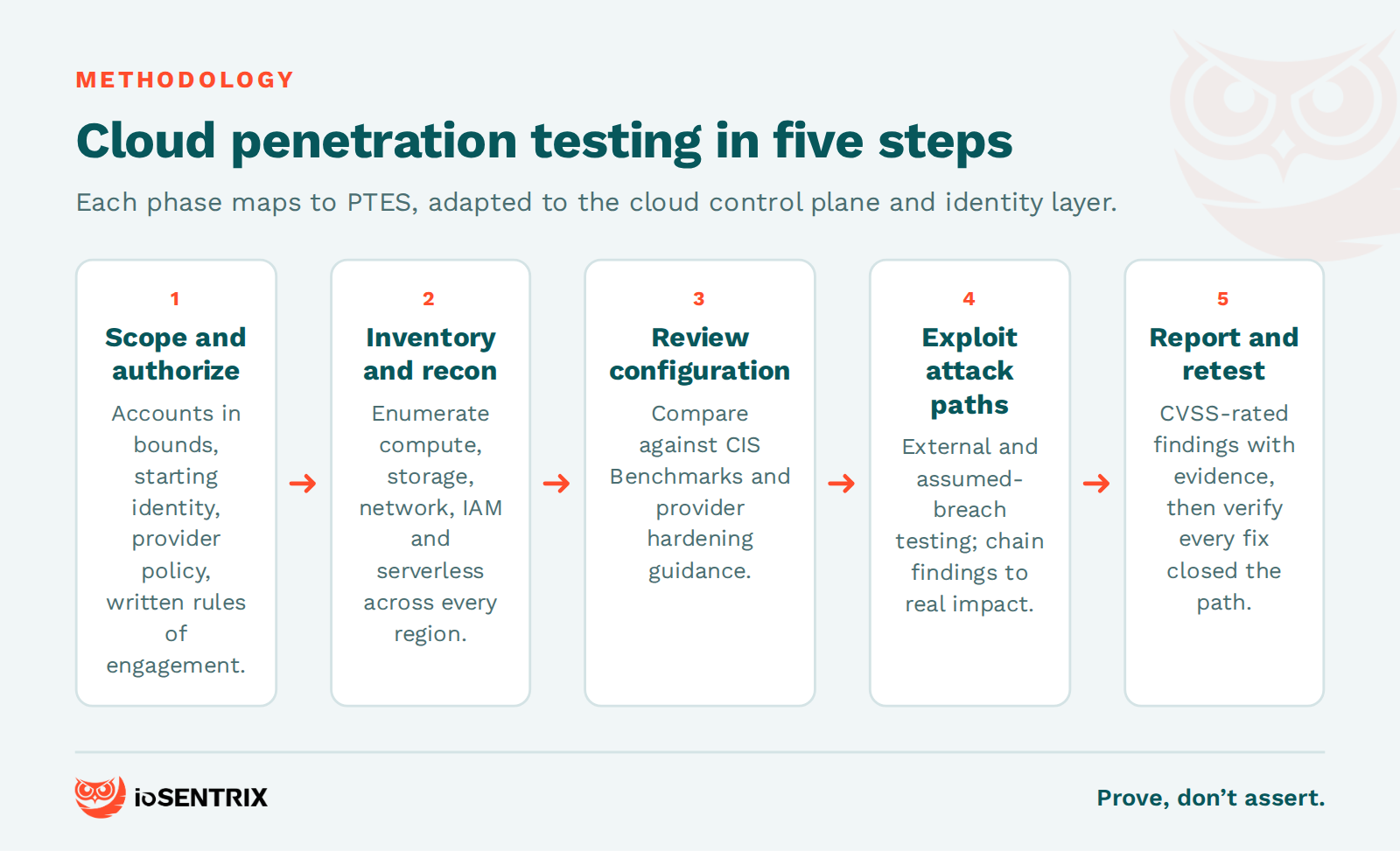
The test starts with a written scope: which accounts, subscriptions or projects are in bounds, which identities the tester starts with, and whether the test is black box (no credentials), gray box (a low-privilege user) or white box (read access to configuration). The scope must also respect the provider's testing policy, covered below. Our guide to rules of engagement in penetration testing covers what the document should contain.
The tester builds an inventory of compute, storage, network, identity and serverless resources across every region and account in scope, using provider APIs and open-source enumeration tools. Externally, that means public buckets, exposed endpoints, forgotten DNS records and leaked keys in public repositories. Internally, it means roles, policies, trust relationships and service accounts. A structured cloud security assessment is a good precursor and tells you where the test should spend its time.
The tester compares the environment against the CIS Benchmarks for AWS, Azure and Google Cloud and the provider's own hardening guidance. This produces a list of misconfigurations: public storage, permissive security groups, disabled logging, missing MFA on privileged accounts, unencrypted volumes. On its own this is a posture assessment. What makes it a penetration test is what comes next.
Cloud external penetration testing attacks the environment from the internet with no starting credentials. The tester probes exposed load balancers, API gateways, storage endpoints, management interfaces and web applications for a way in, then tries to turn any foothold into cloud credentials, for example by reaching an instance metadata service through a server-side request forgery flaw. Our comparison of internal vs external network penetration testing explains how the two views complement each other.
Cloud internal penetration testing starts from an assumed compromise: a leaked developer key, a phished user, a compromised CI runner or a low-privilege role. The tester then tries to escalate privileges, move between accounts, read data they should not reach and persist. This is where most high-impact cloud findings come from, because it tests the blast radius of the credential theft that real incidents usually begin with.
Every finding is validated by exploitation where it is safe to do so, and chained into an attack path that shows business impact rather than a list of isolated issues. The report rates each finding with CVSS, gives reproduction steps and evidence, and maps fixes to the responsible team. After remediation, the tester retests to confirm each fix closed the path. A finding that is "fixed" but still exploitable is not fixed.
Cloud application security testing and cloud infrastructure penetration testing are two halves of one engagement, and most environments need both. Cloud application security testing targets the software you deploy in the cloud: web apps, APIs, containers and serverless functions. Cloud infrastructure penetration testing targets the platform underneath: IAM, networking, storage, compute and the control plane itself.
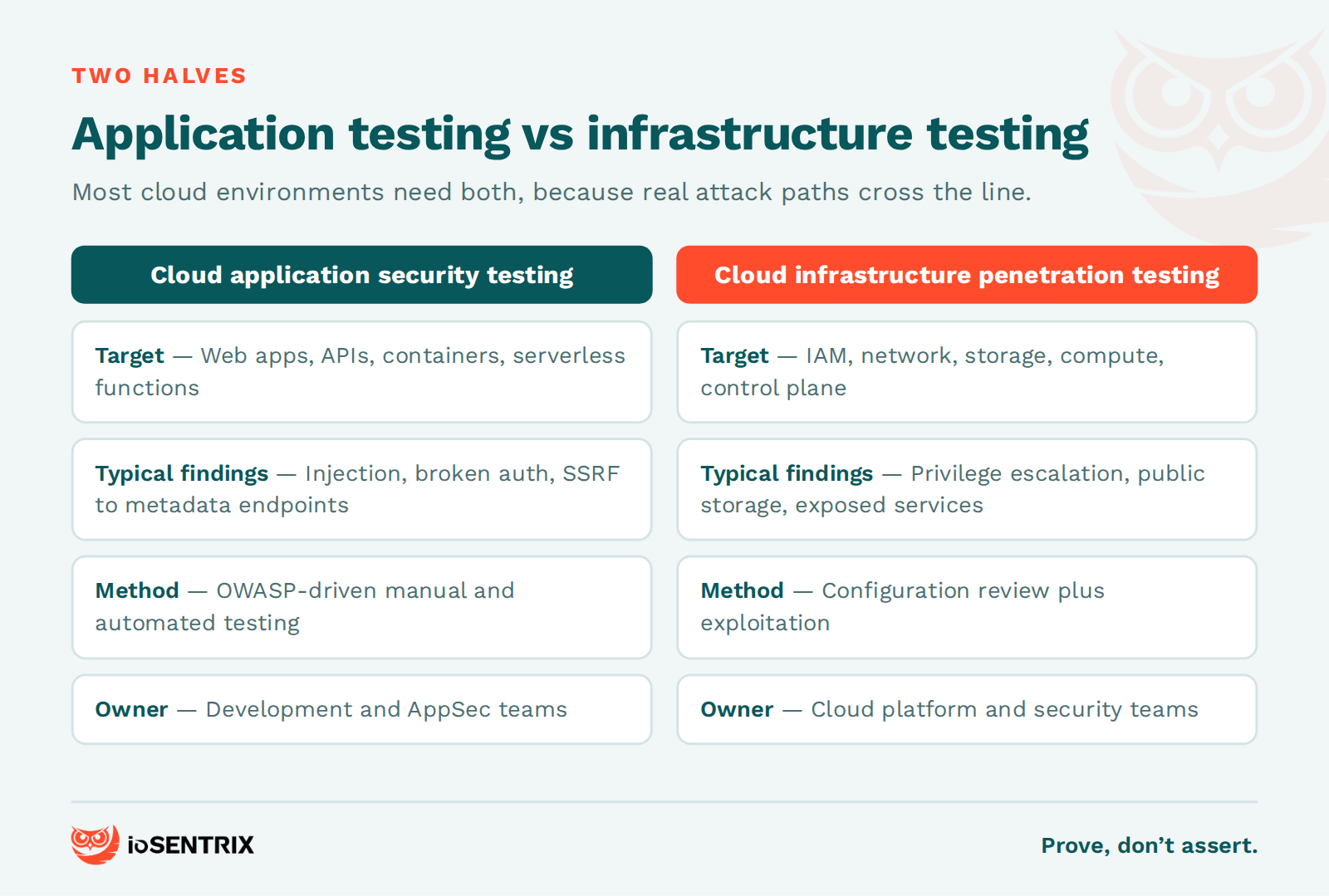
The two overlap at exactly the point attackers care about. An injection flaw in a cloud-hosted app is an application finding. Using that flaw to reach the instance metadata endpoint, steal a role credential and list every bucket in the account is an infrastructure finding. A test that covers only one side misses the chain. Our web application penetration testing guide covers the application side in depth.
Cloud penetration testing tools fall into three groups: open-source enumeration and exploitation frameworks, provider-native posture and vulnerability services, and the manual work that connects them. Tools produce leads; a tester validates them.
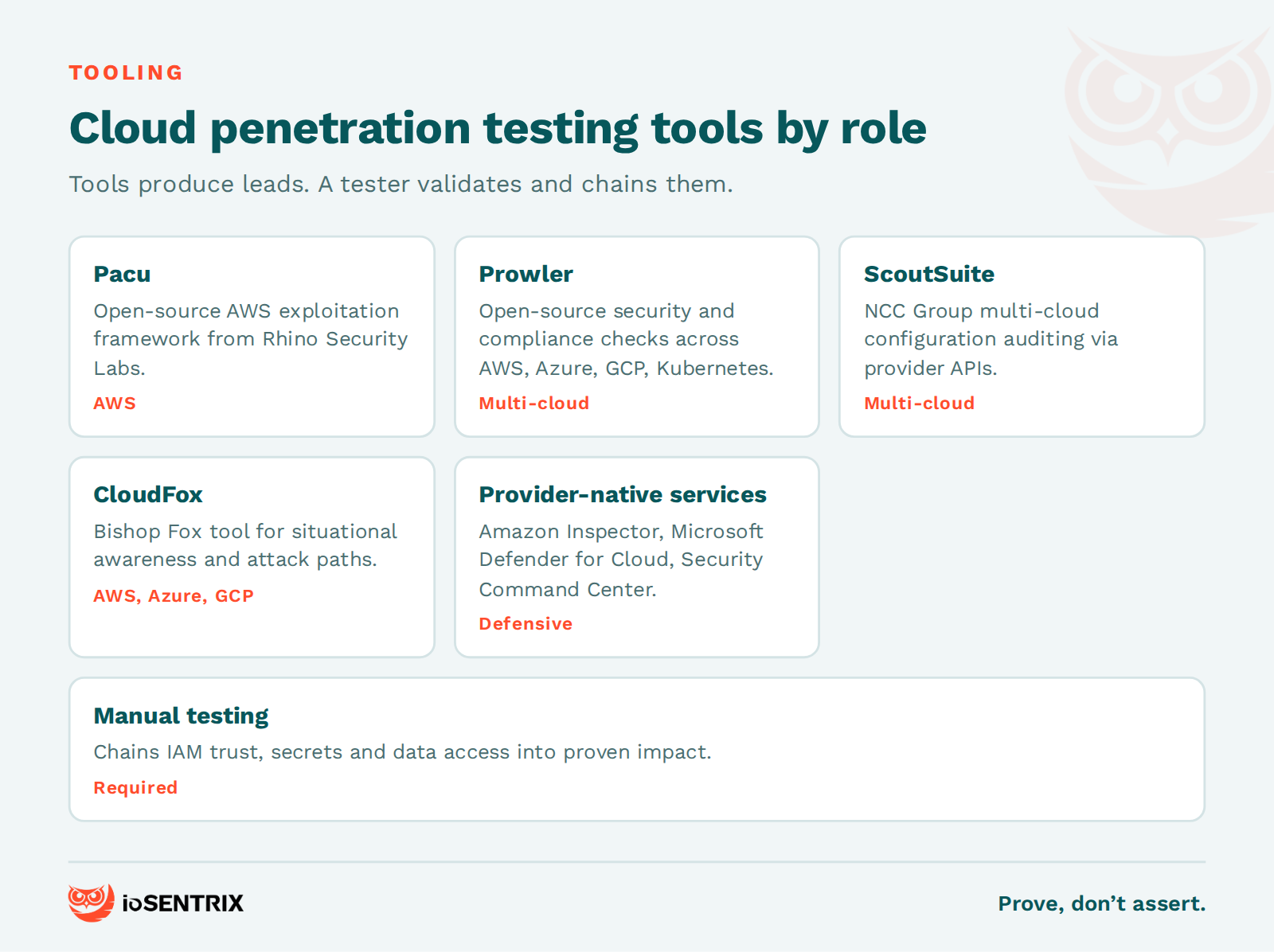
Pacu, maintained by Rhino Security Labs, is an open-source AWS exploitation framework with modules for privilege escalation and persistence. Prowler is an open-source cloud security platform that runs security and compliance checks across AWS, Azure, GCP, Kubernetes and other providers. ScoutSuite, from NCC Group, is a multi-cloud auditing tool that pulls configuration through provider APIs and highlights risk across AWS, Azure and Google Cloud. CloudFox, from Bishop Fox, helps a tester gain situational awareness in an unfamiliar AWS, Azure or GCP environment and find exploitable attack paths.
On the provider side, Amazon Inspector scans EC2 instances, container images and Lambda functions for software vulnerabilities and unintended network exposure. Microsoft Defender for Cloud, formerly Azure Security Center, includes cloud security posture management for Azure and multicloud resources. Google Cloud's Security Command Center provides posture management and threat detection for Google Cloud projects. These are useful sources of leads, but they are defensive posture services, not attack tools.
Free tools are a good starting point and a poor stopping point. They do not chain a weak IAM trust policy to a readable secret to a production database, which is where the real risk sits.
Yes. All three major providers allow customers to run penetration tests against their own cloud resources without prior approval for most test types, with limits on what can be attacked and how. The rules differ, and a tester must read the current policy before the first packet.
AWS permits customer testing against a published list of services, including EC2, RDS, Lambda, API Gateway and CloudFront, without prior approval. Denial-of-service testing, DNS hijacking through Route 53, and S3 bucket or subdomain takeovers are prohibited, and simulated events such as red team exercises, phishing and malware testing require a form submitted at least two weeks ahead. Customers may not assess AWS infrastructure or the AWS services themselves. See the AWS customer penetration testing policy.
Microsoft's penetration testing rules of engagement allow fuzzing, port scanning and vulnerability assessment against your own Azure resources and permit test tenants for cross-tenant isolation testing. They prohibit denial-of-service testing, accessing data that is not yours, and post-exploitation actions such as lateral movement or dumping secrets.
Google Cloud states that customers planning to evaluate the security of their own Cloud Platform infrastructure with penetration testing are not required to contact Google, provided they follow the Acceptable Use Policy and Terms of Service and their tests affect only their own projects. That statement is in the Google Cloud security FAQ.
Provider permission does not replace your own written authorization. And if workloads sit on a smaller provider or a SaaS platform, check that policy separately; many prohibit testing entirely.
Cloud penetration testing services should include scoping against your actual architecture, both external and assumed-breach testing, application and infrastructure coverage, manual exploitation with evidence, a report your engineers can act on, and a retest. If a proposal describes only an automated scan with a benchmark report, it is a posture assessment, and it should be priced like one.
Ask a provider which starting positions they test from and why, how they handle the credentials you give them and the data they reach, whether findings come with attack paths and reproduction steps or with a CVSS number and a paragraph, and whether the retest is included. Our guide to vulnerability assessment vs penetration testing is a useful filter for proposals that blur the two, and penetration testing cost and pricing explains what drives the price.
Yes. Cloud penetration testing is an established discipline with its own tooling, provider policies and methodology guidance. The Cloud Security Alliance publishes a Cloud Penetration Testing Playbook, MITRE maintains a Cloud Matrix in ATT&CK, and AWS, Microsoft and Google each publish rules for customers who test their own environments. Attacking the provider's shared infrastructure is not part of it.
The Penetration Testing Execution Standard defines seven phases: pre-engagement interactions, intelligence gathering, threat modeling, vulnerability analysis, exploitation, post-exploitation and reporting. A cloud penetration test follows the same seven phases, with the cloud control plane, identities and provider policies shaping how each one is carried out.
A cloud security assessment reviews configuration, policies and controls against a framework and reports gaps. A cloud penetration test attempts to exploit those gaps to show what an attacker could actually do. The assessment tells you what is misconfigured; the penetration test tells you what it costs you. Run the assessment first and use it to focus the test.
At least annually, and after any significant architecture change, new account or region, major IAM redesign or migration. PCI DSS, for example, requires internal and external penetration testing at least once every 12 months and after significant infrastructure or application changes. Because cloud environments change continuously, many teams pair an annual deep test with continuous or quarterly targeted testing.
Penetration testing is legal when it is authorized in writing by the owner of the systems being tested and stays inside that authorization. Testing systems you do not own or have no permission to test is unauthorized access, whatever the intent. In the cloud, that means written authorization from the account owner plus compliance with the provider's testing policy.
ioSENTRIX is a CREST-accredited penetration testing firm, ISO/IEC 27001 certified and SOC 2 Type 2 attested. Our cloud security and penetration testing services cover AWS, Azure and Google Cloud from both the external and assumed-breach positions, test applications and infrastructure as one attack surface, and deliver findings as attack paths with evidence and reproduction steps. We retest every fix. The goal is not a list of what exists in your environment; it is proof of what holds.
If you want to know what an attacker could do with one leaked key in your cloud account, talk to us about scoping a cloud penetration test.