June 28, 2026
AI Penetration Testing Services: How to Choose an AI and LLM Pentest Vendor in 2026
AI Penetration Testing Services: How to Choose an AI and LLM Pentest Vendor in 2026

Omair


Omair Manzoor is the Founder, CEO, and Chief Hacker of ioSENTRIX, a CREST-accredited cybersecurity firm. With 14+ years in offensive security, he has led penetration tests for Fortune 500 companies including engagements for Amazon, Bank of America, VISA, and the London Underground. His exploits are part of the Metasploit Framework and Immunity Canvas. Omair is a published researcher, conference keynote speaker (DOD, CISA, BSides), and technical reviewer for academic security textbooks.
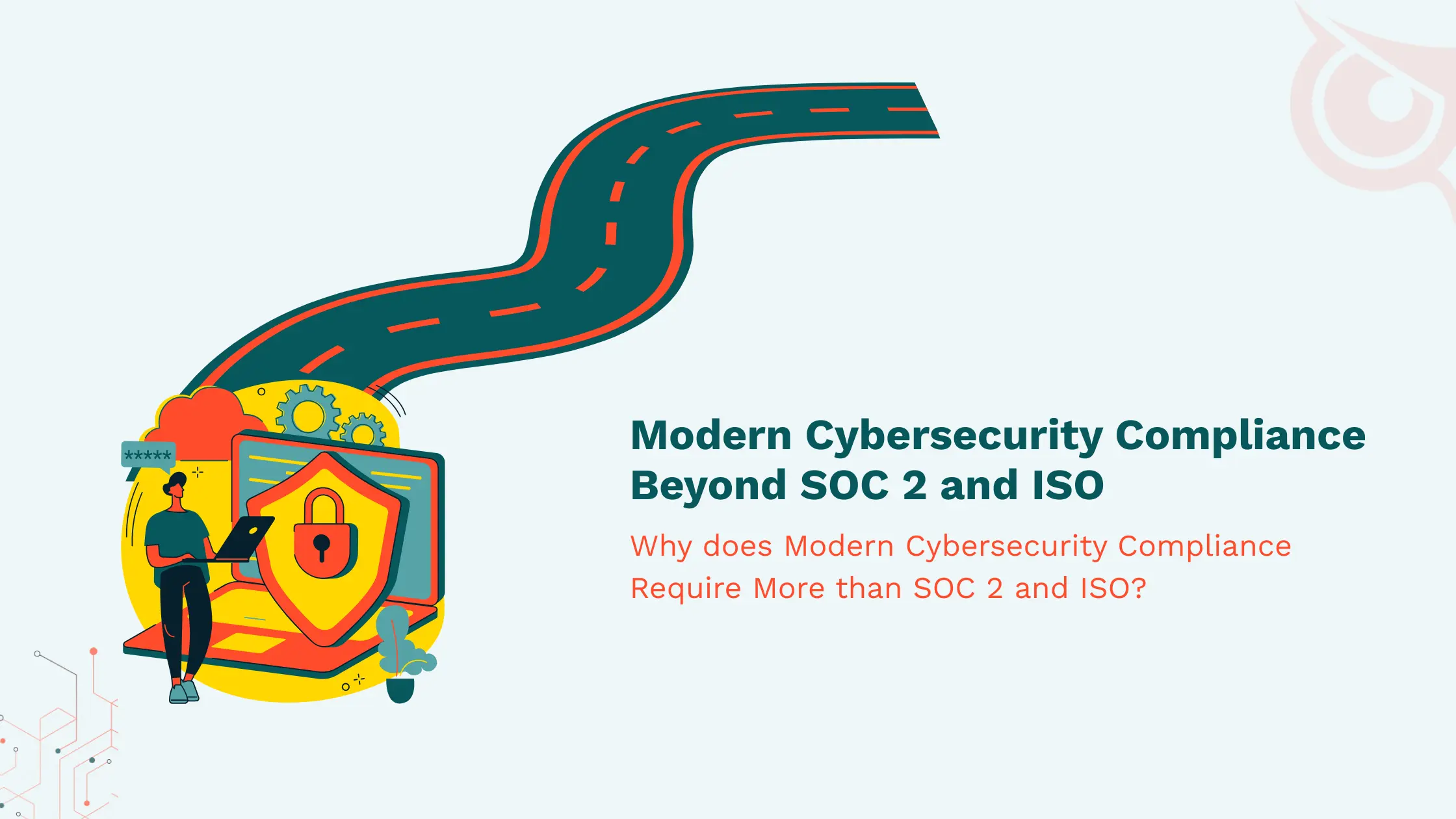
Modern cybersecurity compliance requires continuous validation, real-time risk visibility, and operational assurance beyond static certifications like SOC 2 and ISO. Traditional frameworks confirm point-in-time controls but fail to reflect evolving threat landscapes.
Organizations face expanding attack surfaces across cloud workloads, APIs, AI models, and third-party integrations. Compliance must demonstrate ongoing security effectiveness, not historical readiness.
According to IBM’s 2024 Cost of a Data Breach Report, breaches involving compliance failures cost organizations an average of USD 5.05 million. Trust now depends on continuous security outcomes.
Learn how continuous monitoring strengthens compliance posture through Continuous Security Monitoring with PTaaS.
SOC 2 and ISO frameworks validate governance and documentation but lack continuous threat detection and attack simulation capabilities. They emphasize policies, not adversarial behavior.
SOC 2 focuses on Trust Services Criteria such as availability and confidentiality. ISO 27001 emphasizes Information Security Management Systems.
Neither framework requires active exploitation testing or live telemetry. This gap leaves unknown vulnerabilities unvalidated between audit cycles.
NIST research confirms that static controls degrade within 90 days due to configuration drift and software changes. Security assurance must adapt continuously.
Cybersecurity compliance has evolved toward continuous assurance aligned with attacker tactics, techniques, and procedures.Threat actors now exploit automation, AI, and supply chain dependencies.
Modern environments include SaaS platforms like Salesforce and ServiceNow, container orchestration systems like Kubernetes, and AI pipelines using LLMs. Static compliance cannot validate these dynamic components.
MITRE ATT&CK mapping is increasingly integrated into compliance programs. This shift enables measurable security effectiveness.
Trust requires evidence that security controls work under real-world attack conditions. Certifications alone no longer satisfy customers, regulators, or boards.
According to Gartner, 60% of organizations will require continuous control validation by 2027. Buyers demand demonstrable security performance.
Continuous validation identifies misconfigurations, exposed APIs, and authentication weaknesses before exploitation. This approach transforms compliance into risk reduction.
Modern compliance emphasizes continuous validation, while traditional compliance focuses on periodic documentation reviews.

Penetration Testing as a Service enables continuous, evidence-based compliance through recurring adversarial testing. PTaaS replaces annual assessments with ongoing validation.
PTaaS platforms test applications, cloud infrastructure, and APIs throughout development cycles. Findings are prioritized by exploitability and business impact.
For compliance teams, PTaaS produces audit-ready artifacts aligned with SOC 2, ISO 27001, and GDPR. This ensures defensible security posture.
Understand PTaaS integration workflows in How to Integrate PTaaS into DevSecOps.
AI systems introduce non-deterministic risks that traditional compliance frameworks do not address. These risks include prompt injection, data poisoning, and model inversion.
AI supply chains rely on datasets, open-source models, and third-party APIs. Each dependency expands compliance scope.
According to Stanford HAI, over 55% of enterprise AI failures stem from governance and security gaps. Compliance must extend into model behavior validation.
Read more about AI risk exposure in Securing the AI Supply Chain.
AI-enhanced security testing improves compliance accuracy by simulating adaptive attacker behavior. Traditional testing cannot match evolving exploit strategies.
Machine learning-driven PTaaS identifies patterns across thousands of attack paths. This improves detection of chained vulnerabilities.
Organizations gain continuous insight into exposure trends across releases. Compliance reporting becomes data-driven and predictive.
You may enjoy reading: AI-Enhanced PTaaS vs Traditional Penetration Testing.
LLM compliance requires governance across training data, inference pipelines, and output validation. ISO and SOC controls do not natively cover these vectors.
Risks include data leakage, unauthorized fine-tuning, and adversarial prompt exploitation. Each risk impacts regulatory obligations.
OWASP Top 10 for LLM Applications highlights prompt injection as a primary threat. Compliance must integrate model-specific controls.
Adversarial ML attacks manipulate model inputs to bypass controls or extract sensitive information. These attacks directly impact confidentiality and integrity requirements.
Examples include evasion attacks on fraud models and poisoning attacks on recommendation systems. Both violate compliance assurances.
ENISA warns that adversarial ML risks will drive regulatory enforcement by 2026. Proactive mitigation is essential.
Compliance readiness for 2026 requires integrating security testing, AI governance, and real-time risk metrics. Regulators increasingly demand demonstrable control effectiveness.
Organizations must align security with regulatory foresight. Continuous assurance platforms enable proactive readiness. They reduce audit friction and breach likelihood.
Organizations build trust by proving security continuously, not by passing audits periodically. Modern cybersecurity compliance demands evidence, automation, and transparency.
By integrating continuous monitoring, PTaaS, and AI security controls, organizations align compliance with real-world threats.
To assess your compliance maturity and modernize your security posture, contact the ioSENTRIX team.
Modern cybersecurity compliance combines continuous security validation with traditional frameworks to prove real-world risk mitigation.
SOC 2 remains relevant but insufficient without continuous testing and operational security evidence.
PTaaS generates continuous, timestamped findings aligned with audit controls and risk statements.
AI systems introduce new data, integrity, and privacy risks not covered by legacy frameworks.
Controls should be validated continuously to account for configuration changes and emerging threats.