October 23, 2026
What AI Evidence Does a SOC 2 Auditor Want?
What AI Evidence Does a SOC 2 Auditor Want?

Omair


Fiza Nadeem is an SEO content writer at ioSENTRIX with 2.5+ years of experience in content writing, copywriting, and SEO.
AI-enhanced PTaaS is a security-testing model that uses artificial intelligence to accelerate vulnerability discovery, automate repetitive tasks, and support continuous security validation.
This testing approach integrates machine learning models, anomaly-detection algorithms, and automated reconnaissance engines into a cloud-based PTaaS platform.
AI improves scan depth, identifies patterns across large infrastructures, and increases testing frequency without increasing cost.
Research from Gartner (2025) shows that AI-augmented security testing improves detection speed by up to 45% and reduces false positives by 30%, making it effective for cloud-native systems, microservices, and high-change DevOps environments.
ioSENTRIX uses AI to map assets, correlate vulnerabilities, and prioritize risks, while certified human testers verify exploitability and business impact before any finding is released to the client.
Traditional PTaaS is a cloud-based penetration testing service that delivers manual testing and scheduled assessments without AI automation.
It relies on human testers to conduct reconnaissance, scanning, exploitation, and reporting. Traditional PTaaS delivers reliable results but struggles with speed, scalability, and retesting cycles in fast-moving environments.
Most organizations using non-AI PTaaS wait days or weeks for updates, which slows remediation and delays compliance validation.
You may want to read: Penetration Testing as a Service (PTaaS): Credit vs Subscription Model
ioSENTRIX combines both models and ensures that automation never replaces human-led exploitation, PoC creation, or business-logic testing.
The following comparison highlights differences in accuracy, speed, and real-world usability. ioSENTRIX uses a hybrid model, ensuring AI increases speed while human testers provide depth and accuracy.
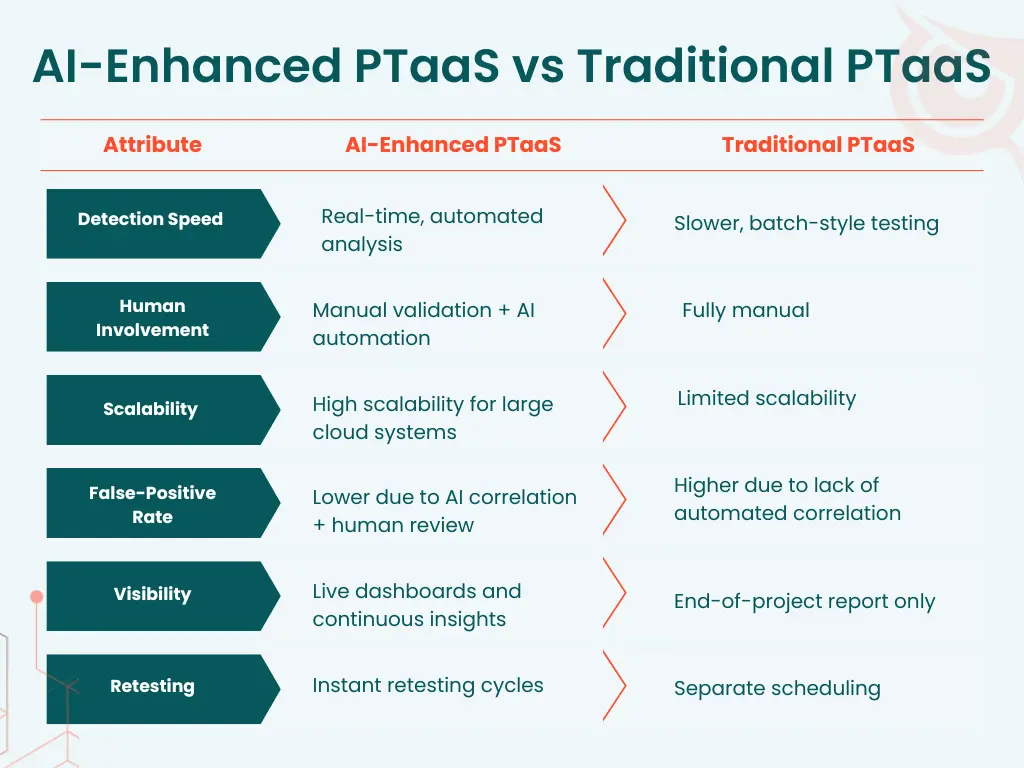
Businesses are shifting to AI-enhanced PTaaS because it supports continuous monitoring, faster remediation, and lower operational cost while maintaining testing accuracy.
Modern infrastructures change daily, new code releases, cloud deployments, and configuration updates. Annual pentests cannot detect risks created between audits.
A 2024 IBM Security study found that 61% of breaches involved vulnerabilities less than 90 days old, proving the need for ongoing visibility.
ioSENTRIX’s PTaaS platform provides continuous scanning, real-time dashboards, exploit validation, and compliance-ready reporting mapped to SOC 2, ISO 27001, PCI DSS, HIPAA, and NIST frameworks.
Automated AI scanners often provide surface-level results and label them as “pentesting,” which misleads non-technical teams.
ioSENTRIX Solution:
ioSENTRIX validates every AI-identified vulnerability through manual exploitation, business-impact analysis, and PoC evidence. This keeps reports accurate, actionable, and compliant.
Many organizations buy “AI pentests” only to meet audits.
ioSENTRIX Solution:
ioSENTRIX delivers audit-grade PTaaS validated by OSCP, CREST, and ISO 27001-certified testers, ensuring both compliance and real-world security.
AI identifies known patterns but cannot interpret complex logic flaws or chained vulnerabilities.
ioSENTRIX Solution:
ioSENTRIX testers analyze application logic, multi-step attacks, privilege escalation paths, and misconfigurations using human creativity supported by AI-generated insights.
A scan-only approach leads to a backlog of unverified vulnerabilities.
ioSENTRIX Solution:
ioSENTRIX provides real-time severity ranking, AI-driven prioritization, and unlimited retesting until issues are resolved.
Aggressive scanning can cause service outages in sensitive environments.
ioSENTRIX Solution:
ioSENTRIX uses controlled automation, Rules of Engagement (RoE), and reviewer oversight to maintain operational safety.
The most effective model is hybrid, AI for speed, humans for accuracy. This is the core methodology at ioSENTRIX.
AI-enhanced PTaaS strengthens cybersecurity by accelerating vulnerability detection, improving prioritization, and supporting continuous monitoring, while human-led validation ensures accuracy, context, and real-world exploitability.
AI alone cannot replace the creativity and judgment required for complex penetration testing, but it significantly reduces manual workload and improves operational efficiency.
As systems scale across cloud platforms, microservices, and CI/CD pipelines, organizations require testing models that deliver speed, depth, and audit-ready evidence.
ioSENTRIX delivers this hybrid advantage by combining advanced AI automation with CREST, OSCP, and ISO 27001-certified experts who validate findings, chain vulnerabilities, and map business impact.
With real-time PTaaS dashboards, continuous retesting, and compliance-aligned reporting, ioSENTRIX helps businesses maintain ongoing visibility and reduce breach likelihood throughout the year.
The future of penetration testing is not AI-versus-human, it is AI-plus-human.
Organizations adopting this combined model gain the fastest detection, the most accurate results, and long-term resilience against evolving cyber threats.
AI improves security threat prevention by analyzing patterns, detecting anomalies, and identifying vulnerabilities faster than manual methods.
AI cannot replace pentesters because it lacks creativity, contextual reasoning, and the ability to exploit complex vulnerabilities.
AI helps stop cyber attacks by identifying suspicious behavior, correlating threat signals, and predicting attack paths in real time.
AI increases safety by automating routine analysis, reducing human error, and allowing security teams to respond to threats early.
The four types are strategic intelligence, tactical intelligence, operational intelligence, and technical intelligence.