
September 24, 2026
The Reflected XSS Methodology: 11 Labs Behind $5,000+ in Bounties and 80+ Pentests
The Reflected XSS Methodology: 11 Labs Behind $5,000+ in Bounties and 80+ Pentests

Salman Khan


Omair Manzoor is the Founder, CEO, and Chief Hacker of ioSENTRIX, a CREST-accredited cybersecurity firm. With 14+ years in offensive security, he has led penetration tests for Fortune 500 companies including engagements for Amazon, Bank of America, VISA, and the London Underground. His exploits are part of the Metasploit Framework and Immunity Canvas. Omair is a published researcher, conference keynote speaker (DOD, CISA, BSides), and technical reviewer for academic security textbooks.
Artificial intelligence (AI) and machine learning (ML) are now part of many business-critical systems. Organizations use ML models for fraud detection, healthcare applications, cybersecurity, and automated decision-making.
Weaknesses in any of these areas can affect how a model behaves. Attackers may manipulate training data before a model learns from it. They may also create inputs designed to mislead a model during inference.
These attacks fall under the broader field of adversarial machine learning, which focuses on how attackers can manipulate ML systems and how organizations can make those systems more secure and resilient.
One important example is data poisoning. In a poisoning attack, an adversary interferes with the data or training process so that the resulting model behaves in an unintended way.
This guide explains what data poisoning is, how attackers can target ML systems, the main types of adversarial ML attacks, why these attacks can be difficult to detect, and how organizations can improve AI and ML security through threat modeling, monitoring, and model robustness testing.
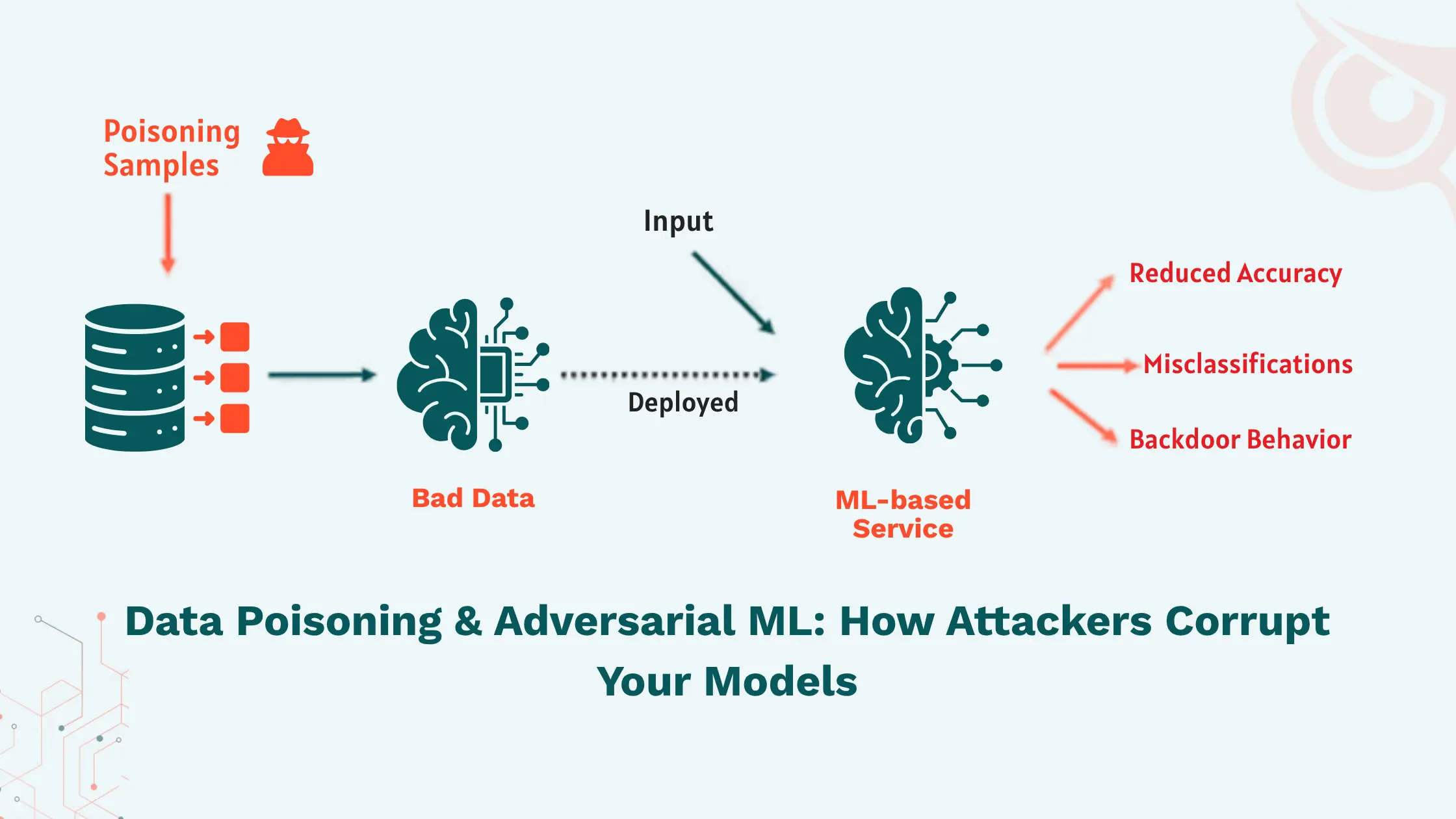
Data poisoning is an attack in which an adversary intentionally manipulates training data or the training process to influence how a machine learning model learns and behaves. An attacker may add, modify, or remove data so the trained model produces incorrect, biased, or attacker-controlled results.
This makes data poisoning a training-stage security threat. NIST defines data poisoning as a poisoning attack in which an adversary controls part of the training data.
Unlike a traditional attack that may target a server or application vulnerability, data poisoning targets one of the foundations of an ML system: the information from which the model learns.
No single indicator proves that a model has been poisoned. However, certain changes should trigger further investigation. Potential warning signs include:
These indicators can have many causes, including normal data drift, changes in model configuration, or errors in the training process. They should therefore be treated as signals for investigation rather than definitive proof of an attack.
A typical data poisoning attack can occur through several stages:
The impact depends on the attacker's goal, the amount and quality of manipulated data, the model architecture, and the controls protecting the ML pipeline.
Data poisoning can affect an ML model in different ways. An attacker may attempt to:
For example, an attacker targeting a fraud detection model may try to make certain fraudulent transactions appear legitimate. In another scenario, a poisoned dataset could cause a classification model to behave differently when a particular trigger is present.
The key risk is that the model may continue to appear functional while its underlying behavior has been compromised.
Adversarial machine learning is the study of attacks that deliberately manipulate or exploit machine learning systems, along with techniques for detecting, mitigating, and managing those attacks.
NIST's 2025 adversarial ML taxonomy covers attacks across different ML methods, lifecycle stages, attacker goals, and capabilities. It includes attack categories such as poisoning, evasion, privacy attacks, and misuse against different types of AI systems.
Data poisoning is therefore only one part of the larger adversarial machine learning landscape. Traditional cybersecurity often focuses on vulnerabilities in software, networks, operating systems, APIs, and infrastructure.
AI and ML security requires organizations to consider those areas as well as the behavior and dependencies of the model itself. Attackers can target several parts of an ML system, including:
This creates a broader attack surface than the application layer alone. A secure AI system therefore needs controls across the complete ML lifecycle.
Data poisoning does not always require direct access to the model itself. The attack can begin much earlier in the ML lifecycle, particularly when a model depends on external or user-controlled data.
The most direct form of data poisoning involves manipulating the dataset used to train a model. An attacker may insert malicious samples, alter existing records, or manipulate labels.
If those changes are not detected, the training process can incorporate the manipulated information. The resulting model may then learn incorrect relationships. Depending on the attack, the impact could range from general performance degradation to targeted behavior.
This is why training data security is an important part of machine learning security. Data should be treated as a security-sensitive asset rather than simply as an input for model development.
Many ML systems collect data automatically from multiple sources. These may include websites, user submissions, sensors, applications, APIs, customer interactions, or third-party services. Every additional source introduces another trust boundary.
If an attacker can influence one of these sources, malicious or misleading information may enter the training pipeline. Automated ingestion can make this particularly challenging because large volumes of data may be processed without manual review.
Strong validation, source verification, anomaly detection, and monitoring can help reduce this risk.
.webp)
Fine-tuning allows organizations to adapt an existing model to a specific task, industry, or business requirement. However, the process also introduces another opportunity for manipulation.
If fine-tuning data has not been properly reviewed, an attacker may attempt to introduce malicious samples or unwanted patterns. The risk is especially important when organizations use external datasets, community contributions, or other sources that they do not fully control.
Before fine-tuning, organizations should understand where the data came from, how it was collected, whether it was modified, and whether it has passed appropriate security and quality checks.
The ML supply chain includes more than training datasets. It can include:
Compromising one of these components can introduce weaknesses into an otherwise secure AI environment. This is similar to software supply chain security, but the assets and attack paths are different. Organizations need visibility into both the origin and integrity of the data, models, tools, and dependencies used throughout the ML lifecycle.
Data poisoning attacks can have different objectives. Some aim to reduce overall model performance, while others attempt to control specific predictions or introduce hidden behavior.
Availability poisoning attacks attempt to degrade the overall performance or reliability of a model. Instead of targeting one specific prediction, the attacker aims to make the model less effective across a wider range of inputs.
The result may be lower accuracy, increased errors, or reduced confidence in the model's predictions. For organizations that depend on ML for automated decisions, even a broad reduction in model reliability can have significant operational consequences.
Targeted poisoning focuses on specific inputs, classes, or predictions. Rather than making the entire model unreliable, the attacker attempts to influence how the model responds to selected cases. This can make the attack harder to notice because overall model performance may remain acceptable.
For example, a model could continue performing normally on most inputs while producing incorrect results for a particular category of transactions or images.
Backdoor attacks introduce hidden behavior into a model. The attacker attempts to make the model behave normally under ordinary conditions while causing a specific response when a particular trigger is present. That trigger could be a specific feature, pattern, or other condition.
This makes backdoor attacks especially concerning because standard testing may show that the model performs correctly. The malicious behavior may only appear when the trigger condition is encountered.
Research from NIST has also examined poisoned models in security and safety-sensitive applications, including models trained with images containing malicious triggers.
Clean-label poisoning is designed to make malicious training samples appear legitimate.
The labels associated with poisoned samples may remain correct, making simple label checks less effective. This can make detection more difficult because the manipulated data may not contain an obvious labeling error.
The broader lesson is that training data security cannot rely on labels alone. Organizations also need to consider data provenance, patterns, distribution, and unusual influence on model behavior.
Data poisoning is only one category of adversarial machine learning. Attackers can also target models during inference, attempt to extract information, or manipulate inputs to bypass AI-based detection.
An adversarial example is a modified input designed to cause a machine learning model to make an incorrect prediction or behave unexpectedly.
The modification may be difficult for a human to notice but significant enough to affect the model. NIST describes an adversarial example as a modified testing sample that induces misclassification or other misbehavior at deployment time.
These attacks demonstrate that an ML model can be vulnerable even when its training data has not been poisoned.
Evasion attacks occur during inference. The attacker modifies an input so that the model fails to identify or classify it correctly. For example, an attacker may attempt to modify malicious content so an ML-based security system classifies it as benign.
Unlike data poisoning, which targets the training stage, evasion attacks generally focus on how the deployed model responds to manipulated inputs.
Model extraction involves attempting to reproduce or approximate a model by interacting with it repeatedly. An attacker may send many queries to an exposed model or API and study the resulting outputs. Over time, these observations may reveal information about the model's behavior.
This can create risks for proprietary models and may increase the chance of intellectual property loss or unauthorized replication.
Model inversion attacks attempt to recover information about the data or features used to train a model by analyzing its outputs. The risk is particularly important when models are trained using sensitive or private information.
A successful attack may reveal information that the organization did not intend to expose through model responses.
Membership inference attacks attempt to determine whether a particular record or individual was part of a model's training data. This can create privacy concerns, especially when models are trained using sensitive datasets.
Even without directly recovering the original data, revealing that a particular record was included in training may expose sensitive information. Together, these attacks show why adversarial machine learning covers much more than data poisoning.
There is no single control that can eliminate every data poisoning risk. A stronger approach combines data security, pipeline security, access controls, monitoring, and regular model testing.
Training data should go through security and quality checks before it reaches the model. Organizations can use:
The goal is to identify suspicious or unexpected data before it influences model training.
Data provenance provides visibility into the history of a dataset. Organizations should be able to determine:
This makes it easier to investigate suspicious changes and identify which data may have affected a model.
.webp)
ML pipeline security should be treated as part of the overall AI security strategy. Organizations should implement appropriate:
Access should be limited according to business needs. Developers, data scientists, administrators, and automated services should not automatically have the same level of access to training data or model artifacts.
External and user-generated data should not automatically receive the same level of trust as verified internal data. Organizations should establish clear trust boundaries and validation requirements before external data enters a training environment.
This is especially important for systems that rely on web-scraped content, public datasets, crowdsourced information, third-party data, or user feedback.
Security monitoring should continue after a model is deployed. Teams can monitor for:
Monitoring provides an additional layer of visibility when an attack or unexpected model change occurs.
A structured testing strategy helps organizations evaluate the security of the complete ML environment rather than focusing only on the model.
Start by mapping the components that could influence or expose the model. This may include:
Understanding these components helps security teams identify where an attacker could potentially manipulate data, access models, influence predictions, or extract sensitive information.
Next, identify which adversarial ML threats are relevant to the system. Threat modeling frameworks such as MITRE ATLAS can help teams map potential AI attack techniques to specific components and stages of the ML lifecycle.
The objective is not to test every possible attack. Instead, organizations should prioritize threats based on the model's purpose, data sensitivity, exposure, and potential business impact.
The next step is to evaluate how the model responds to adversarial conditions. Depending on the system, testing may examine areas such as data poisoning, adversarial inputs, model manipulation, inference attacks, or other AI-specific weaknesses.
Testing should use controlled scenarios designed to measure whether existing security controls can detect or resist the attack.
Automated tools can help identify suspicious behavior, but they should not be the only source of evidence. Security teams should validate important findings through controlled testing and evidence.
This helps distinguish actual security weaknesses from false positives or normal model behavior. The result should be an actionable understanding of what was affected, how serious the weakness is, and what controls need improvement.
Fixing a vulnerability is only part of the process. After remediation, the organization should retest the affected component to confirm that the security control works as intended.
This is particularly important for AI systems because changes to data, models, or pipelines can introduce new behavior. A continuous cycle of test, remediate, and retest helps maintain model resilience as the AI environment evolves.
Machine learning models are only as trustworthy as the data, processes, and infrastructure behind them. An attacker does not always need to compromise the model server to influence its behavior. Manipulating training data or other parts of the ML lifecycle can be enough to create security and reliability problems.
Organizations should therefore secure the complete ML lifecycle rather than focusing only on the deployed model. Strong data validation, provenance tracking, secure ML pipelines, monitoring, and model robustness testing can help reduce exposure to AI-specific threats.
With ioSENTRIX’s AI/ML penetration test, security experts can identify weaknesses across your AI environment, including data poisoning, adversarial attacks, model manipulation, training pipelines, and deployment interfaces.
Get actionable remediation guidance and retesting to help strengthen your model's security and resilience. Contact ioSENTRIX today to get started.
Data poisoning is an attack in which an adversary manipulates part of the data or training process used by a machine learning model. The goal is to influence the model's learned behavior, potentially causing reduced accuracy, targeted misclassification, hidden backdoors, or other unwanted outcomes.
Adversarial machine learning is the field concerned with attacks that deliberately manipulate or exploit machine learning systems and the techniques used to mitigate those threats. Data poisoning is one type of adversarial ML attack, while other examples include evasion, adversarial examples, model extraction, and privacy attacks.
Data poisoning can reduce model accuracy, cause targeted misclassification, introduce hidden backdoors, create unwanted biases, or make automated decisions less reliable. The impact depends on the model, the poisoned data, and the attacker's objective.
Organizations can reduce detection gaps by validating training data, tracking data provenance, monitoring datasets for anomalies, reviewing unexpected model behavior, and performing regular security testing. Suspicious model changes should be investigated alongside changes in training data, pipelines, and model versions.
Data poisoning cannot be addressed through a single control, but organizations can reduce the risk through trusted data sources, data validation, provenance tracking, access controls, secure ML pipelines, monitoring, and adversarial testing. Regular model robustness testing can also help identify weaknesses as models and datasets change.