
September 24, 2026
The Reflected XSS Methodology: 11 Labs Behind $5,000+ in Bounties and 80+ Pentests
The Reflected XSS Methodology: 11 Labs Behind $5,000+ in Bounties and 80+ Pentests

Salman Khan


Omair Manzoor is the Founder, CEO, and Chief Hacker of ioSENTRIX, a CREST-accredited cybersecurity firm. With 14+ years in offensive security, he has led penetration tests for Fortune 500 companies including engagements for Amazon, Bank of America, VISA, and the London Underground. His exploits are part of the Metasploit Framework and Immunity Canvas. Omair is a published researcher, conference keynote speaker (DOD, CISA, BSides), and technical reviewer for academic security textbooks.
Network infrastructure security is the set of controls, configurations and practices that protect the routers, switches, firewalls, wireless access points, DNS, and management planes that every other system depends on. It is the layer beneath your applications and cloud accounts. When it fails, everything above it is exposed at once. This guide explains what network infrastructure security covers, which components a secure network infrastructure needs, ten best practices for securing network infrastructure that map to NIST and NSA guidance, and a checklist you can use to prove the controls work rather than assume they do.
Network infrastructure security is the protection of the hardware, software and services that move traffic through an organization: routers, switches, firewalls, load balancers, wireless controllers, VPN concentrators, DNS and DHCP servers, and the management interfaces that configure them. Its goal is to keep attackers from using the network itself as a foothold, a path for lateral movement, or a place to intercept data. It is distinct from application security, which protects the code running on top of the network.
Network devices are attractive targets. They sit in the path of all traffic, they are managed by a small team, and they are patched less often than servers. A compromised edge router or a switch with a default management password gives an attacker visibility and control that no single application breach can match. The NSA Network Infrastructure Security Guide, first published in 2022 and updated in October 2023, exists for exactly this reason: it is a device-level hardening reference for the equipment most organizations forget about.
Two phrasings get used interchangeably: "network infrastructure security" is the discipline of securing the infrastructure, and "network security infrastructure" is the stack of security products deployed on it. A secure network infrastructure needs both.
A network security infrastructure has four functional layers: perimeter and segmentation controls (firewalls, network access control, VLANs and microsegmentation), secure connectivity (VPN or zero trust network access, TLS), visibility (logging, intrusion detection, behavioral analytics and XDR), and data controls (secure web gateways and data loss prevention). No single product covers all four, and the gaps between them are where most real intrusions happen.
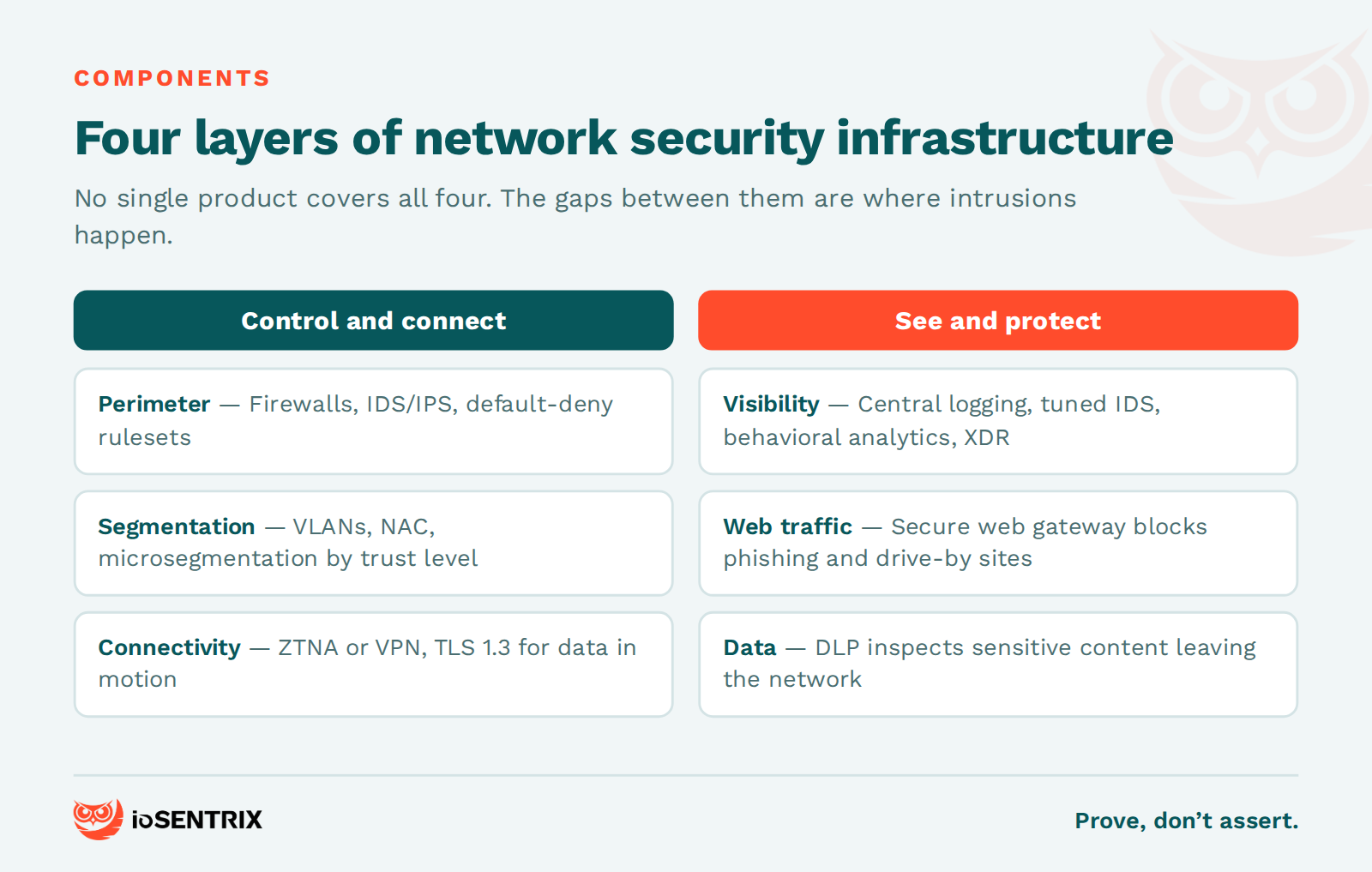
Firewalls and intrusion detection or prevention systems still anchor the perimeter. A firewall enforces which traffic may cross a boundary; an IDS or IPS inspects what is allowed through and alerts on or blocks known-bad patterns. NIST's SP 800-41 Rev. 1, Guidelines on Firewalls and Firewall Policy, remains the reference for writing, testing and reviewing firewall policy: default-deny, document every rule, review the ruleset on a schedule.
Secure connectivity used to mean a VPN: remote users tunnel in and, once inside, are trusted. That model is giving way to zero trust network access (ZTNA), where every request is authenticated and authorized individually. Transport Layer Security protects data in motion either way; TLS 1.3, specified in RFC 8446, should be the floor for new deployments.
Visibility is where most organizations are weakest. Centralized logging from every device, a tuned IDS, and behavioral analytics that baseline normal traffic are the difference between detecting lateral movement in hours and discovering it months later. Extended detection and response (XDR) correlates those signals across endpoints, network and cloud, but only if the network telemetry is collected in the first place.
Data controls sit at the edge of the stack. A secure web gateway filters outbound web traffic against reputation and policy, which blunts phishing and drive-by downloads. Data loss prevention inspects content leaving the network for patterns you define as sensitive. Both depend on segmentation good enough that traffic actually passes through them.
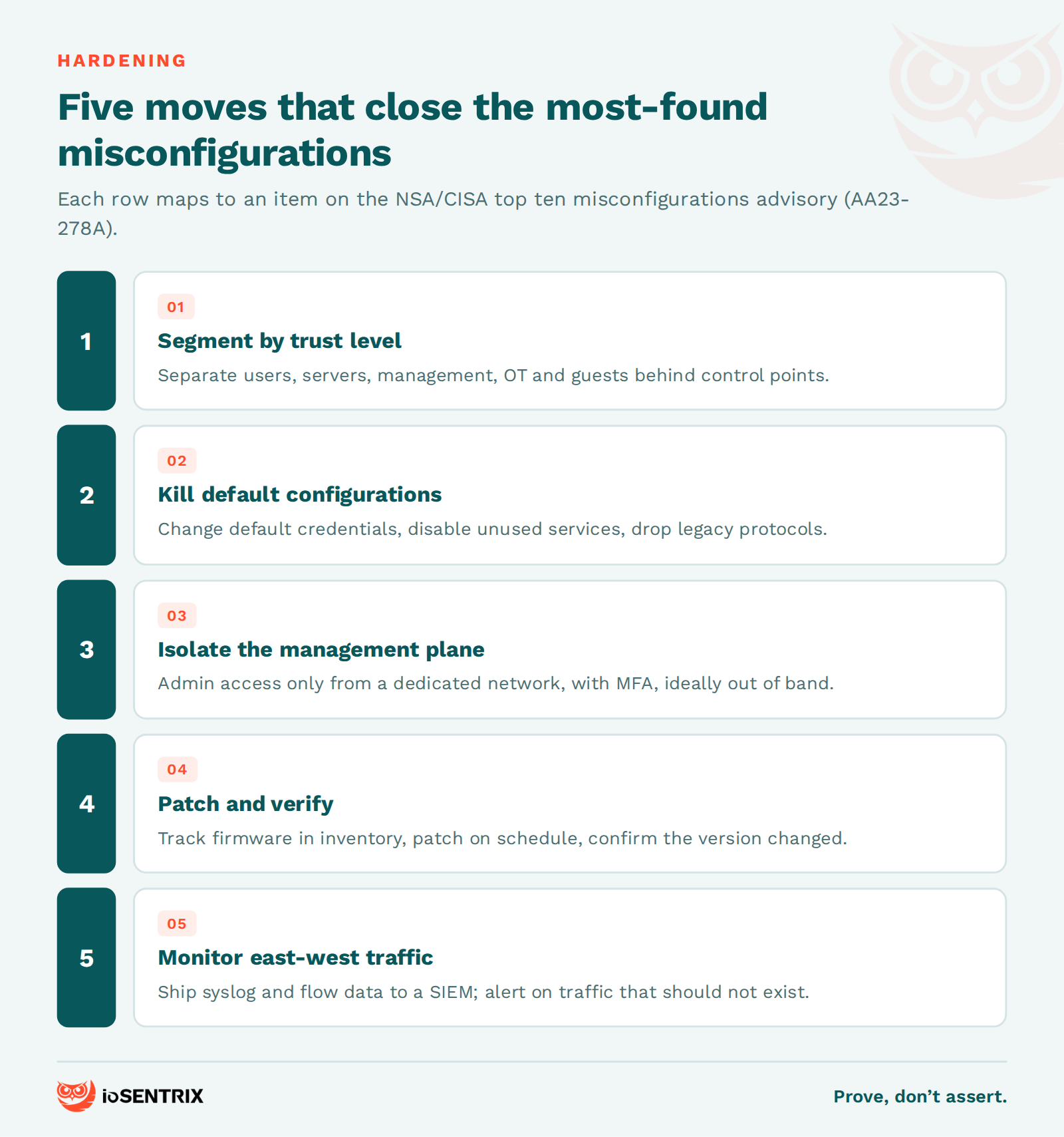
To secure your network infrastructure, start with the controls that stop lateral movement and unauthorized administration: segment the network, harden and patch every device, lock down the management plane, and log everything centrally. The ten best practices for securing network infrastructure below are ordered by how much attacker capability each one removes, and they map closely to the misconfigurations NSA and CISA report finding most often.
Network security protects data as it moves and controls who can communicate with what. Infrastructure security protects the physical and virtual components that make communication possible: the devices, their firmware and configurations, the management plane, and the facilities and cloud accounts that host them. Network infrastructure security is where the two overlap, and it is the part most programs underinvest in.
A practical way to see the difference: a firewall rule that blocks inbound RDP is network security. Making sure nobody can log in to the firewall itself with a default password, from the guest Wi-Fi, over Telnet, is infrastructure security. The second kind of failure is the one that gives an attacker persistent, invisible control. The same applies in the cloud, where virtual networks, security groups and private endpoints are misconfigured in the same ways physical networks are; a cloud penetration test covers that layer.
A useful network security architecture diagram shows every trust boundary, every control that enforces it, and every path an administrator or attacker could take between zones. At minimum it includes the internet edge, DMZ, user, server, management, OT or IoT, and guest zones; the firewalls and access control points between them; remote access and site-to-site connections; and the logging flows. If a zone or a management path is not on the diagram, it is probably not being defended.
Use the diagram as a working checklist rather than a slide. Walk each boundary and ask three questions: what enforces it, who can change that control, and what evidence shows it works. The checklist below turns those questions into items your team can score.
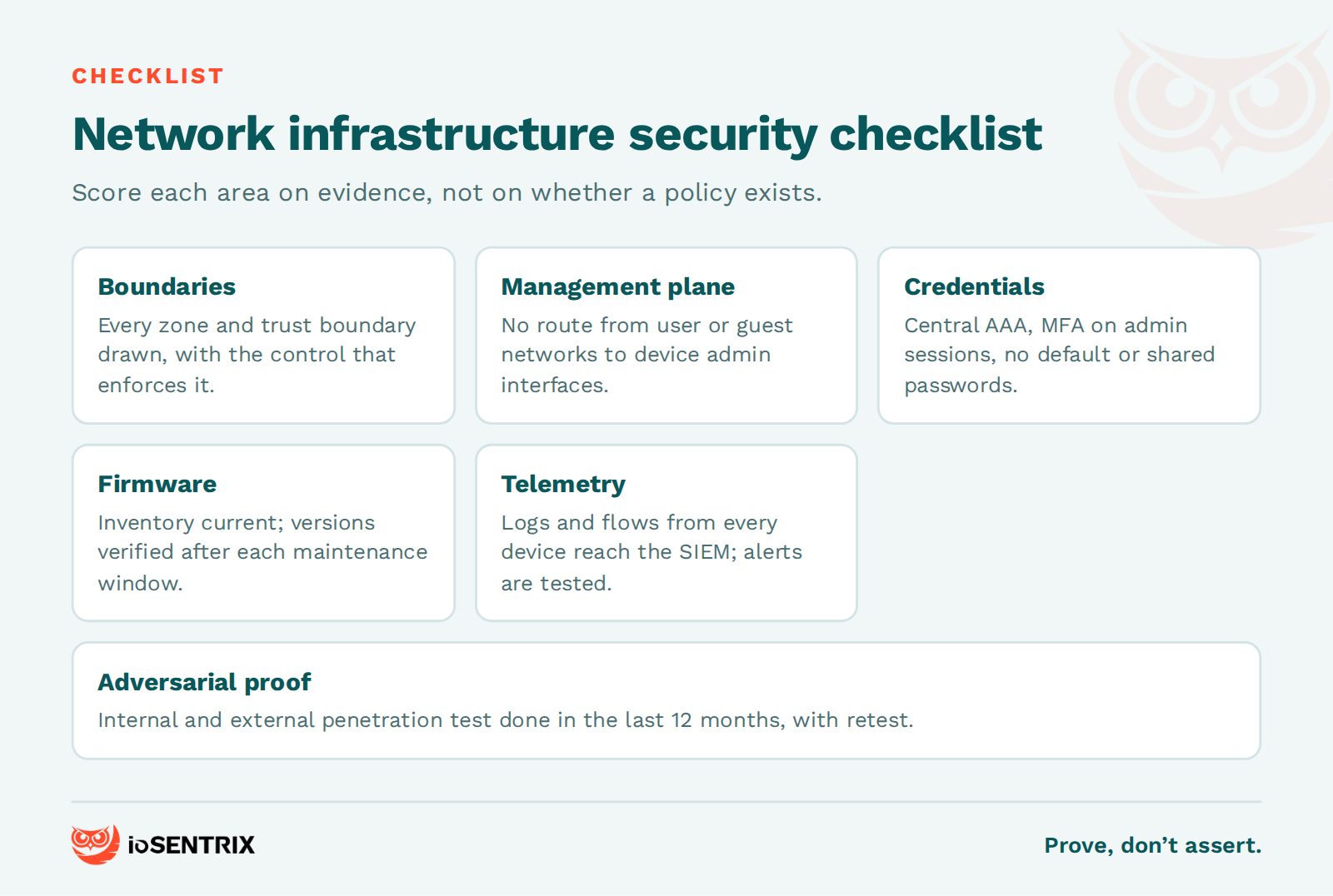
Four public references cover most of what an organization needs. NIST SP 800-215, Guide to a Secure Enterprise Network Landscape (November 2022), describes how segmentation, zero trust network access and secure access service edge fit together in a hybrid, cloud-connected enterprise. NIST SP 800-207 defines the zero trust architecture those designs rest on. The NSA Network Infrastructure Security Guide gives device-level hardening direction. NSA/CISA advisory AA23-278A lists the ten misconfigurations red and blue teams find most often, which makes it a useful priority list.
Aligning with these documents is good practice. It is not a certification, and it is not proof. A control that appears in a diagram and a policy can still be bypassed in production by a forgotten firewall rule, a management interface on the wrong VLAN, or a credential nobody rotated. Treat the frameworks as the specification and adversarial testing as the acceptance test.
You prove a network control works by trying to defeat it under agreed rules and recording what happened. That means an authorized penetration test that attempts lateral movement across segments, tries to reach management interfaces from user networks, and checks whether logging captured the attempts. A configuration audit confirms a control exists; a penetration test confirms it holds.
The pattern we see most often (a composite across many assessments, not any one client) is a network that is well segmented on paper but has a "temporary" any-to-any rule, a management VLAN reachable from a jump host everyone can log into, and core-switch firmware several major versions behind. None of that shows up in a policy review. All of it shows up on the first day of an internal network test. For larger environments, a red team engagement goes further and tests whether your monitoring and response teams notice and contain the activity.
Network infrastructure security solutions fall into two groups: products you deploy (firewalls, NAC, ZTNA, IDS/IPS, SIEM, XDR, secure web gateways, DLP) and services that configure, validate and monitor them (architecture review, hardening, penetration testing, managed detection). Buying the products is the easy half. When evaluating a service provider, ask for the evidence they will hand you, not the list of tools they use: a map of what was reachable from where, a prioritized list of configuration changes that close those paths, and a retest showing the paths are closed.
Network infrastructure security means protecting the equipment and services that carry your traffic (routers, switches, firewalls, wireless, DNS and their management interfaces) so attackers cannot use them to move through your environment or intercept data. It covers hardening, segmentation, access control, patching and monitoring of those devices.
Segment by function and trust level, harden devices to a documented baseline, isolate the management plane, patch on a schedule, enforce MFA and least privilege for administrators, log and monitor internal traffic, encrypt management and data traffic, move remote access toward zero trust, maintain a network-specific incident response plan, and test all of it adversarially.
At least annually, and after any significant change such as a new site, a firewall replacement, a cloud migration or a merger. Many compliance frameworks require annual testing and retesting after major changes; the frequency that actually reduces risk depends on how often your network changes.
A VPN encrypts the connection, but once connected the user is usually treated as inside the network. Zero trust network access fixes that by authorizing each request against identity, device posture and the specific resource. If you keep a VPN, restrict what VPN users can reach, require MFA, and never expose device management interfaces to the VPN pool.
ioSENTRIX is a CREST-accredited penetration testing firm, ISO/IEC 27001 certified and SOC 2 Type 2 attested. Our network security services include architecture and configuration review, device hardening against NSA and NIST guidance, and internal and external network penetration testing that shows which segments, management interfaces and credentials an attacker could actually reach. Every finding comes with evidence and a retest, so you can show your board and auditors that the controls hold, not just that they exist.
If you want to know what an attacker could reach from your guest Wi-Fi, a contractor VPN account or a single compromised workstation, talk to us about scoping a network infrastructure assessment.