September 24, 2026
The Reflected XSS Methodology: 11 Labs Behind $5,000+ in Bounties and 80+ Pentests
The Reflected XSS Methodology: 11 Labs Behind $5,000+ in Bounties and 80+ Pentests
Salman Khan


Omair Manzoor is the Founder, CEO, and Chief Hacker of ioSENTRIX, a CREST-accredited cybersecurity firm. With 14+ years in offensive security, he has led penetration tests for Fortune 500 companies including engagements for Amazon, Bank of America, VISA, and the London Underground. His exploits are part of the Metasploit Framework and Immunity Canvas. Omair is a published researcher, conference keynote speaker (DOD, CISA, BSides), and technical reviewer for academic security textbooks.
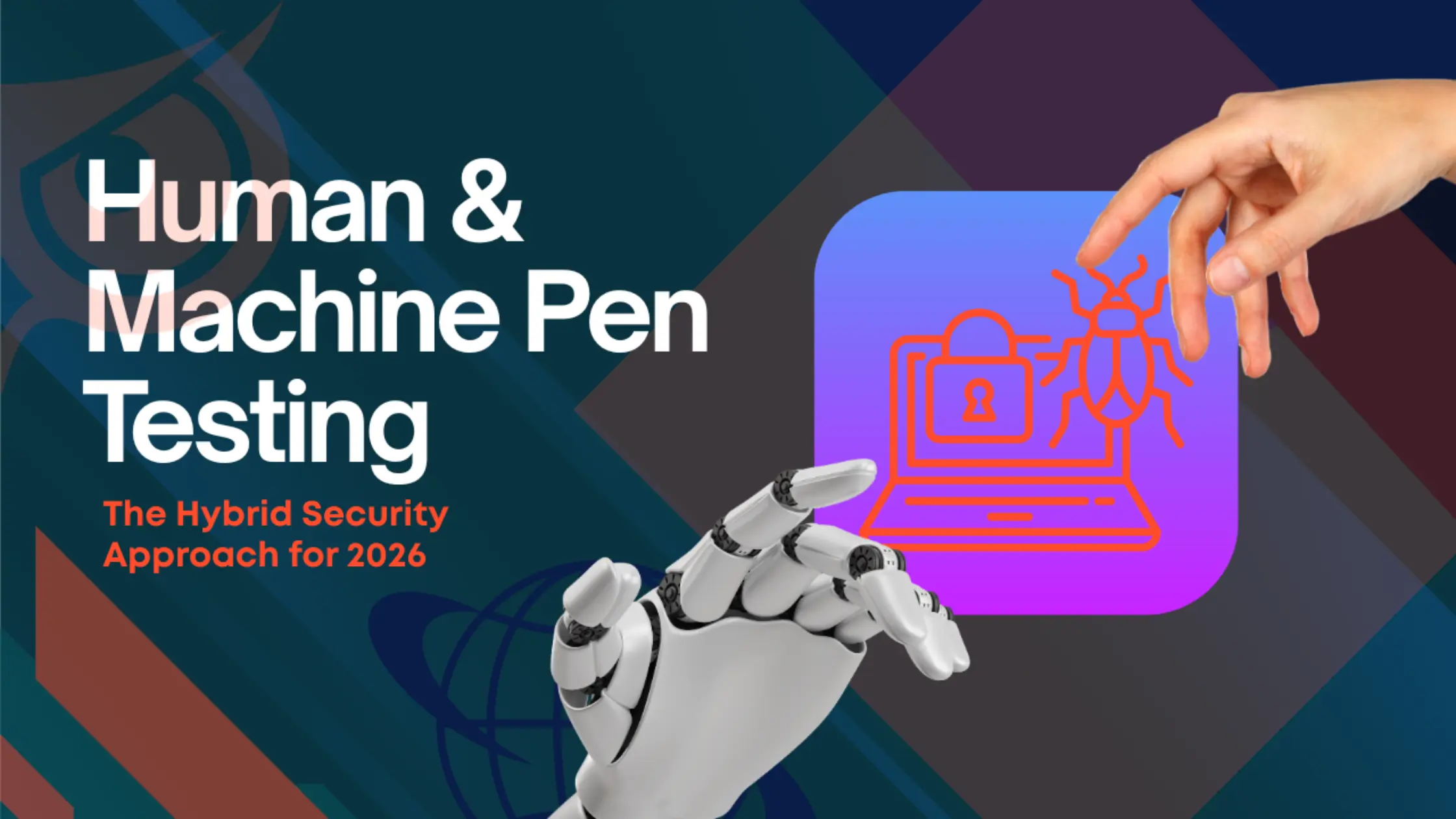
Traditional, fully manual pentests no longer align with fast DevOps cycles, while AI-only “automated pentesting tools” fail to deliver real-world security.
The future lies in human + machine collaboration, a hybrid model where automation accelerates discovery and expert testers deliver deep, context-rich exploitation.
In 2026, this combined approach is redefining how businesses strengthen security, maintain compliance, and achieve continuous, validated risk reduction.
ioSENTRIX sits at the center of this shift, blending automation, PTaaS technology, and CREST/OSCP-certified experts to deliver penetration testing that is smarter, faster, and more accurate.
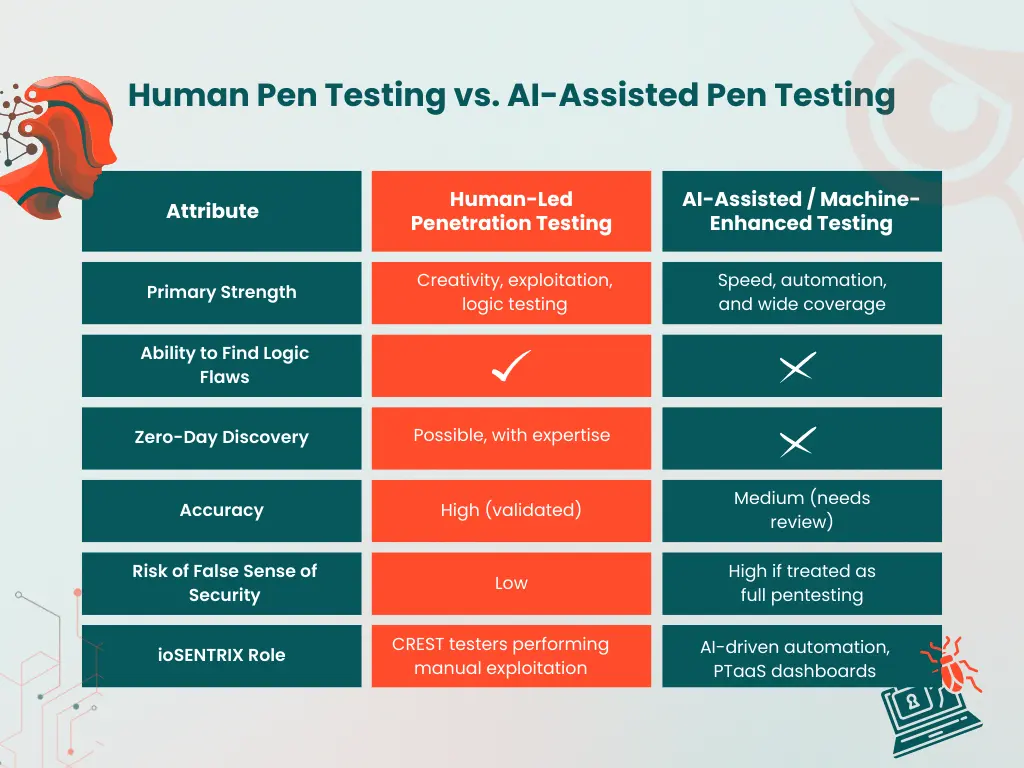
Human-led penetration testing is a manual, expert-driven security assessment where experienced ethical hackers uncover vulnerabilities by thinking like real attackers.
It blends creativity, strategic reasoning, and deep understanding of business logic to exploit weaknesses that automated tools consistently overlook.
Human testers examine how systems behave under unexpected conditions, how permissions can be chained, and how real attackers would pivot inside an environment.
They look at context, not just whether a vulnerability exists, but how it can be exploited in practice and what damage it could cause.
This approach is essential for discovering:
According to Verizon DBIR 2024, 82% of exploited vulnerabilities were either misconfigurations or logic flaws that scanners failed to detect, highlighting the continued need for human expertise.
At ioSENTRIX, our human testing team includes OSCP, CREST, CEH, and ISO 27001-certified experts who handle deep exploitation, multi-vector attack chains, and validation for high-risk issues.
Machine-assisted penetration testing uses automation and AI to accelerate and extend the discovery process.
Rather than replacing human testers, AI works as an augmentation layer that speeds up repetitive, noisy, or time-consuming tasks.
Modern AI tools can:
This improves coverage and reduces testing time especially in cloud-native architectures where systems evolve daily.
However, AI has clear limitations:
This is why Reddit practitioners repeatedly warn that “AI penetration testing” is often just glorified scanning, especially when marketed dishonestly.
At ioSENTRIX, we use AI responsibly, for speed, visibility, and automation, while human experts handle complex exploitation, validation, and reporting.
Purely automated testing is too shallow to stop real attackers. The only sustainable model in 2026 and beyond is a hybrid approach that merges the strengths of both worlds.
Automation handles:
This allows humans to focus on actual exploitation, not repetitive tasks.
AI may flag thousands of issues but only human testers can determine true severity. Human experts confirm:
Traditional annual pentests leave long periods without visibility. The hybrid model supports:
.webp)
SOC 2 ∣ ISO 27001 ∣ PCI DSS ∣ HIPAA ∣ NIST 800-53
All require:
Automation alone cannot meet these requirements.
The hybrid model reduces cost by automating what machines do best while preserving human talent for high-risk areas.
ioSENTRIX offers the industry's most balanced hybrid model, combining AI efficiency, human exploitation, and PTaaS visibility.
Choosing between human, machine, or hybrid testing depends on your environment, risk tolerance, and business goals.
For Modern DevOps, Cloud, and Fast Release Cycles
Choose: Hybrid Human + Machine (PTaaS Model)
Outcome: Continuous detection + deep validation
For Annual Compliance Audits and Regulated Industries
Choose: Human-Led Penetration Testing
Outcome: Audit-ready reports, PoCs, regulatory alignment
For Startups or Rapidly Scaling Tech Teams
Choose: Machine-Assisted PTaaS + Manual Testing on Priority Targets
Outcome: Budget-efficient + validated real-world testing
For Mature Enterprises With Complex Architectures
Choose: Fully Integrated Hybrid Testing
Outcome: 24/7 monitoring, deep exploitation, strategic risk management
ioSENTRIX provides the most balanced and mature hybrid pentesting ecosystem:
You get the accuracy of human expertise, the speed of automation, and the visibility of a modern SaaS platform all in one place.
The future of penetration testing is neither purely human nor fully automated, it’s the intelligent combination of both. As threats evolve and businesses accelerate release cycles, hybrid testing delivers the only sustainable approach: continuous coverage, validated exploitation, and evidence-based risk reduction.
ioSENTRIX is leading this transformation by merging certified human expertise with AI-powered PTaaS technology, ensuring organizations stay ahead of threats, achieve compliance, and protect their digital ecosystems in 2026 and beyond.
AI cannot replicate human creativity, attack intuition, or logic-based exploitation. It supports human testers, not replaces them.
It states that AI can automate around 30% of repetitive tasks, while humans handle complex reasoning and decision-making.
Human attackers and skilled pentesters remain more powerful because they innovate and evaluate context beyond patterns.
No. AI enhances SQL workflows but relies on SQL databases and human-driven logic.