September 24, 2026
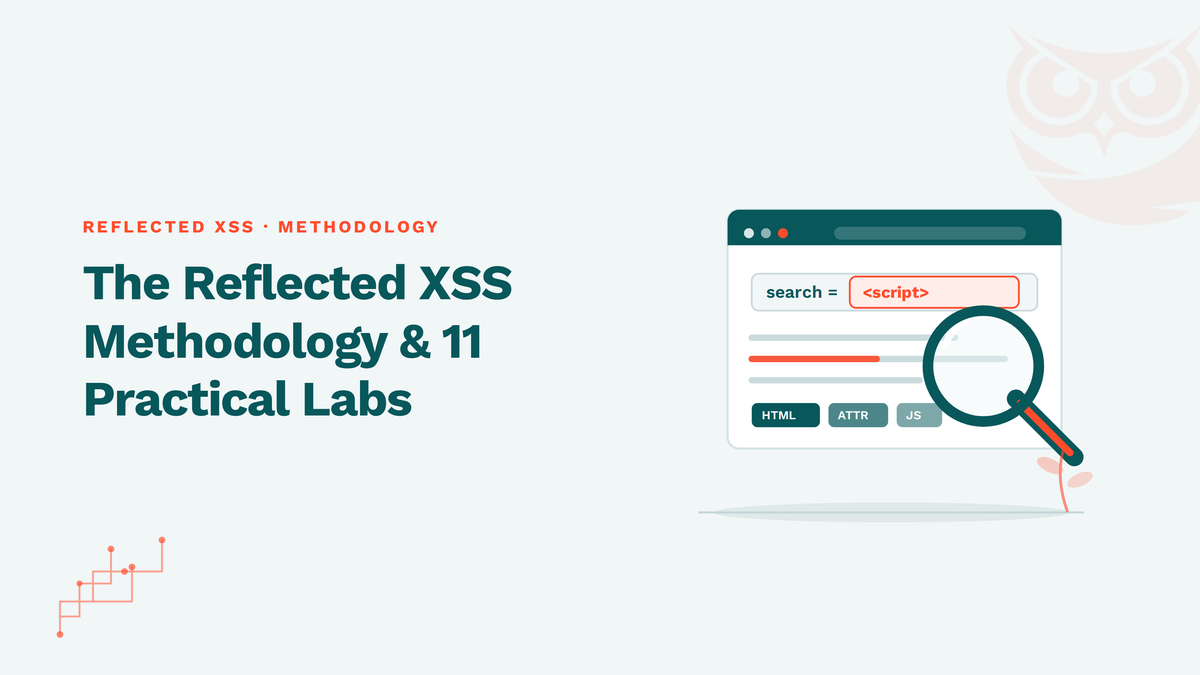
The Reflected XSS Methodology: 11 Labs Behind $5,000+ in Bounties and 80+ Pentests
The Reflected XSS Methodology: 11 Labs Behind $5,000+ in Bounties and 80+ Pentests

Salman Khan


Omair Manzoor is the Founder, CEO, and Chief Hacker of ioSENTRIX, a CREST-accredited cybersecurity firm. With 14+ years in offensive security, he has led penetration tests for Fortune 500 companies including engagements for Amazon, Bank of America, VISA, and the London Underground. His exploits are part of the Metasploit Framework and Immunity Canvas. Omair is a published researcher, conference keynote speaker (DOD, CISA, BSides), and technical reviewer for academic security textbooks.
Modern organizations use several security testing methods to identify weaknesses before attackers can exploit them. Three of the most common are vulnerability scanning, penetration testing, and red teaming. While these terms are sometimes used interchangeably, they are not the same.
A vulnerability scan helps organizations identify security weaknesses across a broad environment. Penetration testing goes a step further by manually validating vulnerabilities and determining whether they can actually be exploited.
Red teaming takes a broader, objective-driven approach by simulating how a real attacker could compromise systems, move through the environment, and reach a specific target.
So, when comparing red team vs penetration testing, the main difference comes down to the question each assessment is designed to answer.
A vulnerability scan asks, "What weaknesses might exist?"
A penetration test asks, "Can these weaknesses actually be exploited?"
A red team exercise asks, "Can a realistic attacker use these weaknesses to achieve a meaningful objective without being stopped?"
Understanding these differences can help organizations choose the right security testing types for their risk profile, security maturity, and business goals.
Organizations use different assessment methods depending on what they need to discover or validate. Vulnerability scanning, penetration testing, and red teaming each provide a different level of insight.
Vulnerability scanning is an automated method for identifying known security weaknesses in systems and applications. Scanners inspect assets for issues such as missing security patches, known CVEs, insecure configurations, exposed services, outdated software, and other common weaknesses.
Organizations can use vulnerability scanners across large environments, including networks, servers, cloud assets, applications, and infrastructure. This makes scanning useful for maintaining regular visibility into the attack surface.
However, automated scanning has limitations. A scanner may identify a potentially vulnerable component without confirming whether an attacker can actually exploit it in the organization's specific environment.
It can also produce false positives or miss weaknesses that depend on application context and business logic. For this reason, vulnerability scanning is an important part of a vulnerability assessment, but it should not be treated as a replacement for deeper manual security testing.
Penetration testing is an authorized security assessment that combines automated tools with manual testing techniques. Its purpose is to identify vulnerabilities and determine whether they can be exploited under controlled conditions.
A penetration test allows security professionals to investigate how weaknesses interact with one another. Testers may assess authentication and authorization controls, exploit vulnerabilities, test business logic, attempt privilege escalation, and examine whether multiple weaknesses can be chained into a larger attack.
The scope is usually defined before testing begins. It could cover a web application, API, mobile application, SaaS platform, internal network, external infrastructure, cloud environment, or another specific asset.
ioSENTRIX describes its penetration testing approach as a combination of automated and manual techniques, with additional focus on business logic and abuse-case testing.
Our current service portfolio covers areas including web applications and APIs, mobile applications, SaaS, embedded devices, ICS/IoT/IIoT, and AI/ML environments.
Red teaming is a goal-driven form of adversary simulation. Instead of focusing primarily on finding as many vulnerabilities as possible, a red team attempts to behave like a realistic attacker and achieve a defined objective.
Depending on the engagement, this may involve reconnaissance, phishing or social engineering, exploitation, credential compromise, lateral movement, physical security testing, and other attack techniques.
The objective is often to determine whether an organization's security controls, SOC, and incident response team can detect and stop an attack before the red team reaches its target.
ioSENTRIX's red team service uses real-world attack simulation and MITRE ATT&CK-aligned tactics, techniques, and procedures (TTPs) to assess the resilience of an organization's people, processes, and technology.
The easiest way to understand these security testing types is to compare their objectives, methods, scope, and outcomes.
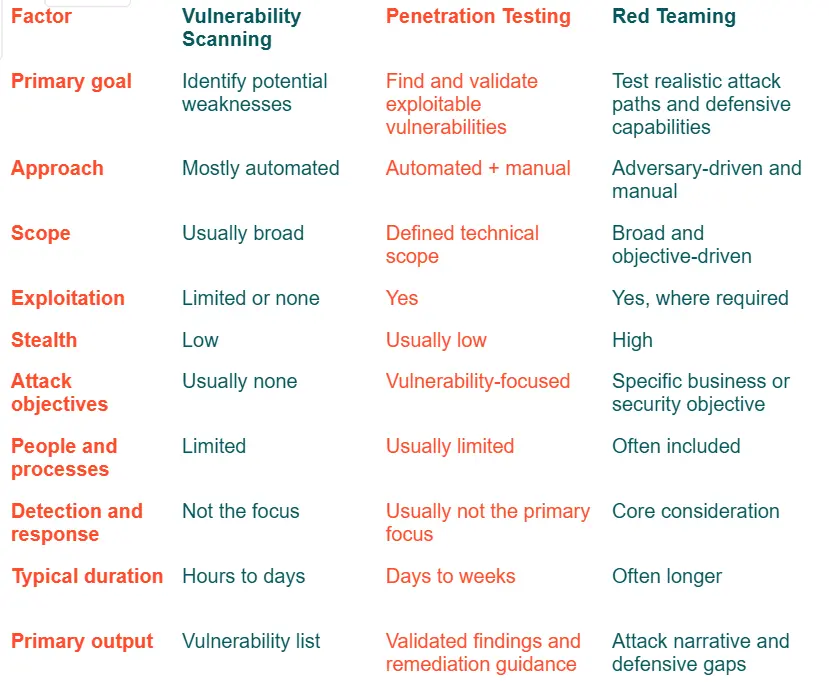
In simple terms, vulnerability scanning tells you what may be vulnerable. Penetration testing tells you what can actually be exploited. Red teaming tests whether a realistic attacker can use those weaknesses to accomplish a meaningful objective.
One of the most common questions in cybersecurity is: What is the difference between red teaming and pen testing? Both involve authorized offensive security testing. Both may use exploitation techniques. However, their objectives and methods are different.
A penetration test is primarily designed to identify and validate vulnerabilities within a defined scope. The tester wants to understand the technical risk associated with those vulnerabilities and provide recommendations for fixing them.
For example, a web application penetration test might identify an authorization flaw that allows one user to access another user's records. The tester would validate the issue, demonstrate its impact, and provide remediation guidance.
A red team exercise has a different objective. The team may be given a target such as gaining access to sensitive customer data, or reaching a privileged account. The red team then determines how a real attacker could achieve that objective.
Penetration testing generally has a clearly defined technical scope. For example, an organization may authorize testing against a specific application, API, network range, mobile application, or cloud environment.
Red team engagements can cross multiple security domains when necessary to achieve the agreed objective. An attack may begin with publicly available information, move to social engineering, lead to an initial compromise, and then involve lateral movement inside the corporate environment.
This broader scope allows organizations to understand how individual weaknesses can combine into a realistic attack path.
Penetration testing usually follows a structured process of discovery, vulnerability identification, validation, exploitation, and reporting. Red teaming follows an adversary-driven approach.
Depending on the objective, the engagement may include:
The exact techniques depend on the agreed rules of engagement. A red team does not need to use every possible technique. Instead, it chooses realistic attack paths that help answer the organization's security question.
Penetration testing reports are generally organized around individual vulnerabilities. They typically include severity, affected assets, evidence, business impact, proof of concept, and remediation recommendations.
Red team reports are more focused on the attack story. They explain how the simulated attacker moved through the environment and whether the defined objective was achieved. A red team report may cover:
ioSENTRIX states that its red team engagements map TTPs to MITRE ATT&CK and provide insights into detection gaps and recommendations for improving security monitoring and response.
Penetration testing and vulnerability scanning are also frequently confused. Both can identify security weaknesses, but the depth and purpose of the testing are different.
A vulnerability scanner can inspect thousands of assets much faster than a human tester. It can identify known CVEs, missing patches, outdated software, insecure configurations, exposed services, and other common weaknesses.
This makes vulnerability scanning valuable for organizations with large and changing attack surfaces. Regular scans can help security teams maintain visibility and prioritize issues that need attention.
However, the scanner generally does not understand the full business context of an application. It may identify a technical weakness without understanding how that weakness could affect a specific business process.
Penetration testing combines automated discovery with manual analysis. A tester can investigate whether a vulnerability is actually exploitable and what an attacker could accomplish after exploitation.
Manual testing is especially important for vulnerabilities that depend on application behavior. These can include:
For example, a scanner may identify an endpoint with weak access controls. A penetration tester can go further by manipulating requests, changing user roles, testing different authorization conditions, and determining whether sensitive information can actually be accessed.
ioSENTRIX’s penetration testing combines automated tools with manual techniques and specifically emphasizes business-logic testing and abuse cases to identify issues that traditional scanning can miss.
These approaches should not necessarily be viewed as alternatives. A mature security program can use all three at different stages.
Regular vulnerability scanning helps organizations maintain visibility into their attack surface. Security teams can use scans to identify newly introduced vulnerabilities, outdated software, exposed services, and configuration issues.
This information can then feed into patch management and vulnerability prioritization. Because scanning is highly automated, it can be repeated more frequently than manual security assessments.
Penetration testing provides deeper validation of security controls and vulnerabilities. Organizations can use it to test applications before major releases and assess new infrastructure.
It can also help evaluate exposed APIs, authentication controls, and authorization controls. Penetration testing can also confirm whether previously identified vulnerabilities have been properly fixed.
Red teaming adds another layer by testing the organization's ability to respond to a realistic attack. Instead of asking only whether a vulnerability exists, the exercise examines how an attacker could combine different techniques to reach a target.
It can also reveal whether security monitoring, SOC processes, incident response, and defensive controls work as expected. This makes red teaming valuable for measuring security resilience, not simply vulnerability counts.
Vulnerability scanning is a good choice when an organization needs broad and recurring visibility into its security weaknesses. It is particularly useful for:
For example, a company with hundreds of servers and cloud assets may use automated scanning to identify newly disclosed vulnerabilities across its environment.
However, scanning should not be treated as a replacement for penetration testing. A scan can identify a potential weakness, but manual testing is often needed to determine whether that weakness can actually be exploited.
Penetration testing is a better fit when an organization needs deeper technical validation. You may consider a penetration test when you need to:
For example, a SaaS provider may conduct penetration testing against its web application and APIs to determine whether attackers can bypass authorization controls or access another customer's data.
ioSENTRIX provides penetration testing across a broad range of environments, including web applications, APIs, mobile applications, SaaS, thick clients, embedded devices, ICS/IoT/IIoT, and AI/ML systems.
Penetration testing can also be performed through a PTaaS model when organizations need testing that aligns more closely with ongoing development and release cycles. ioSENTRIX currently offers subscription-based and credit-based PTaaS models.
Red teaming becomes especially valuable when an organization wants to understand how well its defenses perform against a realistic attack. It can help organizations:
For example, an organization may use a red team exercise to determine whether an attacker could compromise a privileged account and use it to reach sensitive systems. Other objectives may include testing:
The purpose is not to create disruption for its own sake. A properly scoped red team engagement operates under defined rules of engagement and is designed to produce useful security insights.
Choosing the right security testing provider matters because the quality of an assessment depends heavily on how deeply testers understand the target environment and business risk.
ioSENTRIX approaches red teaming as a realistic attack simulation rather than a simple vulnerability exercise. Its red team assessments use MITRE ATT&CK-aligned TTPs to evaluate the organization's security ecosystem across people, processes, and technology.
The methodology can include intelligence gathering, reconnaissance, social engineering, exploitation, and other attack techniques depending on the engagement scope and objectives.
Effective penetration testing requires more than running automated scanners. ioSENTRIX combines automated tools with manual testing to investigate vulnerabilities that require human reasoning and contextual analysis.
This is important because an application can be technically secure against common automated checks while still containing flaws in how users, permissions, transactions, or workflows interact.
Business logic vulnerabilities can be difficult for automated tools to identify because they depend on how an application is intended to work.
ioSENTRIX describes its approach as turning legitimate use cases into abuse cases. Testers examine how functionality could be manipulated from an attacker's perspective and connect technical findings to potential business risks.
A security assessment is only useful if the organization can act on its findings. ioSENTRIX provides reports containing evidence, business impact, and remediation guidance. Its penetration testing services also include free retesting to help validate that fixes are effective.
For red team assessments, reporting focuses on the attack path, security gaps, and recommendations for improving defensive capabilities.
Modern organizations rarely have a single attack surface. Applications, APIs, cloud infrastructure, mobile platforms, connected devices, and AI systems can all introduce different security risks.
ioSENTRIX's penetration testing portfolio covers web applications and APIs, mobile applications, SaaS platforms, thick clients, embedded devices, ICS/IoT/IIoT, and AI/ML environments, alongside red team assessments.
For organizations that want to strengthen their security program, combining these approaches can provide a more complete view of risk.
Think your current security testing only tells you where vulnerabilities exist? ioSENTRIX can help you go further with penetration testing and red team assessments designed to validate real-world attack paths, business risks, and defensive readiness.
Explore ioSENTRIX Penetration Testing
Not necessarily. Red teaming and penetration testing serve different purposes. Penetration testing is often the better choice when an organization needs detailed technical validation of an application, API, network, cloud environment, or other asset.
Not always. Vulnerability scanning is generally an automated process for identifying potential weaknesses. A vulnerability assessment can be broader and include analyzing, validating, and prioritizing those weaknesses based on risk.
It can. Many penetration testing engagements use automated scanning as one part of the overall methodology. However, penetration testing should not stop at automated results. Manual analysis and exploitation are important for validating vulnerabilities and identifying issues such as business logic flaws.
Red teaming places greater emphasis on realistic attack paths, stealth, attack objectives, and defensive capabilities. It can also involve people and processes in addition to technical systems.
For example, a red team may test whether a phishing campaign can lead to an initial compromise and whether the security team detects the subsequent lateral movement.
The appropriate frequency depends on the organization's risk, environment, regulatory requirements, and rate of change. Organizations should also consider testing after significant changes to applications, infrastructure, architecture, or security controls.