October 23, 2026
What AI Evidence Does a SOC 2 Auditor Want?
What AI Evidence Does a SOC 2 Auditor Want?

Omair


Fiza Nadeem is an SEO content writer at ioSENTRIX with 2.5+ years of experience in content writing, copywriting, and SEO.
AI model drift is what happens to a model after launch day. The model that passed validation keeps running, the world it was trained on keeps changing, and the two quietly separate. Nobody gets an alert. The predictions are just a little more wrong each month, until a fraud model misses a new pattern or a credit model declines the wrong customers.
Most writing on model drift in deployed AI systems treats it as an accuracy problem for the data science team. That is half the story. Drift is also an integrity problem, because a system that is expected to change slowly is a system an attacker can change deliberately without anyone noticing. This post covers what AI drift is, how data drift, concept drift and model drift differ, how to detect it, and why a security team should treat drift monitoring as a control that has to be tested, not just installed.
Model drift in deployed AI systems is the decline in a model's predictive performance over time, caused by changes in the data it receives, the relationships it learned, or the environment it operates in, after the model has been placed in production. AI drift is the same phenomenon described from the system's point of view: the behavior of a live AI system diverges from the behavior that was validated at release.
Drift is not a bug in the model. The model does exactly what it did on day one; what changed is everything around it. A model is a snapshot of a moment, and the moment passes.
The scale of the problem is measurable. A 2022 study in Scientific Reports, Temporal quality degradation in AI models, tested 128 model-dataset pairs across four industries and observed temporal degradation in 91 percent of them. The authors call the effect "AI aging." Assume a deployed model is drifting unless you have evidence it is not.
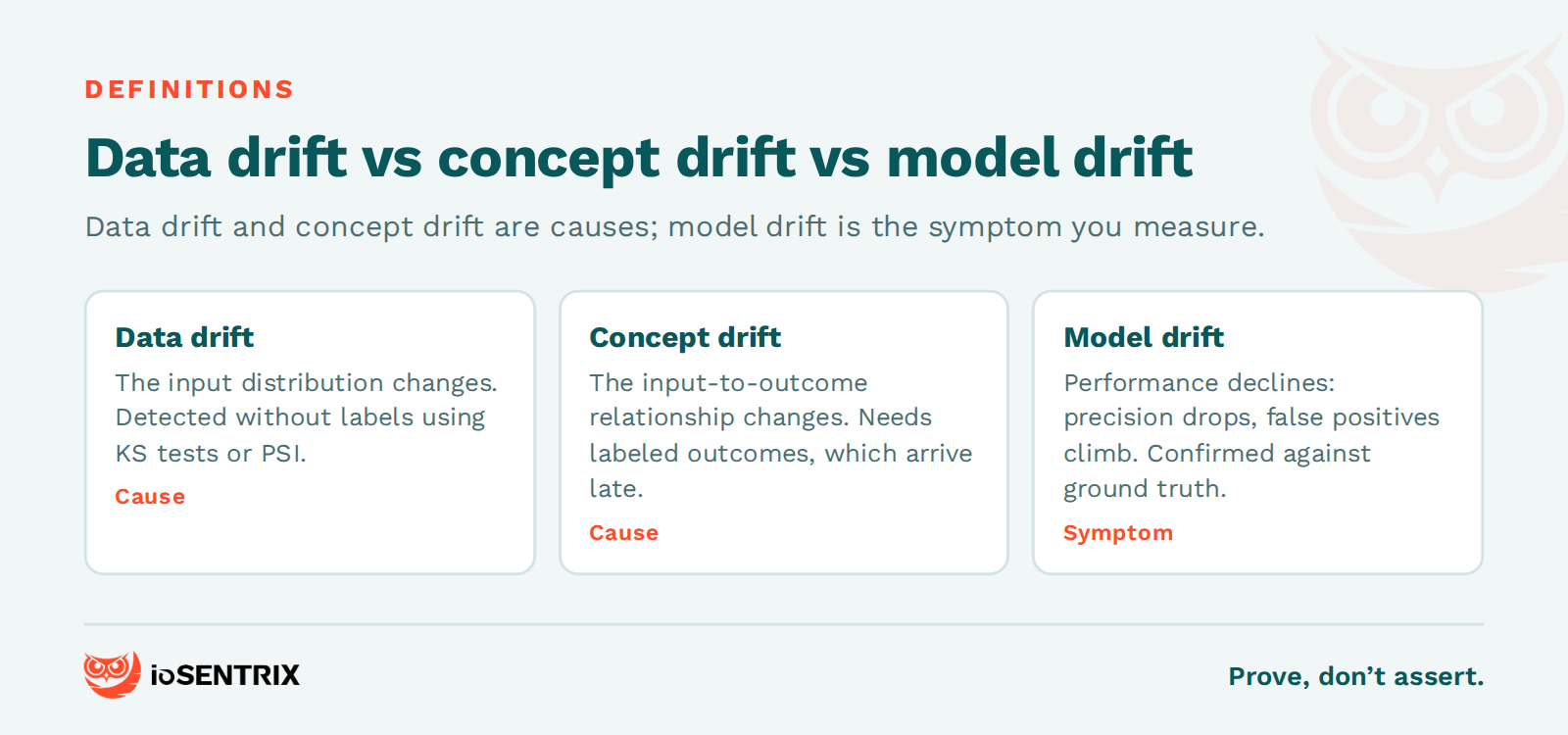
Data drift is a change in the distribution of the inputs a model receives. Concept drift is a change in the relationship between those inputs and the correct output. Model drift is the resulting decline in the model's performance, whatever the cause. Data drift and concept drift are causes; model drift is the symptom you measure.
Data drift shows up first and is the easiest to catch, because you can measure it without labels. If a recommendation model was trained on desktop shoppers and most traffic is now mobile, the input distribution has moved even if the model's logic is still sound. Statistical tests such as the Kolmogorov-Smirnov test or the population stability index compare live feature distributions against the training baseline and flag the shift.
Concept drift is harder, because the inputs can look identical while the ground truth changes underneath them. A loan applicant with the same profile as last year may now be a different credit risk because interest rates moved. A transaction pattern that was benign last quarter may be a new fraud technique this quarter. Detecting concept drift needs labeled outcomes, which often arrive weeks or months after the prediction was made.
Model drift, sometimes called model decay, is what the business sees: precision drops, false positives climb, the forecast misses. By then the underlying data or concept drift has usually been in progress for a while.
Model drift in production is caused by changes in the world the model predicts, changes in the pipeline that feeds it, and changes in how the model is used. The first category is unavoidable; the second and third are engineering and governance failures that look like drift.
Market and behavioral change is the classic cause: seasonality, a new competitor, a shift in customer demographics. Regulatory change alters decision criteria and produces concept drift overnight. Upstream pipeline change is the cause teams underestimate: a schema change, a renamed field, a new default value, or a vendor changing how it encodes a category can shift a feature distribution without a single real-world event. Usage change matters too, as when a model built for one product line gets pointed at another. Every one of these leaves a trace in the data. The question is whether anyone is looking.
AI model drift is a security risk because gradual, expected change is the ideal cover for deliberate, malicious change. If a team accepts that its model's behavior wanders over time, an attacker who poisons the training data, tampers with a feature pipeline, or slowly steers a retraining loop is producing a signal that looks exactly like normal drift. The defense against that is treating drift as an integrity signal to be explained, not a maintenance chore to be absorbed.
Consider the attacker's view. Data poisoning is cataloged by MITRE ATLAS as Poison Training Data (AML.T0020) and by the OWASP Machine Learning Security Top 10 as ML02:2023 Data Poisoning Attack and ML08:2023 Model Skewing. A poisoning campaign that shifts a fraud model's decision boundary by a small margin each retraining cycle produces the same monitoring signature as seasonal drift. If the operations runbook says "performance dipped, schedule a retrain," the retrain ingests more poisoned data and the attacker's change becomes the new baseline. Adversarial machine learning attacks often rely on exactly this: a change small enough to dismiss and persistent enough to compound.
This is where drift connects to the AI integrity question we have written about elsewhere. In AI integrity, we argued that the hard problem for autonomous systems is proving an action was genuine, authorized, untampered and reconstructable. Model drift attacks the "untampered" leg. A model whose behavior has moved is either aging naturally or has been altered, and unless you can distinguish the two from evidence, you cannot make an integrity claim about anything it decides.
It also connects to the "prove, don't assert" principle in our AI security assessment work. Most AI governance questionnaires ask "do you monitor for model drift?" and accept "yes, we use a monitoring platform" as the answer. That establishes the control exists. It says nothing about whether the control works: whether a deliberate shift of the size an attacker would use actually fires an alert, whether anyone triages it, and whether the triage can tell poisoning from seasonality. Drift monitoring is a testable control, and the test is to introduce a controlled perturbation and watch what the monitoring does.
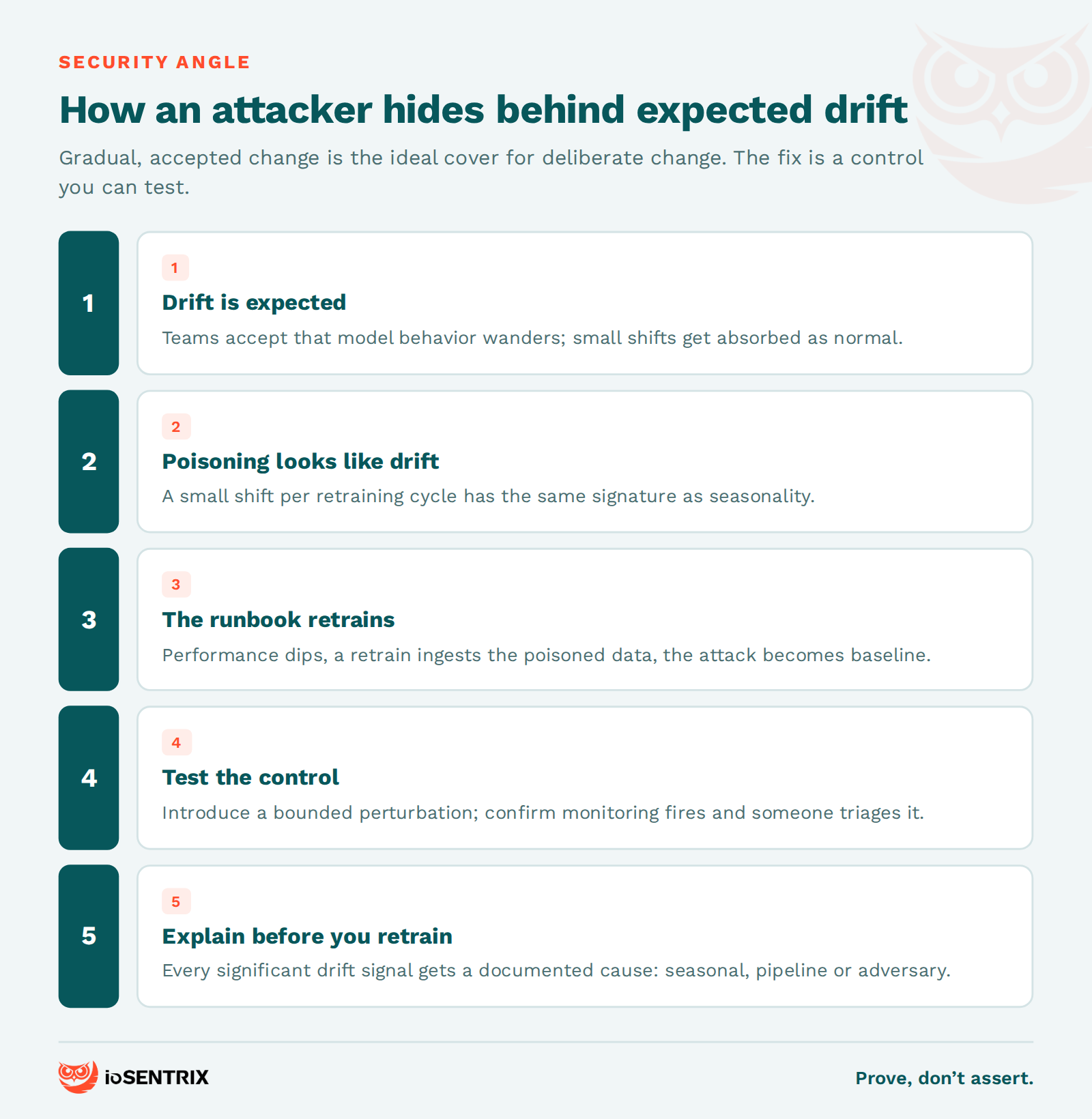
A composite, not any one client: a lender runs a credit model with monthly retraining and a drift dashboard. A third-party feed behind one feature starts returning subtly shifted values after a vendor change nobody was told about. The dashboard flags rising data drift on that feature; the runbook classifies it as vendor variance and the model retrains on the shifted data. Months later, approval rates for one applicant segment have moved noticeably. The control existed and fired. Nobody had to explain the signal before the retrain absorbed it, so whether the change was an accident or an attack, the lender cannot say.
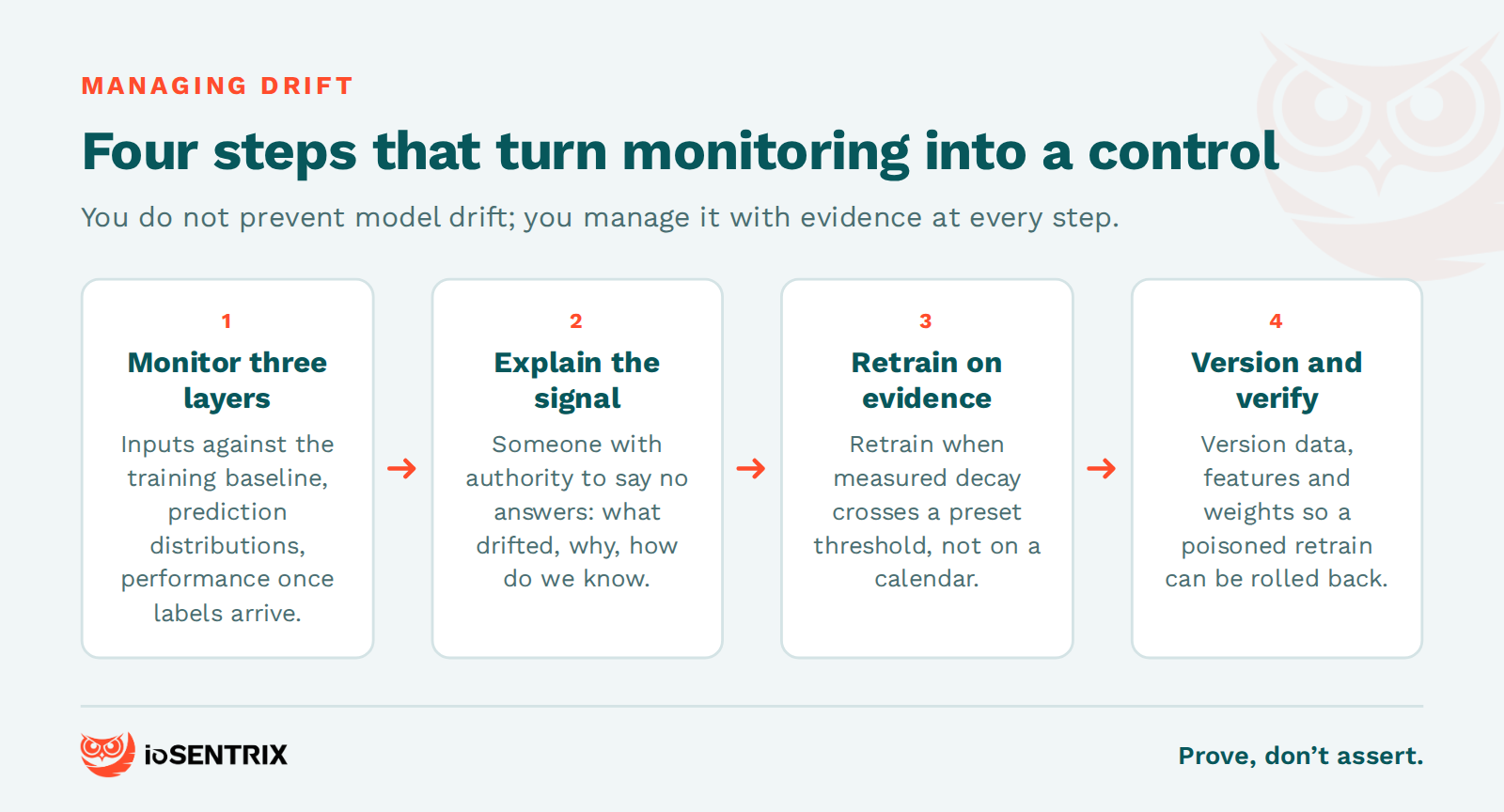
Model drift detection works on three layers: input monitoring that compares live feature distributions to the training baseline, output monitoring that tracks prediction distributions and confidence, and performance monitoring that compares predictions against ground truth once labels arrive. Input and output monitoring give you early warning without labels; performance monitoring confirms whether the drift actually hurt.
On the input layer, the standard tools are statistical: Kolmogorov-Smirnov and chi-square tests for individual features, population stability index for scored variables, and divergence measures such as Jensen-Shannon for whole distributions. Per-feature alerts matter more than a single aggregate score, because a shift concentrated in one feature is exactly what a pipeline fault or a targeted poisoning attempt looks like.
On the output layer, watch the prediction distribution itself. A fraud model that flags far fewer transactions this month than last has changed, whether or not the inputs moved visibly. A model growing more confident while its inputs drift away from the training distribution is usually a model that is wrong with conviction.
On the performance layer, track precision, recall, F1 and AUC against labeled outcomes, and track residuals over time. Shadow deployments, where a candidate model runs alongside production on the same traffic, let you compare before you commit. Whatever you track, keep the raw evidence. A dashboard score is useful for operations and useless for an investigation.
You do not prevent model drift; you manage it with a retraining policy tied to measured decay, data quality gates on the pipeline, versioned models and datasets that allow rollback, and a documented process for explaining every significant drift signal before acting on it. The last item is the one most programs skip, and it is the one that separates a monitoring control from a security control.
Retrain on evidence rather than on a calendar; a fixed schedule retrains models that did not need it and misses models that decayed faster. Put quality checks on the data pipeline so schema changes and unexpected values are caught at ingestion rather than diagnosed as drift a month later. Version training data, features, weights and evaluation results, because if a retrain absorbs a poisoned dataset, rollback is only possible if you know exactly what changed.
Then add the governance step. Before a retrain, someone with the authority to say no should be able to answer: what drifted, why, and how do we know it was benign? NIST's AI Risk Management Framework puts post-deployment monitoring under its MEASURE and MANAGE functions and explicitly notes that AI systems may need corrective maintenance triggers because of data, model or concept drift. The framework gives you the structure; it does not do the explaining for you. Framework alignment is not the same as a working control, and neither is certification against a management-system standard such as ISO/IEC 42001.
MLOps monitoring tools handle the measurement layer of AI drift: computing distribution statistics, tracking model quality over time, and raising alerts when thresholds are crossed. Evidently is an open-source framework for evaluating, testing and monitoring data and AI systems, covering both ML models and LLM applications. Amazon SageMaker Model Monitor monitors data quality, model quality, bias drift and feature attribution drift for models hosted on SageMaker. The major cloud platforms offer comparable capabilities, and most feature-store and model-registry products now include drift metrics.
Tools are necessary and not sufficient. A monitoring platform tells you a distribution moved; it does not tell you whether the movement was seasonal, a pipeline fault, or an adversary. That judgment needs a human process, the evidence to support it, and periodic adversarial testing, the kind an AI penetration testing engagement provides, to confirm alerting works at the sensitivity an attacker would try to stay under. Treat drift alerts the way a SOC treats security alerts: triaged, attributed, and closed with a documented cause.
AI drift is the divergence of a deployed AI system's behavior from the behavior validated at release, driven by changes in input data, in the relationships the model learned, or in how the system is used. It covers model drift in predictive models and behavioral drift in LLM-based systems whose prompts, retrieved data or tools change over time. Either way, the system you tested is no longer the system that is running.
Data drift is a change in the distribution of a model's inputs; model drift is the decline in performance that results from data drift, concept drift, or both. Data drift can be detected without labels. Model drift is confirmed by comparing predictions to actual outcomes.
Retrain when measured performance or input drift crosses a threshold you set in advance, not on a fixed calendar. The right interval depends on how fast the underlying data changes: a fraud model in a fast-moving payments environment decays faster than a document classifier on stable content. Every retrain should be preceded by an explanation of what drifted and why.
Yes. Data poisoning, feature pipeline tampering and manipulation of retraining feedback loops all produce changes in model behavior that look like ordinary drift. MITRE ATLAS and the OWASP Machine Learning Security Top 10 both catalog these techniques. Treating every significant drift signal as something to be explained, rather than absorbed, is the practical defense.
It can be, if it is tested like one. Monitoring that exists but has never been challenged with a controlled perturbation is an asserted control, not a proven one. An AI security assessment should include introducing a deliberate, bounded shift and confirming that the monitoring detects it, that someone triages it, and that the evidence would support an investigation.
ioSENTRIX is a CREST-accredited penetration testing firm, ISO/IEC 27001 certified and SOC 2 Type 2 attested. Our AI and ML penetration testing and AI assurance and control validation work tests drift monitoring the same way we test any other control: we attempt to move the model's behavior in a way an attacker would, and we report whether your monitoring, triage and rollback held. The deliverable is the attempt, the result and the artifact, not a checklist that says "monitoring: implemented."
If you have a model in production and cannot say with evidence whether its last drift signal was benign, talk to us.